Wealthy Mind Equals Wealthy Wallet Success from the Inside Out by Dr Yvonne Oswald Ph D
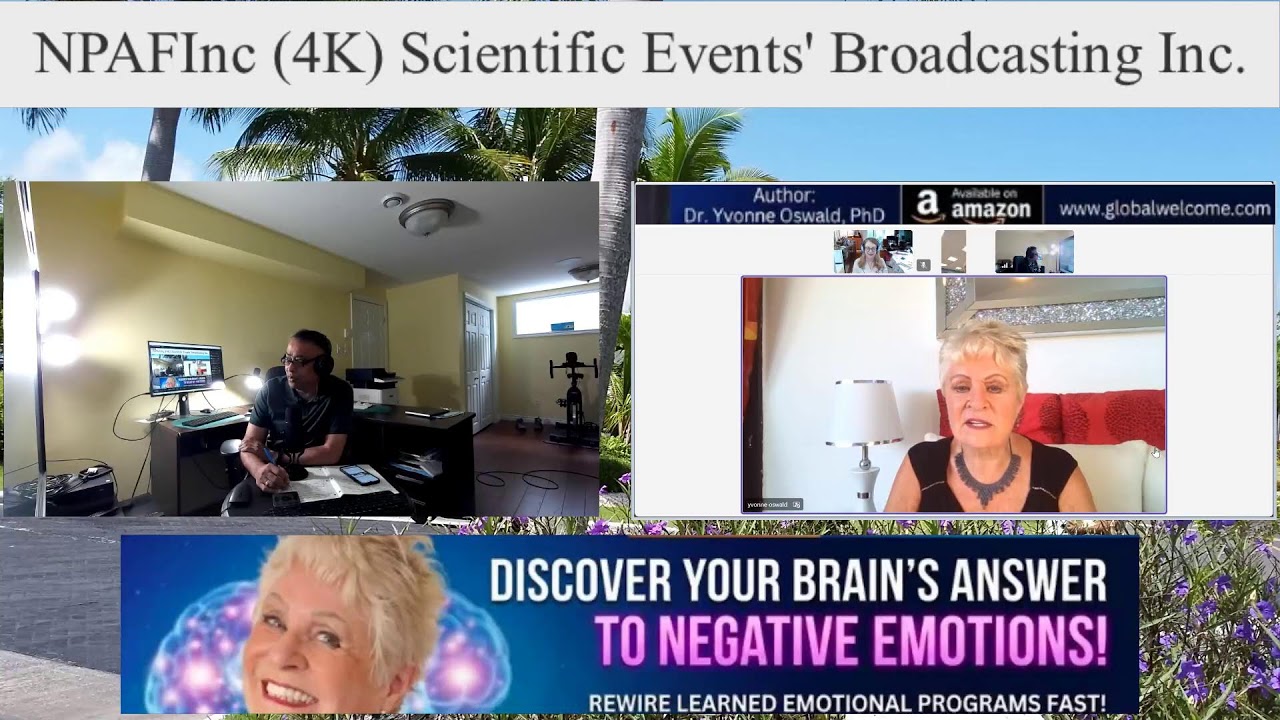
This content was created by Yvonne Oswald. This content was uploaded by Yvonne Oswald. This is a YouTube radio-style interview titled "Wealthy Mind Equals Wealthy Wallet Success from the Inside Out by Dr Yvonne Oswald Ph D" (posted 2022-07-30). The excerpt is a conversational interview on Cracking the Rich Code / Cracking the Rich Code Radio between host Ms. Marilee (Ms. Marilee / Ms. Barilee / Miss Meredith appears as the host) and guest Dr. Yvonne Oswald. Dr. Oswald describes her background (author, trainer in NLP and hypnosis), gives practical entrepreneur and marketing advice (client acquisition, business cards, conferences, YouTube, websites, speaking fees, pricing, freebies vs. paid work), explains Neuro-Linguistic Programming and hypnosis (including a live, guided clearing exercise), and discusses her Breakthrough Blueprint sessions and working with various clients. The content is in English and focuses on business-building, emotional-clearing techniques, and practical steps for therapists/coaches/entrepreneurs.
Chapters
You are listening to Cracking the Rich Code with Ms. Marilee, your insider's club from authors and entrepreneurs across the country giving us their best to help us crack the rich code.
And now, here is Ms. Marilee. Welcome everybody to Cracking the Rich Code Radio. I am Ms. Marilee. My guest today is Dr. Yvonne Oswald. She not only is my co-author in Cracking the Rich Code, but she's also the author of bestselling book, Every Word Has Power, and it's now in 11 languages, so it must be good. I haven't read it yet, but you can bet I'm going to get it. She is a wealth of knowledge, sharing all of the basics and how-tos for starting your business. Her chapter is amazing. I just, I absolutely loved it. She's a visionary working with war veterans specializing in PTSD and depression. She also has a 4-hour breakthrough blueprint in the field of neurological medicine. So I want to hear all about that. She has an outstanding reputation for exciting, fun, and innovative interactive trainings, and she's known both public and private. You can find her on YouTube. She's got her own YouTube channel. So Dr. Yvonne, are you there?
I am here, Miss Merilee.
Yes.
And I'm excited to chat with you.
Absolutely.
I am—
I always look forward to these conversations. I cannot stress to people enough how much they need this book. Each time a co-author comes on here, I'm just like, wow. And your chapter gives so much valuable information to anybody starting out that has absolutely no clue what resources are out there, what they can actually get done. And, you know, nobody can do it alone, and Man, did you give a great launch for so many. Thank you for that.
Yes, you're welcome. It was actually really interesting because when I was asked to write, you know, a chapter for an entrepreneur, I realized when I train people, I do 4-day trainings in NLP and hypnosis, and I do master's level as well. And, you know, everybody I've trained says, "Well, what do we do now? We've got the training. How do we get clients?" And I was like, "Well, it's easy. You just go to conferences and meet people." They did that, and then they didn't know what to do when they got to the conference. And I was like, okay, so we need a step-by-step on how to start from the very basics. Because what used to really not make me happy was hearing people leave my trainings and then take a 2-year business course, or they would go and pay some wild money to set them up with a funnel, but they didn't even have a client. And I'm like, you have to get your client base first. Before you do anything. And just getting that client base, the 5,000 people who you, you know, your solid base, is the most important thing for an entrepreneur, especially in the health and wellness field.
But then how do you go about getting that base?
Oh, okay.
Just like that. Nice one.
Okay, well, what I did, I actually came to Canada when I was 36 years old.— and I didn't have a client in sight. You know, I had a nice client base in England, but not here. And I started going to all the little meditation classes or yoga classes, and I joined the kind of a non-denominational church. You know, it was kind of a nice one that did a really nice chakra meditation in the morning kind of thing. And I started chatting with people, and they would say, "What do you do?" And I'd say, you know, "I do therapy. I do health and wellness." And what I realized was if I gave someone my card and said, "Here, I'm a therapist," they would go, "Oh, oh, thank you very much, I don't need it." And I was like, "Okay." Nobody wants to admit that they need therapy, right? So I'd just say to them, "Look, I do therapy, I do hypnosis, and you know, if you know anybody who would like some hypnosis or who's going through not an easy time, could you give them my card, please?" And every single person looked at the card and said, "Hmm, I may be interested actually. How much do you charge?" And it was such a sweet and easy way to get clients. I've done it always since. It's kind of not— if you sell direct, if you speak directly to people, they don't want to know. But if you say, you know, "Keep this for a friend," and they will keep it for a friend as well. You know, and that's the most important thing. Like when I first started out, I had masses of like flyers and information and all kinds of things. These days I have my business card with my face on it and that's it. You know, it's really—
that's it. I mean, your face and a phone number.
Face and phone number. You want face, phone number. What you do, it says, ask me about a breakthrough session, and that's it. And I realized that real estate people always have the face on a card. And I used to go to conferences and come home with like 300 cards, and I'd be looking through them afterwards going, wow, I don't remember any of these people. And the ones I remembered were the ones who had the face on it. And I would look at it and go, I like her, yeah, she's nice. And I'd make a little note on the back. And people don't like to throw a face away as well. It's kind of uncomfortable to throw a face away. So—
Psychology there.
It is, it's really interesting, 'cause I've hesitated at throwing a card away when it has a face on it. I'm like, isn't that interesting? I'm hesitating at throwing it away 'cause it's got a face on it. So, yeah. Very, very interesting. So that's the simplest way.
That is a great tip. Some people would say, you know, well, who has business cards these days? You know, I just put it in my phone, right?
Right, yes. And the thing is with that, that's very nice, and how do they get it to their friend then? If you've got a physical card you can give to a friend, they'll take it and put it in the phone.
Right.
Whereas, you know, I always find people will say to me, I've recommended you to everybody I know, and I won't get one single phone call. What I ask people to do instead, I say to them, give me the information of the person who wants to see me. I'll give them a call and they'll be so surprised to get the call, they'll just be like, and even though they, you've done it yourself, you know, you really, really want to see that massage therapist. You've heard she's amazing. You know, you know you're going into the town like next week and then you get home and you go, oh, I should have booked a massage before I went. You know, whereas, whereas if you've actually got the card and all the massage therapist says, you know, I believe you're coming into town next week, do you want a massage? You'll go yes, 100%.
Mm-hmm.
You know, sure. I've got a couple of people who phone me like once a month and say, you coming into Toronto this weekend? And I'll be like, sure, I'll book in. And it's really interesting that we don't think to initiate the call, but when we get that call, it's like 100% Right, so true.
And then we appreciate it because it's like, oh, thank you, I've been meaning to make that call.
Exactly.
And yeah, I mean, yeah, and people hesitate though, you know, people in sales, whatever, it's like, oh God, they're so insecure and I don't want to bug them and I'm selling and this and that. It's that way. Yes, it is.
You're being a friend. I mean, yeah, I even did it a couple of months ago. There was a massage therapist I found at a hotel in Toronto and I thought, oh, this man is so good, next time I come in, I'll call. I've been 3 times since, and I can't— I didn't remember to call him. And, you know, he does something as simple as call me and say, are you coming into Toronto anytime the next month or 2? I would have booked him in a heartbeat. Yeah, you know, actually, I must— I'm going to write that down for myself now.
Remember, so yeah, yeah, that is a great tip. And some people, you know, they listen and but they don't do. Yeah, right. There's— what, so what, what can help us get over that hump of, no, go ahead and make the call? What's stopping you?
Right, right. So what I've always done, and I never think of it as a sales call, that's the one thing in my head, I don't have it as a sales call. I think if it is, if someone's called me and said, I'm interested in the NLP training, or I'm interested in hypnosis class, or I'm interested in having a breakthrough session, I'll call them back with the idea of giving them more information so that they can come to the earliest one possible, because the fact that they've called you means they're already sold. You don't have to actually sell them, right?
Right.
You know, the sales bit, the sales bit's been done. They've already called you. They're just, you know, you know yourself, if you're signing up for something, all you want to know is the price and when is it, thank you very much. And right, I don't know if you're, you're like me, and most entrepreneurs are like, like us. They'll, you know, when they decide on something, they'll follow it through that day and do it.
Mm-hmm.
It's not something that, you know, you'll think about, or, you know. And I've been offered hundreds of businesses over the years. I was offered one yesterday, actually, and it was a product. And I just, I just said to the lady, I love the product. I said, I'll buy the product. I said, I won't sell it because I don't sell products well. I'm not that interested. It doesn't make me passionate. I'm interested in helping people through their emotions. I'm helping people in their goal setting, in their in their motivation strategies and how to get the past in the past and start looking forward. That's what I'm interested in. That excites me.
Yeah, and I love that, and I love that there's a lesson in that too, because although you could have sold that product and you are an advocate of the product, you like the product, at the end of the day you have to follow your bliss and your truth, and that's what you chose to do. Mm-hmm.
Yeah, yeah. And it's taken me a long time to get to do that, Miss Meredith, actually. I mean, it's 20 years or more I was trying out every product under the sun and saying to all my clients, "This is amazing, buy this." And I was directing people to other people, not to me. And in the end, it was actually when I went to get my book endorsed. It was a super, oh, very famous scientist, and I went to his class, and at the end of it I said, "Is there any chance of you endorsing my book?" And he said, "Well, what's your book about?" I said, "It's about the power of words." He said, "Honestly, it's not in my genre." He said, "And I won't sign anything or endorse anything that's not in my genre." He said, "Because it doesn't do me or you any good." Even though he was a famous name, and I said, "You know what? That's actually very relevant." Yeah. And it taught me a lot about staying within your genre, staying within what you love to do. You know, it was actually endorsed by John Gray in the end, who is totally in my genre., and he actually wrote the little endorsement on the front cover, and it was great. You know, someone like John Gray is like much better than the scientist I was thinking of, so yeah.
That is wonderful. You see that? I definitely want that book too, and I want it signed.
Okay, I'll do that for you. I'll send you a copy.
Absolutely.
And I also think what's interesting is the— The whole idea of getting yourself out there is it's much easier than people realize. You can join the Chamber of Commerce. You can join just the local bowling club. You can join a dance club. And as long as you've got your cards on you, it's just a matter of giving a card or them taking the number down on the phone.
Right. Mm-hmm.
Okay. And I never say, "Do you need it?" I always say, "Do you know a friend who needs it?" Exactly, you got to bypass instead of being direct. Yeah, it's an indirect way and it's much better.
Yeah, people take offense.
Yes, they do, they do. And something like hypnosis, you know, well, 20 years ago when I was starting with the hypnosis, they would all say, oh my gosh, you're going to make me cluck like a chicken. And I'm like, no, why would I make it look like a chicken? You know, because they're thinking of stage shows. These days, it's totally mainstream. People will say, oh, hypnosis, my friend quit smoking with that, and my other friend lost weight. Can I— how much do you charge? And they're absolutely over the moon about the hypnosis. And the NLP is, is just starting to be accepted as mainstream now. It's kind of where hypnosis was 10 years ago. And it's so much faster. It really is quick.
Now, for those who are not familiar, explain what it is.
—Okay. NLP is Neuro-Linguistic Programming, or Neuro-Linguistic Psychology, we're starting to call it actually. And it's a way of retracking all the old programs in your brain. And I truly believe that everything you did happened before you were 7 years old. Everything you believe, everything you came to believe, happened before you were 7, when you were still that imprint, in the imprinting stage, where you, you had no kind of filters on at all. And the The only two things that hold us back in life are negative emotions and limiting beliefs. Well, negative emotions, I can clear even the suicidal ones in minutes. It literally is so easy with the Neuro-Linguistic Programming, because what it does, wherever we hold a memory, we simply overlap that memory with a better, with a beautiful memory, and it literally gets kind of absorbed into the beautiful memory, so you don't remember the emotional baggage that the memory has anymore. It becomes neutral. And it's very, very simple. You know, that's the emotional side of the NLP. The other side is the communication side. So, we're working with people who are visual, who are very fast and very quick talkers, like me and you, and people who are auditory, people who are kinesthetic, or people who are auditory-digital, like, you know, Sheldon from The Big Bang Theory. And you need to know what system that person's using in order to work with them, in order to sell to them, in order to communicate with them. And in relationships as well, it's hugely important. So, there's lots of aspects of NLP. It's about studying human behaviors and making it a technology. So, we actually change the behavior really fast. Like, we're talking minutes, we're not talking years. And it will never happen again. It's as simple as that. It's fabulous stuff.
So, Yvonne Oswald Oswald Oswald, speaking of NLP, tell me, where did this get started?
Well, it was very interesting because in the late 1980s, about 1985, John Grinder was Richard Bandler's professor at university. And they were talking about how is it that some people did things really, really well and produced fantastic results, and other people did the same thing and didn't produce the same results. So they said, what is it that these people are doing that's so special? And they studied Milton Erickson, a hypnotist who was— he was 60 years in the business. And they said, he just tells stories and produces amazing results. What's he doing? And they studied hours and hours of footage of Milton Erickson and said, you know, why are you looking at that woman's ankle? And he said, "I'm studying the, I'm watching the heartbeat to see it slowing down." And then they'd say, "You know, why are you looking at her chest?" He said, "I'm looking at her shoulder, and I'm matching my breathing with hers so that I can pace and lead her." And it was really interesting. They literally came up with some techniques. They followed Virginia Satir, who worked with couples for years, and she had, they did the Satir categories, which are the body language movements that males and females use to communicate, which ones are powerful and which ones aren't powerful. And then, It was Tony Robbins who studied with them, and then he did, he did so well with it that they then studied him. So it's basically the psychology of success and how to reproduce it quickly every time, so consistently. And it's a consistent success, which is really important about the NLP. I can teach someone a technique and they will do it 2 minutes later and produce the same results, which is phenomenal. You don't get that in most in most techniques ever. So it's really good. Fast too.
Well, yeah, that would be beneficial to just about everybody. Wow. Yes. Can you imagine?
Oh, it is. Just to study it for yourself, even if you don't want to do the, you know, be a therapist or be a, you know, a coach or anything. Mm-hmm.
Yeah, it's great. So who do you find that usually comes to you? What are they trying to do? When they want to.
Basically, what they find is that as adults, they don't, they're not being successful as they want to, or they've had repeat patterns in relationships where they're not working, or they seem to be able to not make money, you know, and over and over again. And what happens is, before you're 7 years old, you learn a behavior. If it works, you do it again. So, you know, a young guy who's shouting and screaming will get attention as a 7-year-old, but by the time he's 45 and still shouting and screaming, he's laid off and he doesn't realize why. Why, you know, and it's a behavior that has to change and adapt as you get older. So I always say to people, and I literally see everybody from like, I usually work with 8-year-olds upwards. I have worked with 5 and 6-year-olds, but the parents have to be in the room. And it's always the parents who are, the kids are great. The kids will do anything you ask them to. The parents will say, look at her when she's speaking to you, I told you that. They can't help themselves. So by the time they're 8, they're quite happy to be with me, you know, and I do a little bit of palmistry or I do some numerology, or it's just to get them interested. And then, you know, they'll be with me 3 hours or 4 hours and they just say it's great fun. And a lot of techniques, you know, very so fast, and they just sit there going, wow, that's amazing. I've been— I've had that hanging over my head for like 50 years and suddenly it's gone. There's nothing there. Like, I was working at a convention with them, with one of the First Nations chiefs, a couple of months ago. And he was— his house was invaded by, you know, the people who had taken them off to residential schools. They walked in, they knocked his grandmother out, and took the 3 kids off to residential school. And he, he was crying even talking about it. And he was in his 60s. And I said, would you like me to clear that? And he's like, yes. It took 2 minutes. He just— it was like, wow. I said, "That is so interesting." He said, "There's nothing there when I think of it now. I can remember it happened, but no emotional charge with it." And that's the idea. If it's got an emotional charge, it's not finished. It's not complete. Your unconscious mind is saying to you, "You know what? Is this— are we safe yet?" And the whole idea is to complete things. You know, when you have all these memories coming up from your childhood, and the ones that hang around are the ones that are not complete. You haven't had closure on them. So, wow, those are the ones we just complete and leave in the past where they belong and start a whole new, a whole new chapter. It's fabulous stuff, it really is.
It really is. I can totally appreciate that. So what is the difference with NLP or hypnosis?
So the NLP is like, it is more, you, you do it with your eyes open. It's a technique, it's various, various techniques. Um, so for instance, we can do one. I can do one right now if you like. It's a super one. Yeah, fast phobia one. And we use it just for any negative emotions. So I don't even need to know what the event is. Just give me the name of an emotion and I will clear it for you really fast. And everybody listening can join in too. Frustration is a good one. Frustration and anger are really the top dog one, right?
That was the first one that came to my mind was like anger.
Okay, anger and frustration. Okay, you want to clear it? Ready? Yeah. I want you to imagine yourself, and everybody else can do it too, I want you to imagine yourself in a theater watching a film of your own life from, in black and white, from yourself with the angel just before you conceived, then seeing your mom pregnant, and then you being born, and then your childhood, and all the times you were angry and frustrated all the way through to now. Right? And now think of a time in this lifetime where you got angry and frustrated. Can you think of a time right now?
Okay.
Have you got one? Yeah? Where are you holding that in your body? Because we hold our negative emotions in our body.
I think in my shoulder. Okay.
My left shoulder. And you— and if you don't know where it is, just pick a place. It really doesn't make any difference. Your unconscious mind is very adaptable. So, your left shoulder? Cool. So, you can feel that emotion now, correct?
Good.
We're going to check in with you afterwards and it will be completely gone. You ready? So now I want you to imagine yourself as the projectionist watching the back of your own head watching the film. Got that? Okay, good. Mm-hmm. So you can close your eyes and watch that you're the projectionist watching the back of your own head watching the film. See yourself with the angel, see your mom being pregnant, you being born, and all the times you were angry and frustrated all the way through your life to now. And black it out, and then jump into the screen and run it backwards all the way back to the angel through those negative emotions and events, all the way back into the projection booth. From the projection booth, watch from the angel to the, to mom being pregnant, to the baby being born, all the times you were angry and frustrated, all the way through to now. White it out, jump into the screen, run it backwards all the way back through those negative events and emotions, and back to the angel, back up to projection booth. From the projection booth, watch The film from the angel— this time we're going to include sadness and disappointment because we need to clear both of those if we're clearing anger. We're going through all the times you felt sad, disappointed, angry or frustrated all the way through to now. Black it out! Jump into the screen. Run it backwards for all the times you were sad, disappointed, angry and frustrated all the way back to the angel back at the projection booth. From the projector's booth watch from the angel to now. Wipe it out! Jump into the screen. Run it backwards all the way back to the angel back up the projector's booth. From the projection booth watch from the angel all the way through to now through those negative emotions and events. Black it out!
Jump into the screen.
Went backwards all the way back to the angel, back at the projection screen. From the projection screen watch from the angels now— All times you were sad, disappointed, angry, and frustrated all the way through until now white it out last time jump back into the screen. Went backward all the way back to the angel, back up the projection room. Projection move what? From the angel till now black it out, jump into the screen went backwards to the angel back of the projector view. From the projector we watched from the angels so now wipe it out open your eyes and now try and search for that anger and frustration and it won't be there.
Huh, it's gone.
Wow, neutral. That was— it will have neutralized everything, and it's as simple as that. You can think about that event as many times as you like, you will not get any emotions associated with it to do with anger and frustration. Hmm, interesting.
Wow, yeah, it's very, very interesting.
It's great. And it's just displacing the neurological patterning. You're just changing the, the direction the memory is going, so it completely cleans it out. Fabulous. Other stuff.
I love it, I love it. Yeah, see? Okay, well then there's that.
I know, yeah, run it. Instant healing, I know. Yeah, I'm going actually— go ahead, go ahead. I'm in Florida on August 12th and I'm going to be doing another few little clips. I'm going to be doing, you know, 3-minute clips and that's going to be one of the ones I'm going to be putting on YouTube. So if you go to YouTube and look up Yvonne Oswald Uh, there's, there's one that's called Mind Magic, which is really good for clearing emotions. And go onto YouTube. I think I've got about 18 little YouTubes up there, which is also, by the way, a really good way of getting yourself out there for business, because I've got more business from YouTube this last 5 years than I have ever on anything else. Mm-hmm. They'll find me on YouTube, they'll look at me, they'll go to the website, and then they'll contact me. Mm-hmm. That's wonderful.
You know, it's funny. Yeah, I'm doing this exercise with you, and I'm sure our audience can do the same thing. And then you think, in that short little time, you healed so much. So what do you talk about in the rest of that seminar? Well, that's the whole thing.
There are lots of different ways. There are lots of different ways to clear things. And what I've done is I've consolidated it into my, like, 4-hour Breakthrough Blueprint sessions so I can clear anybody, anything. It's non-situational. I can clear anything you give me, whether it's OCD, whether it's suicidal thoughts, whether it's sexual abuse. It's so simple for me now. I've done it for so many years, and every time I thought, you know, everybody else has taken 3, 4, 5, 30 years— why won't we take 3 minutes? And I've got everything down to 3 minutes with each little technique. It's fabulous stuff, really works quickly. But for me too, I do it on me, remember?
Yeah, well, you have to, right? Yeah, be a proponent of our own work. Absolutely. Yeah, I respect that. Yeah, I'm glad that you said that. Um, yeah, yeah, I, I sit there and I think to myself, uh, there are so many, so many things that we're holding, all that baggage. And just use that one little thing that you gave and then put everything that you've given in the book There's so many golden nuggets here that you've given for the entrepreneur. So that little exercise, if you could clear the fear, right? Does it work on fear?
It works on fear, and there's a big difference, Ms. Barilee, between fear and anxiety. Fear is something we had in the past. Anxiety is the future one, and that's the big one of the 21st century, really, because we're so busy trying to measure up to everybody else's standards. That we get totally stuck in like a closed loop. So we get anxious about making those phone calls. We get anxious about going to meet new people. And there's some such simple techniques to clear that. It's quite amazing. So if you go to YouTube, you'll find one on anxiety. You'll find one on a little YouTube on procrastination. And you can literally sit and walk through me with the, on YouTube, and you'll clear everything that you've got coming up. It's great stuff.
Wow, I'm definitely going to go there and I'm going to— it's done. I— you are, you are so valuable. I mean, just reading this short little clip that you had here in the book there, I can't— I cannot stress enough to our audience, it's like, go here because whatever— I know that you're struggling and you obviously knew that, you know, how entrepreneurs that are just starting out are struggling with all this stuff that you gain.
It's overwhelming. It is, it's really overwhelming. And you know, when I was starting out, I spent thousands, literally thousands, on things that I never got the money back for. Right. You know, and I always say these days, if you know you can get that money back within 6 months, then do it. If you are not sure whether you're going to get it back within 6 months, don't bother. You know, people say that I'm going to do— I'll get my business going when my website's finished. Your website will never be finished. Trust me, it's an ongoing project. It's like, start with one page and go from there. Open your business and see what comes up. You know, it's a much easier way to do it.
You know, the perspective of that though is accountability. What you're doing is you're putting all the— yes, all the pressure and the responsibility onto the website. It'll, it'll say everything for me and that's where I'll get clients. It's like, no, really, you are your business. Exactly.
It's true. You're your own business. And you literally, you'll ask someone. I went to, oh, it was a fabulous training in Las Vegas. I can't remember the woman's name. And she had 15 of the top Fortune 50 and Fortune 500 people on the stage. And she went to every one of them and she said, "How do you get your keynote speakers or your trainers, your training development trainers for your company?" Every single one of them said, "I go to Joe next door in the office and say, 'Who do you know who's any good?'" There wasn't one of them— and then they would look them up online, but they would never ever just look online and find someone. It was always, "Who do you know who?" So your job is to get to know— yep, your job is to get to know as many people as you can.
Absolutely, but that's a testimony to who you are. Yes. Who have you really built yourself to be? Not your website.
No, the website's very much a by-the-way thing. It really is. I mean, people will go and have a mooch around my website, they'll look at some videos and things, and then they'll call me. And it's actually quite fun when that happens because I'm really good at answering my phone. I really do answer the phone personally. And they'll say, "Who is this?" And I'll say, "It's Dr. Yvonne Oswald." They'll go, "The Dr. Yvonne Oswald?" No way! Oh my gosh! And I'm laughing at the other end. Can I call my friend and tell her that I've got Dr. Yvonne Oswald on the phone? I'm like, sure. Yeah, it's great, you know. And I always, when I've, when I've done a training, I keep in touch with people afterwards as well. They can call me anytime knowing that if they've got a client coming, I'm going to tell them exactly what to do with that client.
Mm-hmm.
I do it for free. I do it for free. Yeah, that is one.
Okay, so that's another really excellent point, and it's doing it for free. Yeah, I, I feel that there are plenty of people out there who expect to get paid the moment they have a product or whatever. That's, that's it. And it's like, no, you have to have an open hand and be willing to give a lot of free stuff. Yeah, free information. Yeah, it's true.
Free support. Exactly, and it's really, really important. I mean, what I find is the more successful I've got, the more successful people I'm meeting, the more free and open their hands are. It really is, you know. If I find someone who's in need, every single thing tells me in my head, go ahead and do it, whatever. You know, if they've not got the money, that's fine too.
Yeah, but you know what, that, that alone, that open heart and not following the money is literally in alignment with the vibration of the universe. And it just, it will support you in everything that you do because you're out there loving people. Yes.
And, and there's a little, little codicil I want to put on the bottom of that one because when I was actually, um doing that just for the love of it, I didn't make that much money. And then I had to put my daughter through university in New York, and I suddenly thought, wow, I'm going to need $200,000 like through any minute. And I suddenly started saying, you know, if you want me to speak, how much are you paying? They were like, nothing. And I'm like, well, I don't speak unless I'm paid. And suddenly I found people were offering me money that had never offered before. And my— I literally doubled my income in about 3 months. It was ridiculous. So yes, it's really important to make sure that you ask for money. I used to phone the— Conventions are great because rather than just go to a convention, if you can speak at a convention, that makes you the expert. So you go to the convention and you phone them up and say, "How much is your budget for speakers?" That's your first question. And when they say, "Well, we haven't got a budget," you just say, "Well, what budget could you get for speakers?" And you know, when they say, how much would you charge? I'll just say $10,000, you know. And if they go, oh my gosh, but they'll come up with something, you know. And it's like really important, right? You get them to realize that you value your own time and they need to value as well, you know. Yeah, it's very interesting. And you'll get a lot of people expecting you to— I don't mind speaking for free if it's local, you know. If I just— I'm getting a car and going down, down somewhere for an hour, I don't mind. But going over to the other side of the country, I want my expenses paid. I want I want it worth my while, you know. So, and there has to be a sliding scale, Miss Marilee, there really does. There's, you know, a lot of, I have a lot of talks with my clients about this, you know, the students. And they say, well, what should we charge? Should we have a fixed rate? And I'll say, you can have a fixed rate if you like, and you have your ideal rate, and you have the rate you will give to people who you truly like, who you want to work with. And there has to be that second rate because Some people you want to help really, and they literally haven't got the money. I do make them pay something because, you know, you have to have some skin in the game. And I'm quite happy to kind of adjust the price. So, you have to be very aware that there's flexibility involved in life coaching.
Mm-hmm. You know what I like about that, and I hope that people are hearing, is that we skipped from, you know, giving so much for free, and then we went to getting paid. And the thing is, when we're, when we're helping person to person, we're— we give a lot of stuff for free. But when it comes to a big organization like that where you're having an event, you know, a speaker's event, yeah, then it's different because other people will be paid. And why not you? Exactly. Yep.
Yeah, yeah, yeah. It's, it's really important. And of course, the more money you get, the more money— the more people you can help, actually, because the more famous you'll get then too. Right, that's true. So I call it my little entrepreneur triangle. You've got the money, you've got the fame or the recognition, which we all want, and you've got the helping people. If you just help people, you won't make any money. If you aim for the money, you will help a lot more people and you will get recognition. Or if you aim for the fame, you'll get more money and you'll get to help more people. So the actual way you— where your head should be pointed really should be the money and the recognition, because that's going to bring you more people. And it's a catch-22. You know, we tend to think, oh gosh, it should all be for free because it's God, universe, and everything. In actual fact, you do it for free, you'll just do it for free. You won't be able to get your bills paid. If you've got lots of money coming in from lots of different directions, and if you're an entrepreneur, you do need like residual income as well. You need to take up those slack times.
Mm-hmm, that is true. Yeah, residual income. Well, okay, so now since we're talking about that, and again I'm going to reiterate how much value you put into your, your chapter with telling people like exactly where to go, like what do you do when you get your .com, you know, and then what do you do with that. I mean, there's, there's practical information here, but on the topic that we're, we're talking about right now with money and being free and giving it this and that, a lot of people have an issue with that value? Like, how do I price myself? How do I actually ask for money? How do I do that?
The best way, in honesty, is look to someone— look on someone else's website and see what they're charging in the same industry, you know. And also, it's also a good way to design your website. I mean, Tony Robbins has spent hundreds of thousands of dollars on his website. So is Oprah Winfrey. So is Dr. Phil. You know, they've all spent this hundreds of thousands of dollars. Go and just model it. That's what NLP is about. It's about modeling someone who's successful. Why would you want to reinvent the wheel? They've spent the money on the marketing. You know, you don't need to copy them verbatim, but you can actually see what they're actually offering on the pages because they've got all the top people getting, getting all the marketing information on that front page. Well, you just need to copy it. So on your, on your opening page of your website, you always do a call to action. It's like, "Claim your free MP3 here," or "Claim your free 10-page downloadable." And they have to put their email in to do that, and there's your newsletter list started. Right, exactly. Yeah, I mean, people have said to me, "Gosh, I've had clients for years and I don't even know their emails." I'm like, "Wow, you should have the email of every single person." Yeah, you know, and this is the big— there's a big opt-in thing these days where you have to get someone's permission to get their email. What I always do from the stage is I just send around a sign-in sheet and I'll say, sign in because I'm going to send you 2 free CDs, 2 free MP3s on prosperity or on relaxation, and I'll put you on the newsletter list and let you know what classes I'm teaching. And then if they signed in, they've opted in. Hey, you can unsubscribe. You can just go to unsubscribe at the bottom when you've seen one. I find it fair with everybody's just to find out what are they offering because I like the person. So why not have a look at what they've got? And I'll get it 2 or 3 times. If it's getting too often, I usually stop. Or if it's something I'm not that interested in, I usually stop. I'm quite, you know, and people know when they put their email down that they're going to get an email. It's like rocket science, really, is it?
You know, okay, so in light of this, of Cracking the Rich Code and bringing all these entrepreneurs together, we're really helping those who want to be an entrepreneur, right? Yes. So now we're talking about, you know, your network, having people's email addresses. You gotta look at your phone and go, well, I don't— I mean, I may have a couple emails in there, but yeah, I really don't like to keep a lot of people in my phone. If you're thinking that, how are you going to jump to being an entrepreneur?
Exactly. And I mean, being an entrepreneur is always about, you know, everybody says, aren't you lucky being an entrepreneur? You know, you got so successful so quickly. Yeah, it only took 20 years of 15-hour days. Oh, you're so lucky you can take time off. And I'm like, mm-hmm. Yes, not exactly. And now I can take time off because I've been doing it for 30 years. I can actually schedule my time so, you know, I can take a week here or a week there. In the old days, I don't think I slept for 20 years, right? So I was up till 3, 4 in the morning. I was doing my PhD for 7 years, and I used to start that at midnight when everybody else had gone to bed. So, you know, it's a lot of work, but, and it's so much more rewarding than working for someone else. Honestly, it is.
It really is. Yeah, when you're talking about, you know, no sleep and nonstop and, you know, how much time it takes, that's enough to turn somebody off going, I don't— I can't do it. I have to work a full-time job. I'm married, I have kids. Yeah, they still don't see the vision of how they can make that jump, right?
Would you— you know what, it shouldn't be a jump. What it needs to be is a slow, like, move in. So if you can start part-time being an entrepreneur at the weekends or one evening a week and then let it take over. It took me about 18 months, I think, to go from teaching to being an entrepreneur, because I was a teacher in the old days in my 20s. And I took on extra clients in the evening or on Saturdays, and I suddenly realized I was making more money doing that than I was teaching. And I was like, that's the point when you can say, "Right, I can give up teaching now." And it's so much more rewarding. And I love teaching, you know, but you know, the paperwork wasn't me. So, right, and there is a lot of that.
Yeah. Oh, there's a lot. And also, even it's like you started off doing something that you loved. You got to follow your heart. You love teaching children. But to be that entrepreneur, it's like, again, you have the freedom to do something you love to do. You got to resonate with something.
Yes, you've got to find something you're passionate about. Yeah, I mean, and the reason— yeah, the reason I was drawn into doing emotions is because, you know, my childhood was really abusive. My sister died when I was 13 and she was 11, and my father turned around and said, I wish you died instead of her. You know, it was a real— not a fun place. Sexual abuse, etc. And, you know, I did years work on myself. I did rebirthing, I did meditation, I did Gestalt therapy, talk therapy, you name it. I discovered the hypnosis and loved it. One weekend of hypnosis cleared more, more than 30 years beforehand. And then someone said to me, you will love the NLP if you love the hypnosis. And when I discovered NLP, it was like the lights went on in my life. And the second I realized how fast it was and how quick it was and how we could move forward, I was like, oh my gosh, everybody has to know this. And then I instantly opened up as an entrepreneur, right? If you, if you're thinking everybody has to have one of these, or everybody has to know this, you're an entrepreneur.
There you go. And that sums it up absolutely. Yeah, you have to be passionate. Yes, exactly. And that's what, um, you know, a lot of people haven't landed on. And you know, when you were talking about residual income, and you know, I mean, that could cover a lot of businesses, but with network marketing— network marketing is difficult and sometimes, um, Yeah, I understood. Yeah, very misunderstood. Why would you say that?
Where are you going with it? I did— I did network marketing for years alongside what I was doing, you know, with the USANA and all the other stuff, and I love the things, and I couldn't sell them for toffee because I would get people under me who couldn't sell, and I would end up bringing people in and then putting them under the people under me, so I was doing the work for all of us. Right. You really have to do that full-time and really believe in it to do network marketing.
Right, well, you know what, the key is duplication again. It is.
Modeling. Yes, it is. Finding someone who's as good as you, and that's not easy. It's like really, very—
Or, well, that's the truth, or being able to train them to model you.
Yes, that's true. If you do something really well and train others to do the same, you'll— they'll get results as well. And that's again the NLP idea.
Yeah, then we come back to your expertise, because the person you're trying to train and model and say, it's just this easy, this is what you're doing, they have all those issues from, you know, their childhood that they're holding that is preventing them from doing what needs to be done.
Yes, exactly, which is why I love going into companies and doing this, because, you know, you give them so many tips, and I give them so many tips and so many tricks on how to get past that and how to get through that and over it. And, you know, you do need some, some, you need some basic techniques on how to change your own behaviors.
Definitely, definitely. Okay, so give me a basic technique to change my behavior. Well, what, what behavior do I have that I need to change? —let's just say that.
It's just anything that, anything that's not working in your life is a limiting belief. So if you're not rich enough and you want to be rich, you've got a belief there somewhere that says, 'I don't deserve it,' or, you know, 'I'm not able to.' Right. If you want to be healthy and you're not healthy, you've got a limiting belief somewhere. If you know, and they say it's genetic— well, we have diabetes right the way through my family. I will never have diabetes. I eat properly and I exercise. It's quite simple. I've changed the genetic programming because I do it differently. So if you can literally think of yourself and think, what is it that I keep on doing that is not producing results? And who is producing results? And how can I model them so well that I produce the same results? That's really what you've got to go, you know, go to. And if you've got things that aren't working for you, you've got to think, what's the belief I have around that? Right. Is it okay that I don't deserve to be pretty or have a relationship? Is it— did I, you know, was I in competition with my sister, or what was it that— where it began?
Mm-hmm. But then aren't we blaming?
We're blaming outside things. Or— no, I— that's an interesting idea. I don't like the idea of shame and blame at all. I would rather have the idea of what What's the issue? Where did it— what's the root cause of it? And how can I change that? Because it's not supportive. That's as simple as that. So what we say in NLP is there is no failure, there's only feedback. And success is also feedback. So if your feedback is that this isn't working, there's something more you need to know. You have— don't have sufficient information. So rather than think of it as shame and blame and all the rest of it, you don't have sufficient information to do it as well as this next person. So what more information do you need to be successful?. And if you keep it very kind of cold almost like that, just kind of analyze it rather than take it personally, it's much easier. It's like who's producing this result and how can I literally model them? What more information do I need to produce to have the same result? And then you can't blame yourself because it's like if a kid's learning to tie the shoelace, We don't say, "Oh my gosh, you failed." We say, "Okay, you need a bit more information." Same as someone just learning to walk. How many times do they fall over? But we don't say, "Oh my gosh, look at that, you failed." We say, "Come on, you can do it again, just one foot in front of the other." And then when we're adults, we tell everybody that they're not doing well. It's like, why would you do that? You just don't have sufficient information, simple.
Right, I love that attitude. You know, that it's just, there's no such thing as failure. You just don't have enough information. Gather more. Correct.
Exactly. I love that. That's the whole point of it. It makes life very simple. And, um— And, it is really, if you can take a simple route through, I used to find when I was doing my PhD, oh boy, I would get so tangled up in thoughts and ideas and I'd have to go back and think, what is this about? What's my subject? And, I'd literally find myself at least once a week going back and thinking, what am I talking about? Oh yeah, how to be happy. Oh, that's simple. Let's get back to basics then. So if you find yourself getting your thoughts getting too complex, or your work getting too complex, simplify it, simplify it, simplify it. It's so much easier that way.
I totally agree with that and totally resonate with that. Yeah, because we can, we can really reel ourselves out there so far and then just forget where we even started. Yeah, you know, that, like you said, what was I talking about? Or what was the message I was trying to convey? Or you just— yeah, making it way too complicated. And I think that kind of stems from somewhere from not being understood. Yes, exactly.
And NLP is all about studying, you know, what, what systems people use. Like, if you were talking to Sheldon, you wouldn't talk about emotions. Sheldon from The Big Bang Theory, you would not talk about emotions. Yeah. But it doesn't resonate with that. Neither do the debunkers or techies or people who are very systemized thinkers. You have to talk in their systemized way or they won't understand where you're coming from. And it's all about learning the 4 styles and how to approach them, what actual words to use with them. You know, my ex-husband was auditory. And he would say, "Come and listen to this, come and talk about it," you know, to do with the ears. And I would say, "But you don't see what I mean, you're not looking at it." And then when we realized we were using different styles, I used to say to him, "Come and talk about this, let's discuss it." And he would say to me, "I can see that, yes, I'm looking at it." And it was like, "Oh my God, you're talking my language." It was amazing.
Right. Okay. So then again, remind us what the 4 are.
Visual, so they'll use words like see, and look, and observe. And we'll talk really fast, and we always look good. And there's auditory, so they usually— auditory people don't do eye contact well, and that's a big issue with them, is that they think they're not friendly. People think of them as not friendly because they don't do eye contact. So any kid who's not looking at you a lot, they're usually using their ears. So they'll have their ear pointed to the teacher and the teacher will say, "This child doesn't pay attention." Well, the kid is paying 100% attention with their ears, because if they try and use their eyes, they can't understand. So I usually tell auditory kids, "Just pretend to look at me when you're talking to me because it looks a lot more friendly." And that really, if you can really get kids to pretend to look rather than look, then they don't have to use their eyes. They can just use their ears and pretend to look. It actually works. And you've got the kinesthetic kids who are the touchy-feely ones, the ones who are always jumping up and down. You know, they like cozy, they like eating, they like drinking, they like sex when they get older. It's all about the touching. And then the auditory digital, and that's the Sheldons of the world and the Mrs. Spocks, who are very, very analytical, who have to discuss things endlessly before they'll even attempt to do something. And they usually don't do very good body language, because they're usually not very expressive with the body. They're usually kind of hands by the side, just talking. And it's very interesting. Yeah, so if you, I always give the example of sex, actually. It's a really good one to know the voice style. So someone visual will walk in the door and say, "Oh my gosh, you're looking good. Let's do it on the floor, quick." It's like, "Da-da, you look good, let's do it now." Very spontaneous. Someone who's kinesthetic will walk in, say, "Oh, give me a hug. Let's go and sit down and put cream all over each other's bodies and lick it off and drink a nice drink and then make mad love." And then the auditory person will say, "Oh, let's sit down, have a discussion about how our days went, how our day went, and let's talk about it, and then should we maybe have sex later on in the evening?" And then The Sheldons of the world and the, the auditory digital ones will look at the watch and say, okay, it's 7 o'clock, at 8 o'clock my program's on till 9 o'clock, so sex at 9:30. Oh my gosh, it's very interesting when you get the 4 different styles. It's hilarious. Yeah. Oh my— and people go, oh my God, my husband's like that. I'm like, yep, you've got an auditory digital.
Yeah, what that is That, you know what, that, that information is actually better than the love languages. It really is. It's way better.
It's very easy to explain when you take the sex thing, you know. And the thing is, in relationships, the first 6 months, who cares what, what, what style you've got? It's like, you know, let's do it on the chandeliers kind of thing. After 6 months, then you get into 12 months, and it's like, hmm, all those things you loved about me, you know, my laughter and my Funny habits are suddenly becoming irritating. And then after 3 years, you better know each other's style because you really do need something to back up, you know, what you're working on at that point. 'Cause we tend after— relationships are supposed to last 3 years. That's the official kind of timeline. And after 3 years, you better have something to sustain the relationship, including how to understand the other person's way of looking at things and their love strategy, because we have a love strategy as well. We have a systemized way of being loved, and if you don't love me the way I need to be loved, I won't feel you love me. You know, it's because we tend to do our own love strategy on the other person and then expect them to feel loved. And you know, for instance, my ex used to go out shopping and bring home a steak and cook me a steak, even though I don't eat steak. And I would say, why do you do this? And he said, to show you I love you. And I'm like, mm-hmm. 'Doesn't work for me. This is what you'd like me to do for you, right?' Right. Mm-hmm. Interesting. Very interesting. It is.
It's so powerful. I mean, we have about 7 minutes left and there's so much more to cover, but I think I could sit here and talk to you for hours. Okay, so I keep kind of teasing people about all the stuff that you have in here and all the information, but you literally, you have given so much more than what we're talking about. You've given like, like brass tacks, like here, this is what you go— you're going to start on GoDaddy, you're going to go get yourself a .com, and then from the .com, I mean, you literally talking about MP3s, how to sell them, have your bottom line price ready.
I mean, yes, that's important too. Yeah, well, what I realized was 'cause I've been doing it for so many years, it just comes naturally to me. And then I realized that when people were leaving me after, they were, you know, a housewife, they're just starting their own business, they want to be an NLP coach or a life coach or a hypnotherapist, and they didn't even know where to begin. They even say things like, "I'm not very good on the computer." Well, you need, like, really the manual for the very first steps, and once you've got that, done, you'll do very well from there. It's— we don't do starting points very well. We tend to, you know, bring someone who wants to release weight, they want to release 100 pounds, and I'll say to them, you know, you know, you've got to eat well and do exercise. That's basically all it is, you know. Eat well, do exercise, release weight, you know. Do your cleansing, get your body alkaline rather than acidic. And I'll say to them, how much do you want to release? Oh, 100 pounds. And how much exercise do you do now? Nothing. And how much exercise do you want to do? Oh, an hour a day. And they'll shake their head as they're saying it. There's no way they're going to do an hour a day from nothing. And they'll say— well, I'll say, can you do 20 minutes a day? And they'll say, mm-hmm, maybe. Yes, okay, I can do 20 minutes. And they'll still be shaking their head. And I'll say, could you do 5 minutes a day? And you'll suddenly see them look up as though they're looking up at the ceiling because they're imagining now doing that 5 minutes exercise. And they'll say, yes, I can take the dog a walk down the road and back, that's 5 minutes. And I'll say, "Good, from today onwards you're only ever doing 5 minutes a day." And then they'll say, "What?" And I'll say, "Yep, because anything more than 5 minutes is bonus." 'Cause what happens is we set ourselves this hour a day, hour a day, hour a day. Same with phone calls, same with emails. We've set ourselves this hour a day, and before we know it we're not doing any because we've overwhelmed ourselves. So if you can do 5 minutes of anything, one email, one phone call, anything else is bonus. It's magic. It just, the day gets done really fast. So it's not being an overachiever. As entrepreneurs, we're all overachievers. And we need to kind of really get down to basics.
I really like what you did there. I really, really, really like what you did there. Because what you did was you found spot that they were willing to say okay instead of strong-arming them, guilting them, pressuring them to do the hour and say, well, you know, how do you expect to lose weight if you're not going to exercise, if you're not going to cooperate with what I say?
Yeah, exactly. And you know, if you're sitting there and you really don't want to do exercise and you know you've got to do 5 minutes, you can do that. Yeah. If you're sitting there watching TV, you know you've got to do an hour, there's not a chance of you getting up from that sitting. Yes, so it's really interesting. It's the same with— we always set ourselves too high goals because parents are, "Oh look, you've got 9 A's and a B. Let's talk about the B." Why would we talk about the B? Why don't we talk about the 9 A's? Right. It's that never enough syndrome. And you know, "Oh good, now you've done the dishes. Could you also help me with some cooking tomorrow? Could you have another salad, given that you had one salad this week? Could you have 7 salads next week?" It's like, why? We do that to ourselves? It's very, it's very, um, non-sustainable, right?
So that, um, that's a really valuable information. So what else you got for us for losing weight? Because I mean, I hope people are picking this up, like, yeah, you— that's your, your set point. That's all you could give was 5, 5 minutes. Yeah, it was yours, not mine. I didn't tell you to do 5 minutes.
You said you could do it. Yes, exactly. And you know, and they'll come to you the following week and you'll say, "How much did you do?" "Oh, well, you know, my daughter's birthday party, so I did eat some cake." And you'll just say, "Awesome." That's it. That's the only answer to that. Right.
Right. How was it? I hope you enjoyed it.
Fabulous. Next. But not, you know, "Can you make sure you have 5 salads this week?" or "10 salads this week?" or— we always raise the bar instead of just saying, "Okay." Good. We can have one salad this week and any other salad is a bonus. Is that okay with you? You know, they'll soon be doing 7 salads that way.
Mm-hmm. It's so much more loving.
It is, and it's way easier to do. Right. I used to— yeah, my to-do list used to be like 30 pages long, and I finally got to the point where I was like, what one job do I have to do today to know that I've done what I needed to do today. And some days it was like post a letter, and as long as I posted a letter, I was happy with the day.
You know what, I have adopted that as well. I used to do the same thing, my to-do list, and then the moment I would cross off one or two, I would go, oh, I still have time to add one or two more. And then finally I just got to the point, yeah, if I get one thing done today on my list I'm happy. Everything else, bonus.
Yeah.
And what you'll find, Shirley, is you do all—
you do just about all of them without even realizing it when you do it that way. Mm-hmm. Yeah, look back at the list and you'll go, wow, I got a lot done today.
Oh my gosh, Dr. Yvonne Oswald Oswald, you have been a delight for me. It's just so wonderful to talk to you, and I really want more. I'm gonna go to your YouTube channel. I'm gonna watch everything you do. Okay, I'm gonna learn from you. Yes. And I really suggest everybody Everybody go to Yvonne Oswald on YouTube, look her up, learn some more from her, listen to this program again, and, um, and contact me, Merilee, at britventure.com. We get you a signed autograph from Dr. Yvonne, and, um, or Amazon if you want to get your book there. And we can contact her. Dr. Yvonne, thank you so much for being here with me.
Thank you, Miss Merilee. It was fun, really enjoyed it. And really keep up the good work, you're doing an amazing Thank you, dear.
Okay, bye-bye. Bye.