A4I Day 1 - Building the Workplace of the Future
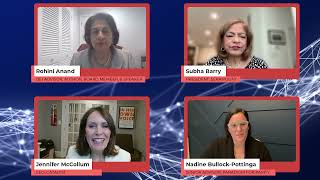
Rohini Anand moderates a panel with leaders from Seramount, Paradigm for Parity, and Catalyst on building inclusive workplaces. They discuss psychological safety, expanded wellness support, and widening diversity to include neurodiversity and first-generation talent. Accountability requires ongoing data collection on hiring and promotion, plus engaging men as sponsors and partners.
Sam.
Hello everyone and welcome to Building the Workplace of the Future by wbc. I am Rohini Anand. I'm author of Leading Global Diversity, Equity and Inclusion. I am a board member and a senior diversity, equity and inclusion advisor. And today we're joined by three powerhouse leaders. We have Suba Barry from Saramount, we have Nadine Bulak Patinga from Paradigm for Parity, and we have Jennifer McCollum from Catalyst. And each one of these leaders represents WBC partner organizations. Their organizations are on the front lines advising companies on how to build modern inclusive workplaces through forward thinking policies, through strategic innovations, and through thought leadership. In this conversation, we're going to explore the impact of technology on workplace dynamics and we're going to highlight what's working among leading companies and discuss what it takes to move from intention to implementation, from performative to sustainable in creating effective, equitable workplaces. So let's dive right in. Given the current environment, what workplace challenges? So this is my first question. So each of you works with clients and you work across the spectrum of clients. So given the current environment, what workplace challenges are you seeing in the organizations that you work with and what innovative workplace practices are you observing that drive inclusion, that drive performance, that shape the culture and organizations, especially for those who supporting caregivers who are neurodivergent or first generational professionals? Let me start and ask you, Nadine, first to answer that question. What workplace challenges are you observing and what are some of those innovative practices that you're supporting sort of seeing?
Yeah. Well, thank you for that opportunity. There certainly are a lot of challenges when you look at the workplace right now, with many different generations now in the workforce. I think it's five or six plus a lot of companies are returned to office after, you know, that time in Covid and we were all alone for so long. There's just so many different changes going on when you add on sort of the polarizing political and social climate. One thing that we're really seeing a lot of is companies trying to navigate how to create these psychologically safe environments for their employees and places where employees really can feel that they can express some of the challenges they might be having with the outside world. We can see in the workplace that particularly younger generations do talk about that within the workplace. And I think it's been a challenge for HR leaders and leaders in general to really figure out how to navigate that, specifically middle managers, which are really in the weeds on some of this. So some of the things that we've seen companies do is really be intentional about naming this and creating programs and spaces to help employees and leaders navigate these 20s. So whether it's listening circles or global town halls where employees feel like they have a safe space to express, whether it's a viewpoint or a challenge that they're having, we see companies being intentional with that. On top of really intentional training for managers on how to navigate some of these conversations, some added layer of training needs to happen within the workforce to be be able to navigate some of this. And then on top of that, we've seen companies employment, expanded mental health days and free counseling services. So when it's not a workplace intervention, it's still giving their employees access to support that they might need. And workplace wellness has been something that we have seen even more important today than ever before and something that companies are really focusing on and investing on. And that doesn't preclude financial wellness. So not just about your health and mental health, but also a lot of companies are helping employees navigate how to navigate financial times that might be tough. So those are some of the things we're seeing.
And Subha, I know that with Seramount and with ab, you've done an incredible job, particularly with technology, to address these challenges. Can you just speak to some of the challenges that you're seeing and some of the solutions, innovative practices?
You know, one of the things that has become an obvious to everybody is Gen Z is 50% multiracial, 50% neurodiverse, and nearly 25% LGBTQ. So this definition of what diversity is continues to evolve. So if you want to open the tent, widen the aperture, you have to consider so many other dimensions. And one of the things we honed in on, other than religion, immigration status, generation, language, facility, et cetera, is socioeconomic status. And the impact of creating inclusion broadly for that and the impact of that on organizations. And in today's climate, where DEI initiatives are increasingly under scrutiny, traditional recruitment programs have been pushed back, especially when they aimed at specific underrepresented groups because they may be perceived as exclusionary. Forage offers a different path. These simulations are open to everyone. But guess what we're seeing? We're seeing strong engagement from first generation college students, those without built in networks or industry connections. So in that way, it's become a natural on ramp for underrepresented talent without needing to single out any specific group. More fair, more inclusive, expanding access, building equity. And ultimately you get high potential candidates that are better prepared, that perform better, not just on academic credentials, rankings or relationships, but essentially being given the tools to develop their own Skills, that's great.
And great, great examples around technology, addressing the challenges. So given I'm going to continue with you, Suva. Given these challenges that we're seeing and we've heard about the needs of employees, the next generation employees, et cetera, what are some of those accountability frameworks that you think are most effective for driving gender parity? What are you observing? What are your member organizations doing if you can share some examples?
One of the things that we're starting with Rohini is helping managers at every level understand what it means to lead inclusively. You can show empathy and vulnerability sharing their own stories and lessons learned. And we have found that that storytelling is becoming a powerful way to lead to build bridges across differences. Again, building awareness around one's own strengths and weaknesses is always a great first step. Creating workplaces where making mistakes is not a career ending move can also be a great start. And we talked about how ergs can become tools for driving business and creating better understanding and allyship. We're finding companies are opening ergs to all and more and more. But guess what they're doing? They're creating intersectional ergs, parents and caregivers, including lead dads and cross generational. A great example I found is, you know, you take something like a gender neutral parental leave policy that's become the norm. But one of the things we show is do dads take all the leave or is that best left to moms? If dads return to work in two weeks and moms take three months, don't dads get a two and a half month advantage in their career journey? What of all the days then that additionally that are taken off for caring for sick children, elderly, parent doctor appointments, school holidays? You know, Covid showed us that even though they all started out together, women still ended up owning such a disparate portion of the parenting responsibilities and home responsibilities. One interesting data point that gives me hope. 23 million dads in the US are playing the role of lead dads. Being the primary parent and caregiver for their families. Let that number sink in. 23 million usually happens when a mom's earning potential exceeds that of dads. If childbearing and child rearing years are not career derailers for women, Think about the possibilities. That is something that gives me hope.
That's terrific. I mean I think that we need male allies and certainly that is a statement of hope that you just the numbers that you shared. So Jennifer, can you speak to this in terms of the needs of employees, the challenges and accountability frameworks and maybe also speak to some of the data that organizations should be gathering in these times. Jennifer, you're muted.
Thanks. Sorry about that. I want to come back to Subha's comment in a moment about the role of men. It's so important, Subha. But very specific, Rohini, to what you're talking about. I think one of the things that's been really painful when we think about the last, you know, the first half to eight months of, you know, the last eight months or so has been organizations really being more reticent to actually gather data, certainly to report on data. There's been this real paralysis. And I think a part of accountability is understanding where your gaps are. And so we can't fall into the trap of thinking that mitigating risk is eliminating risk by eliminating data. And so one of the things that at, you know, Catalyst, we've been really promoting is to make sure that you continue to gather the very data that will help you measure demographics, that measure talent outcomes related to hiring, promotion, retention. So that's got to be a continue, albeit for some it's a start. In terms of stop. We're seeing organizations really being careful about how they're using that data externally. So I guess what I always say is accountability is only as good as the data. You have to make the decisions you need to drive your organization forward. It's not about the data you're gathering, it's how you're using that data. So we're doing an awful lot of guidance there.
That's great. That's wonderful. Let's go back to a point that Subha had made earlier about untapped resources and male allies in driving progress in the workplace. Maybe, Jennifer, you can talk a little bit about how can we specifically empower ally participation in our initiatives and what ways have you seen these resources being activated during this particular moment and the value of that. So if you could speak to that, Jennifer.
Yeah, and this is a continuation of what we talked about earlier. I think one of the most underutilized resources in creating inclusion at work and closing gender gaps specifically is the role that men play. So I'll do a little quick promotion. The men at work, the roadmap to gender partnership is one example of what Catalyst is releasing into the world where we know that men are struggling at work as well. So it's not enough to say, hey, men, come in and be our allies and our advocates. It's how can we more effectively be partners to each other to create inclusive workplaces that work for everyone? And some of Our newest data demonstrates that actually men want to fix disadvantages for women and all historically underrepresented talent at work. They need to understand how to do it and how it benefits them as well. So our new gender partnership work is really driving this idea that we can't leave men out. We certainly can't blame them, nor can we expect them to be our allies and advocates without a real clear understanding of how everyone wins them, their teams and the organizations.
Well, I just want to add one thing to Jennifer's point. She and I have both talked about this important role men can play. But we also cannot ignore the fact that boys in school, in college, and men entering workplaces are underperforming. They are more likely to have depression and struggle with integrating into what is happening to the world around them. And I think that that is something we need to put a pin in and figure out. How do we find a way to pay attention to that before it festers and becomes a big problem for our society? Now what I would like to talk about is one of the things that Saramount is offering as a psychologically safe adjacent to engagement surveys. We call it an employee voice platform, Anonymous online listening tool. Each participant, up to 1,000 at a time, will receive a link assigning them to an anonymous ID number. They enter the platform as Anon201. Jennifer may be Anon503. A moderator poses questions about 15, I mean 25 to 30 of them over the course of an hour. The participants type in their answers, showing up just as Anon id's moderator is able to double click, dig deeper, ask for clarity. So this psychological safety afforded to the participant is really allowing them to answer with clarity and honesty. That may not be possible in either an engagement survey or a focus group. The responses are then cataloged, reported back to the participants, the HR teams, and an executive summary for senior leadership. So change management can then be set in motion to set right areas of disengagement that have been observed in annual surveys.
How?
Because we know why. We know why. And the employees will tell you how to fix the issues. That's what this kind of anonymous listening allows you to do. Can you just imagine the impact on the culture? I'm dissatisfied. You ask me why you do so without me having to fear discovery or retribution. You ask me how I would fix it if I were you. You then take the time and effort to drive the change. Guess what results? I trust my company, I trust my leaders. I am loyal. I become engaged and I bring the best version of myself to work every day. So there are so many small and big technology solutions that are cropping up and we are really delighted to be able to bring this to our partners because it is making the change.
Yeah. So important couple of important points. One, around boys and the importance of paying attention to, to that demographic population. And then this employee voice technology that you have, clearly, you know, you have men who can, who feel comfortable speaking out and speaking up, so you really get a sense of what's going on and you can figure out strategies then to engage them. So excellent resources. Thank you. And Nadine, how about you in terms of what you're observing and in terms of engaging male allies?
Yeah, no, I just want to echo the importance of not just male allies, but allyship in general. I think there's so many ways women can be allies for other women as well. And we certainly, I don't think, have nailed that all the time. So we can certainly get better at that as well. So we can all learn something about allyship, not just our men. And I think it's also important to remember that there's a difference between allyship, mentorship and sponsorship. And that spirit, sponsorship is still a really big part of driving workplace progress. And so certainly it's all important. But we do see where women particularly have sponsorship within the workplace, they do tend to be able to achieve their goals or leadership positions faster. I know myself, I've benefited from a lot of male sponsors in my career that have really shifted the trajectory for me and really shifted the power dynamics, whether that be with a room or just within my leadership journey. So I think that's a really important aspect of this which comes out of allyship as well. But important to differentiate those three roles and really engage both men and women in the very specific opportunity to be a sponsor to somebody else within the workplace and how transformative that can really be.
Yeah, that's great. It's about men and women using their power and privilege in order to uplift others. Excellent point. Thank you for that. Really appreciate it. So I think we're drawing close to the end of our time. And what I'd like to do is to close with a question for each of you. You've all shared some pretty amazing resources. You have compelling assets that each of your companies has developed. And so what I'd like to ask you is how are you utilizing some of these resources and assets that you have to create sort of cross sector collaboration and build a legacy, your personal legacy and the legacy of your organization. So any one of you jump at this point, I'll open it up to anyone who wants to start this conversation.
So if I could start, I'll just say I shared two of the tools at our disposal. We use these to support not just our partners. And many of those partners, by the way, are also your partners. Catalyst and Paradigm for parity. But since the election in November, we've used our Employee Voice platform to gather the state of our partners on a regular basis. It's a place where they can share their most pressing concerns, ideas, best practices and how they are navigating the current environment, all in a psychological, psychologically safe and anonymous setting. So this is an added benefit that we give to our members. But what we've done is we've aggregated the data and findings and we are sharing it with all partners via detailed reports. But it also helps inform part of the work that our partners are doing. So this has become more publicly available, we are sharing this more broadly. The other thing we've developed that we've also going to put out more widely, not within our paywall, but outside of it, is an ERG maturity measurement tool that can be widely shared to help companies assess the maturity of their ERGs and allocate resources and support support judiciously. So we always think about ways in which we can take what we are doing and take portions of it and make that more widely available.
That's terrific. I think these resources are just so important and we don't have to sort of replicate things, we don't have to reinvent the wheel where we share our resources. We can each sort of leverage those and build from those for our own thought leadership. So thank you for that, Jennifer.
Yeah, I think I would say that a few things. At Catalyst, we are committed to becoming the indispensable partner to our 400 or so supporters to give them the confidence, the data, the frameworks that they need in this extraordinary time of evolution. It could be the language is shifting, the climate is certainly shifting. But what we know for sure from our, from our data is that the principles and values of inclusion drive the business metrics we know that our organizations are still committed to. So look to us to. We just released, you know, in the summer, our risk of retreat report. We will be repurposing that three to six months from now so we can continue to monitor together the evolution and of this incredible climate that we're in. And I think the second thing I would say is the convening power of bringing cross industry conversation together to help problem solve and learn what is working in one industry, what is working with one technology platform over another? That convening power is what Catalyst has been doing for the last 60 years. And then finally the development of leadership. As Suba and Nadine were talking about this evolution of gender partnership as opposed to allyship, how do we move together to solve the workplace challenges for everyone?
That's great. So the risk of retreat, some really important data points there encourage you all to access it. It's a great report. And then the convening power that each one of you has to bring cross industry folks together. So thank you. Mehdine, last word from you. Yeah.
So we have a lot of great tools and resources for our member companies. A lot of the topics we talked about today, we do regular webinars, which we are open to all ergs and brgs of all our member companies, which is something a lot of them have taken advantage of. So as we see the roles of BRGs and ERGs becoming more important, that has been something we've been really happy to be able to do and be involved in. And then I would say the second thing is we have a customized program called our Profit and Loss Leadership Accelerator program, which is a six month leadership program that helps companies build their talent pipeline of all individuals, but specifically those that you're looking to get into P and L or operating roles. And when we see when you're in about five to 10 years of your career, that being a path that you either decide to go down or not. And in your talent planning, it can be really important to identify those leaders within your organization that you want to not only get those hard skills, but also add that leadership piece on it too. So our customized program is open to all companies and is a really great way to do some of this talent planning and really figuring out how to get a diverse perspective all the way up through the top.
Yeah. So this is great. I think each one of you shared some pretty unique resources that you contribute towards inclusive workplaces. So thank you. And I think that as leaders, you really demonstrated that the whole is greater than the sum of the parts. Right. I mean this is about collaboration, this is about partnering. This is about coming together for a common cause. So thank you to each one of you, Jennifer, Subha, Nadine, for this very engaging conversation. And I know that we'll have many more opportunities to partner and collaborate. Thank you.
Thank you, Rohini. Thanks everyone.
More from Edie
The Power of Purpose & Connection – A Conversation with Edie Fraser & Jan Duplain
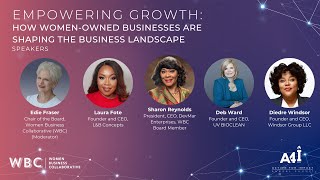
Empowering Growth: How Women-Owned Businesses Are Shaping The Business Landscape

WBC A4I 2023: CEO Excellence in Gender Equality and Diversity Awards Opening Remarks Day 2

WBC A4I 2023: CEO Excellence in Gender Equity and Diversity Awards Opening Remarks