WBC A4I 2023: CEO Awards Day 1
A compilation of short acceptance remarks and statements from multiple CEOs at the WBC A4I 2023 CEO Awards (Day 1). Speakers (from large corporations including Clorox, CDW, Bank of America, CVS, BMS, Coca‑Cola, Sodexo, Cummins, Diligent and others) emphasize their companies' commitments to diversity, equity, inclusion and allyship; describe concrete programs and targets (recruiting pipelines, leadership development, pay equity, employee resource groups, flexible/hybrid work, and DEI-linked executive incentives); and situate DEI within broader purpose-driven strategies (mission, ESG, net‑zero ambitions, community impact). The chunk includes multiple explicit metrics (e.g., board/executive gender parity, percentage figures for workforce composition, revenue figures cited by Cummins) and many examples of programs used to recruit, develop and retain diverse talent.
Thank you so much for this award. Thank you to the wbc. We are incredibly honored at Clorox to receive this honor. I'm honored. As a CEO, we have a deep commitment to inclusion, diversity, equity and allyship. And it's wonderful to see it recognized and rewarded and. And wonderful for us to have this opportunity to talk about all the great work that we're doing. So thank you to the wvc.
Thank you. And on behalf of cdw, I am delighted to represent this organization and everything that diversity, inclusion, equality and equity stand for and deliver across the globe. So thank you so much.
It's an honor to receive the award, Glenn, on behalf of my 200,000 plus teammates to do all the great work that we. So thank you for being recognizing me and more importantly, the team.
Thank you so much. It's really an honor and I'm very grateful for the award. Thanks for the work you do.
Incredibly honored to be a recipient of this award. Thank you.
I am so honored to be awarded this. This is a reflection of the 300,000 colleagues in the company. And thank you so much for the honor.
I'll give thanks in two ways. First, first and foremost, to my colleagues, our corporation is made up of 74,000amazing people who own the company in their own way and come to work each and every day to make a difference. And it's the culture of our organization and it's the execution with our organization that allows us to achieve anything. And this is a powerful symbol. And then I would like to thank your organization for your leadership and the ability to amplify, importantly, amplify and drive, focus on important initiatives such as this one. But back to my team. I'm really proud of our team and this is a team victory from that standpoint.
Thanks very much to the WBC for this award. Let's stay the course and keep making progress.
Thanks for recognizing us. We appreciate it.
Thank you again for this wonderful award, you know, this WBC award. And I'm very proud. And I'm very proud first personally, but also for the rest of the organization. It's very important for us, you know, at Sodexo and for many, many years. And I want to thank all the team around the world, you know, that are actively involved to make our organization a more inclusive organization where everybody can thrive. So thank you so much to all the teams around the world.
As an organization, first and foremost, it's important to put it into context. We're guided by our mission, which is to improve the health and vitality of those we serve. So we use that as our guidepost to everything we do. And we believe deeply that not only you can, but it's better to be a purpose built corporation, in our case, guided by a mission, who strives every day to make a positive difference in people's lives and importantly, make a difference in the communities that we work, serve and play in. That's how we talk about it, but also in our case, to be a performance based growth company as well. And some people, I believe, cause a false trade off. They cause you to choose one or the other. We resist a false trade off and we say no, not only can, but they should cohabitate and they actually feed and fuel one another. So as an organization, our 74,000 colleagues around the world ultimately wake up every day guided by our mission and again, try to make that positive difference in the lives of those we are fortunate enough and entrusted to serve. And as I said, make a difference in the community. For me personally, it makes your professional career a lot more rewarding.
Yeah. Inclusion, diversity, equity and allyship are foundational to our business strategy. And they were how we create additional value through the choices we've made. The strategy that we employed since 2019 is called our ignite strategy. And what it sets out to do is be more consumer obsessed, faster and leaner and a faster growing company. And we center that around people because our business, of course, is a people business, as all businesses are. We want to make sure we know our consumers, we want to know the talent that we have in our organization and serve them better than anyone else does. And in order to do that, we have to know them better. And so we have inclusion and diversity at the center of that strategy because without ensuring that we are putting the right products together, the right messages for all of the people who we serve, we can't get it right. And so we fundamentally believe it's the way we create the most business value is by leveraging inclusion and diversity to get the best results. And that's tied just as importantly as it is to any marketing effort or supply chain effort that we do. It is foundational to how we create value as a company and foundational to how we become a more consumer obsessed organization.
It takes a business system to make sure that everyone has an opportunity in a company, no matter which gender they are, in this case or whatever ethnicity or where they came from, what school they went to. And so we gear our whole programs at ensuring that teammates can make progress. And so we watch the rate of people moving through the company because for many Years we've been hiring diverse populations from schools, and now you're watching those populations that are 10 years ago, five years ago, moving up through the organization. And that's how you did it. And so you have to build a great pipeline from below and make some strategic hires from outside, but importantly, have to manage the process so that slates get formed that are robust and diverse and have talented women on them. And then you let the selection take place. And after having accomplished that, we've gotten to levels where we are now and we will continue to make progress.
It all starts with our commitment to diversity, equity and inclusion, which really sets us up for a very strong foundation for a strong and healthy business. That's why you see diversity reflected across all levels of cvs. And it really truly demonstrates how much we believe in the importance of DEI as a company. We strive for diversity across all dimensions, thought, experience, gender, race, just to name a few. And focusing on these dimensions is really core to our overall talent strategy, how we attract, how we retain talent, and that continuous development that includes robust mobility across our company. Our development programs are also designed to ensure we support diversity across all career levels. And we have a number of programs that we continue put talent through. Our first program is the General Management Leadership Experience program, where it really is designed for people who want to be general managers. And part of that curriculum focuses on the value of DEI and the importance of cultivating a culture that is committed to diversity. We also have a program called Strategies for Success for Multicultural Women and that supports colleagues in their current roles while preparing them for future growth. And what we have found in that program, we've seen such great retention results around those participants that are participating in that program. And I talked about it briefly, talent mobility is also incredibly critical to our commitment to dei. We move people across the organization so they have different experiences and they have different exposures to different talent and they can apply their skills to support all of our business challenges.
Well, at Bristol my squib, in fact, we have a long standing commitment to advancing women at every level. And we are very proud of the progress we made. In fact, our leadership team is in fact 50% women. And we focus on women leadership across all levels of the organization. We focus on that from individual contributor to managers, and of course at the executive level, all the way up to most senior parts of the company. And what we do is we focused on learning, we focused on growth, professional development opportunities, and we do that internally and through a number of external engagements. So a number of really interesting programs that we focused on over the last few years. One of them is the Catalyst leadership development program that's dedicated to the development of a network of women leaders in the company. And we focus on building capabilities, acquiring a global mindset, self awareness, building confidence to lead. And in terms of leadership, it's about leading self. It's about leading teams and broader parts of the organization. And about a third of the women who have attended this program have already been promoted. The second program that we focus on is the McKinsey Executive Leadership Program. Now, that's a broader program that is open to both men and women in the company, but at least 50% of the participants in the program are women. And this is about convening senior executives to build leadership capabilities that are required and at very senior levels in order to manage an increasingly complex business in a complex world. And we know that at least 50% of participants in the program also achieve promotions after they've attended the program. I would say that the one that is closest to me is the very clear focus we have on what we call our people and business resource groups, which there are eight of them in the company, and they represent groups of employees that choose to voluntarily come together. And at BMS, for over 16 years now, we've had a program called BMS Connections Mentoring, and that's meant to be connecting more junior women with senior executives that can provide coaching and mentoring and the development of the person, both personally and professionally. And so that's one of the ways in which we built a community of women and supported their development.
That's a great question. What are the tools and approaches that we use to ensure parity at all levels? And you know, when you look at our executive team, it is quite diverse from a gender perspective, from a person of color perspective. To answer that question, I would start with where we start and where we start with two words that we think are incredibly powerful and at the core of how we make decisions and how we operate at cdw, and that's value and choice. And at the end of the day, when we think about CDW and what we are here to do, which is make technology work so people can do great things, we have to think about the value that we deliver to all of our stakeholders that we touch starts with our customers and of course the partners whose technology we bring to market, of course our shareholders, but equally our coworkers. We talk about our customers being the center of every decision that we make at the center of our universe and our co workers at our sides. And the reason for that is because we are a technology company that is brought to life as a service company. And as a service company, it is our people, our co workers that deliver the value into our customers and on behalf of our partners and at the communities in which they work and live. So it's very important to understand that when we think about parity and we think about diversity and we think about ensuring the inclusivity of our workforce, it begins with the value that we deliver and is expressed through our co workers. Simply put, we are an incredibly disciplined organization.
We've had a long standing aspiration to, in the case of women, be 50% led by women globally by 2030. And we're making good progress. As you mentioned, you know, the board is 50% women as it happens, and so is the executive leadership team. The broader organization is 44% and it's slightly less at the senior levels than that. We do have to strike the balance because whilst we have a clear aspiration that we want to achieve, it is not at all costs. It's not about compromising on the quality of the individuals and the candidates. It's not a quota system. No one wants to be somewhere other than for their own individual merits. And I think this is the key is finding the right balance of putting in place the tools and programs, whether it be incentives for leaders, whether it be oversight from the board and some of the committees at the board level and the executive levels. But it's really that balance between finding the programs of all sorts of shapes and size that help the pipeline of talents, including women, growing, and by having the aspiration, keeping that in sight, having some confidence, we will achieve broad representationness without having to make it kind of certain assigned seats for certain things.
Well, I think, you know, to have 50% of women at the board and also approaching that number at the executive committee, I think it happens because we have made it a priority for a very long time. And I think for us it is both a moral obligation but also a performance issue. I think we carried out our own internal study at Sodexo and we have found out that the results clearly show that gender balance teams are doing better on all KPIs and our own KPIs like engagement, client retention, profitability, growth, safety and I think really diverse team. So perform better. But also what we have found out is that diverse team are innovative and more creative and as I said, then perform better. Another topic that I think is very important is that what gets measured gets done. So we set targets, we set business target, we measure our progress. And we make ourselves accountable on gender diversity and gender balance. We also have target to achieve a certain level of gender balance at leadership level. By 2025, for example, we already there with our top 150 leaders, women today they represent 41% of the team versus 30% in 2016. And for our population of the top 16 leaders, 1600. Sorry. For the population of the top 1600 leaders today, 39% are women. And that number was 30% in, in 2016. So I think, I didn't say that the target was 40%. So you see for the 150%, we are already above the target. And for the top 1600, we are almost there. So I think it is, you know, we also want to challenge ourselves and we want to go further because the situation is never person perfect. And I think it's an ongoing focus. And for example, in our top 1600 leaders, women in operation only represent 28%. So we want to make sure that now that we are almost at 40%, we want more women in operation and we want more women to have the opportunity to manage a P and L. And especially because out of, you know, globally we are more than 420,000 people. And among those employees, 54% are women and 56% of our frontline employees are female. But only 44% are sites manager. So as I said, you know, there is always room for improvement. And that's what we, you know, we are trying to do well.
So the way that we went about trying to increase the gender diversity of both the board as well as my leadership team is we first and foremost did what everybody does, which is try to go source a diverse panel of candidates. And so we actually do that like everybody does in ensuring that we have representation. But the other thing that we did, which I think was a real, the real game changer, was when we ensured that the interview panels were also diverse. Because I mean, let's be clear, if you have five of me interviewing, you're likely to get one of me. And so that was a real breakthrough for us. It seems pretty logical at this point, but it was when we did that then you let the best talent win. You always have to let the best talent win. The great news is in many cases for us, the best talent were these female leaders. And they've done an amazing job for us both on the board as well as at my leadership level. And that's actually something that has a huge impact through the organization. That was what I believe was one of the big drivers of the continuous improvement that we've had in our gender diversity throughout the organization was them seeing role models and seeing women leaders, both on the board as well as on my direct leadership team, that they believe they could aspire to be in those roles and they could see themselves having an opportunity to get in those roles. And I think that's been a big part of building out our improvement over the last few years in the entire organization.
Well, I'm incredibly honored to be CEO of Cummins and lead a really diverse team. And as you said, Cummins has today leadership team that is nearly 50% men and women, people from around the world, people of color, and most importantly, incredibly talented and experienced leadership team. And that tone at the top in our leadership team and our board is really reflective of our focus of building a diverse and inclusive workforce across Cummins. Our goal is to have employees that are reflective of the communities in which we live and work. So that's 50, 50 gender diversity in the U.S. we aspire to have 13% black employees and 10% Latinx employees. And really, if you look at Cummins, for us, this diversity is about ensuring that we have a variety of perspectives that help us deliver value to our customers, to our communities, and ultimately, business success. I joined the company in2020. That year we had $6.6 billion in revenue. As the diversity of our workforce has grown, our business and our business success has also grown. And last year we saw record revenue of $28 billion. So that's reflective of the power of that diverse workforce and our focus on harnessing diversity to have success for our customers and our businesses. It's not easy to do so. We really have a comprehensive effort that's focused on diversity, equity and inclusion at every level of the company, Starting with how we hire and attract talent, continuing to think about how we develop diverse talent. And one of our strategic pillars for our success is skilled talent and leadership. So we focus a lot on developing our employees and developing employees around the world. And then it's making sure that we create inclusive environments and opportunities that allow us to retain that diverse talent. So a lot of programs, and it starts with that diverse team at the top that is really looking at dashboards that help us understand in different parts of our business, where are we at? How are we doing? Are we moving towards these aspirational goals? What are we seeing in attraction, development and retention of diverse talent?
We have a very systematic approach to recruitment and growth of diverse leaders in the company, women in the company. And it's a systematic approach that starts with how much we appreciate diversity of thought and inclusion. And so we actually work hard to ensure that candidate slates, for example, for all operations include candidates that have a diversity of experiences, backgrounds, capabilities. We also ensure that actually interview panels are diverse in order to look at the potential candidates from different angles, but also represent the diversity that exists in our company to somebody that is interested in joining bms. Of course, there are a number of other ways in which we focus on recruitment. So for example, externally we have important partnerships with specific colleges and universities. I'll mention as an example, historically black colleges and universities where we have early career programming. We work with them on permanent hiring. The other thing that is very important at bms, we recognize that actually our people are the best source of talent from outside. They're the best recruiters of the company to the company because of course, they know our culture, they know our value, they're passionate about our mission. And so we work closely with people and business resource groups to help us identify external talent. And of course, we do have a focus on diversity recruiting sources like diversityworkforce.com and another of other partners that we work with all the time.
The most important thing for CDW to do is to create an environment where every single person and every team feels that they can thrive in this environment. That means that they are in an environment where they can reach their full potential. What does it mean to reach your full potential? It means to be in an environment where you feel that you can be both unique and belong, that you can bring a voice and you have choice. It means that you have agency in the decisions that you make. It means that you can be your authentic self when you are at cdw. So if we get to the core of what drives an environment that is diverse and inclusive, it is about starting at the individual level, building to the team level, and ensuring we are developing and maintaining an environment where everybody can thrive, feeling that the work that they do is meaningful and ultimately has an impact on the customers that we serve and that they are making an impact. It has to do with the people, the people that they work with every day and the caring they bring to each other, the extra mile they will go to how they learn from each other, and how that allows each individual to grow and thrive themselves. It is about rewards. And rewards is not just how individuals are compensated. And of course we want to ensure individuals are compensated fairly and equally. It is about recognition. It is about the things that the organization offers to individuals that matter to them.
You know, it's clear that we are dealing with a changing workforce, an evolving workforce, and a set of evolving requirements from this new workforce. And I think the pandemic actually accelerated that. I mean, the pandemic created this level of informality between an executive team and the employee population. We have a very open environment. We have an environment where we communicate frequently, transparently, and I mean just authentically. We try to be very honest with our employees. I've joked with them on several occasions that you can ask me any question you like, and if it doesn't put me in jail or put the company at risk, I'll answer it for you. And I think just creating that level of trust, and then we have all the things that lots of companies have. We have all the employee resource groups, and we have a lot of engagement. We have executive sponsors on my team who are aligned to these employee resource groups to make sure that they're getting the resources that they need or that their issues are being heard. We've done a lot of work around mental health for employees. We've also created a super flexible work environment from a hybrid work perspective. We've always had a notion of hybrid work because of the technology we build actually enables it. So we've always embraced it. And, you know, we probably had 11 or 12% of our workforce before the pandemic, worked from home full time already. And so now we've created an environment where people can have more balance in their lives. But we're also trying to create a world where we have valuable experiences that we're creating when people do come to the office. And I think it's going to be super critical as we go forward, that talent is going to move and they're going to work in places where they feel like they're heard, they're going to want to work in places where they feel like they have flexibility. And that's the environment we're trying to create.
We're really proud of the diversity that we have in our organization and as it relates to gender diversity, as you mentioned, we have 40%, over 40% overall of our positions filled by women. But what we're really proud of is the fact that our board and our executive team have met gender parity. So we're 50, 50. And of course, that is not the work of just me, who I've been in the position for three years, but many committed to diversity, equity and inclusion for many, many years at the company because that's what it takes. It takes deep, long commitment. It takes commitment in how we recruit, how we retain, and then how we ensure that we create an inclusive culture where people can do their best work and thrive regardless of who they are. And so I think that's the focus as a team that we have, not only on recruiting, etc. But most importantly, do we create an environment where everyone can thrive? And we recently relaunched our Inclusion Diversity Equity and allyship, we call it IDEA Strategy, that takes all of that into account and continues to support advancing not only women, people of color, and other forms of diversity to ensure we reflect the consumers that we serve every day. Pay equity is incredibly important as we want to build a team that reflects the consumers that we serve. And we've been deeply committed and have achieved pay equity for the last three years. And that is part of how we develop an inclusive culture. Equal work should receive equal pay. And we go through an extensive study. We leverage data to ensure that any place there could be a pay equity, that we deal with it and that we achieve that every year. And that's something that we talk to our team about, that we report externally to hold ourselves accountable to. But it is foundational to the work that we do to create that culture and ensure that we have equity across the organization.
At bank of America, we'll stay the course. The way we hire, the way, it's an engine that just works and can't really. You wouldn't want to. But on the other hand, it is an engine which perpetuates itself, which is starting with that. You have the pipeline coming out of schools and going to lots of different schools and lots of different types of colleagues and bringing, you know, we'll have this month, 2,600 new kids join us from colleges. So with the diversity in society, diversity in the colleges, we're getting very diverse populations and. And then we have specialized programs that we try to bring women in STEM and in technology programming or women into investment banking or women into investment financial advisory. And that's by showing teammates the opportunities. And so it takes some specialized programs to help in those areas. But overall, it really starts with who you recruit, how you recruit, and there's tremendous capacity out there to continue to end up with gender parity in our business.
Earlier this year, we announced that we have a new Chief Diversity Equity and Inclusion Officer. And we're excited about what she's bringing and the new exciting idea she's bringing to the company, you know, relative to recruitment. You know, as we think about recruitment, you know, we changed what we define as new equivalent experience guidelines, so we broadened the experience requirements for potential job candidates, which gives us a Much bigger aperture for the kinds of individuals that we're bringing in to the organization. We've trained our workforce in behavioral interviewing so they are focused on helping them recognize the value of varied experiences and varied perspectives. And then when it comes to retention, you know, one of the things that we have been committed to and continue to commit to is our colleague resource groups. Where these colleagues resource groups are colleague led organizations that really encourage the develop the sense of development, the sense of community and they promote diversity. Each one of our executives is a sponsor of our, of those programs and, and those examples of those programs are our WISE program which is focused on women and you know, it supports educational, mentor and volunteer opportunities. I sponsor that program. We also have the BCRG program which is dedicated to the personal and professional interest of those CBS Health colleagues that identify as black. And we also have capabilities which is increasing the awareness of the important role that colleagues with disabilities play in our workforce and our workplace. As a matter of fact, I'm recognizing one of our blind colleagues in our town hall this week who has been instrumental in improving the lives of our customers. And he had the opportunity to meet one of our customers and she was shocked that he was blind. But it just goes to show you the importance of, of these programs and diversity and the impact that people can have on the millions of people that we serve every day. Relative to this topic, our executives compensation is tied to performance in advancing racial, ethnic and gender representation. And we are incredibly proud of the progress that we're making. We had more than 20% increase in racial and ethnically diverse talent at the executive levels in 2022. But you know what, you know, this is how we think about it. There's no gold star, there's no point on the board and to say that we succeeded, we, we always celebrate the progress, but we know we can always do better and we build on that every single single day.
We're certainly trying to recruit people in different ways and hold on to them in different ways than we have done historically as much as anything. Because the workplace has changed, if not for any other reason than post Covid. And when we say diverse talent, really it's about breaking it down. In the end, you know, the Coca Cola Company aims to serve every consumer in the world. And therefore we do need to feel that we are representatives of those consumers, if only for the very simple idea that if we have a broad experience, a broad set of people with different experiences and different skills and different life inputs, we will better understand our consumers and be able to engage with them. And we all know that if you have a broad set of opinions done properly, you can get a better result. So if you want that as an overall aspiration objective, because it makes sense from a business point of view, then you have to go out and find them in the places where they are. Sometimes everyone you're looking for is in one place. That's very rarely true. And so we have reached out to different sorts of universities, different source of colleges. Obviously we're broad geographically across the world, so it is about that. And then of course finding out that, you know, once they're employees and at different stages of life there are different pressures. I mean the pressure we're talking about women in this case, the pressure on women versus men is different as it goes through the childbearing years. And so the programs naturally have evolved to be able to support the individual and to achieve the collective goals of the organization.
We are a people company and women and men are at the heart of our business model. Attracting, retaining talent and enabling them for us is critical. It explains the positioning of our employee value proposition. Working with Solexo, it's about belonging to a team. It's about acting with purpose. It's also about enabling everyone to thrive in their own way. And to do that I will give you a concrete example of an initiative we have implemented this year. And back in February we launched a program called vita. It sets a minimum standard standards for three essential benefits in all the countries where SODEXO operates. First, a life insurance benefit to ensure that the financial well being of our employees family is protected. Second, parental and care leave which provides the ability to take time off to look after children or dependents. And third, an assistant phone line to support our employees with practical advice, guidance and counseling when necessary.
Guided by our philosophy, our belief state as an organization for quite some time I lose track of time. But I'll assert for over a decade we've been at a body of work whereby we have an internal commitment and some external resources that assess, validate and agitate to assess whether or not female to male for like skilled, like positioned individual, person of color to non person of color is their equity and a consistent process for making small adjustments on a dynamic regular basis. And the yield is what you said, something I'm quite proud of. And it's another area where we're transparent on. We're transparent internally, we're transparent externally. Perfection is 1.0, it's 99 with a decimal point on it as well. Very important. It's 99 plus. Sometimes it's been 100 with a decimal point after it, but it vacillates about as close as you could get to 1.0. So goal clarity, conviction of resources, relentless execution, measurement, transparency has helped us to achieve those great results.
When we think about our workforce, obviously our success starts with our people and we're in a fierce war for talent. And so we spend a lot of time thinking about how do we attract the right talent for the company and ensure that we retain it. And that has several elements. It starts with building relationships and connections to organizations, universities, where we can really build the understanding of Cummins, what we represent and the opportunities here and ensure that we have that pipeline of diverse talent interested in opportunities that Cummins. It includes some of the leadership development and skill development programs that we have that are an important part of attracting people, as well as making sure that we have the right compensations and benefits. We also, especially following the pandemic, have enhanced ways of working. So we have different opportunities within the company, some of which require being on site full time, some which are, many of which are hybrid work and some that are also off site working so that workplace flexibility, the right environment to develop and have unlimited opportunities, really in your career at Cummins and attracting talent. And then lastly, I'd say is back to that focus on creating an equitable and inclusive environment and having a diverse leadership team at the top and seeing visible role models is one important piece. In my experience as a woman that came up through the technical organization and now as a CEO, there were times that I looked around and I didn't see people that look like me and I wondered if I fit in. So that leadership diversity is certainly important. It's not enough, though. So we're thinking about how we're building in environments, removing bias from processes and things that that we do within the company, so that once we've attracted talent to Cummins, they're in an environment where they really feel like they can be themselves and thrive. Here in our workplace.
Purpose is all a very simple concept. It's about the why you exist. And for us, it's very clear why we exist. We want to create a better world where people can thrive. And we do that through our brands, we do that through our community involvement, we do that through how we create value for all of our stakeholders. And it's really why we get out of bed in the morning. I think when you're grounded in purpose, that's really all you're grounded in. You're grounded in your why and you connect value Creation, to value creation for people, for humans. That's something that makes the work that we do meet really meaningful. It makes it meaningful for the people who create our product in our manufacturing facilities, to the people who market it, to the people who do all of the work across the company to ensure that we develop great brands. And I think, you know, purpose is something that is a very hard skill. It is not something soft. It's not something that is negotiable to us because it is really how we create brands that people love. And so we view it as something that is the foundation for our strategy, it's the foundation for the policies for our values. And each one of us is committed to championing that world where people can thrive every single day. And that's the first thing you're going to hear people talk about when you talk about the company is my work is connected to a purpose and I know what it takes to deliver that purpose. So to me, again, it's not a soft concept and it's not negotiable. It's why people get out of bed in the morning to do the work they do.
Well, let's state our purpose very simply. The Coca Cola Company has had for almost 140 years a very simple idea which is to refresh the world and make a difference. And right from beginning of the conception of the company was this idea that business would need to engage with the ecosystem and the community around it in order to be able to drive a successful business into the future. And one aspect of that has been investing and empowering women around the world. We ran a program that was now complete. Actually a lot of it came through the Koch Foundation, Five by 20, which was helping empower 5 million women around the world by 2020. I think they got, they got well above that with something like 6 million. Worked a lot around the world. And it was about business skills training, mentoring, networks. And a lot of them were set up, for example, mom and pop stores and small distributors out there in Africa, a place like this. But then you go all the way to North America and you've got all sorts of employee networks. But it all comes back to the idea that for the business to be successful, it needs to be engaged in helping the ecosystem and the community around it be successful. Whether that's about the talent or some of the stuff to do with the environment. And so we have always seen that as part of what it will take to be a successful business.
We are very lucky at Sodexo because from the beginning we have Been a company of purpose when my father founded Sodexo in 1966 with a strong company mission. And the mission is to improve and was at that time to improve the quality of life of our employees and those we serve, and also contribute to the economic, social and environmental progress in the communities where we operate. So now, today, as the chairwoman and the CEO of the company, I'm very proud to keep the mission and our company values alive because I think there are strong fundamentals and we want to keep building on those strong fundamentals. And we are a global organization, but the nature of our business makes us very local. I always say in the US we are American, in France, we are French, in India, we are Indian. And we're a people company that operates at the most local level. And the human dimension is central to what we do. And we're also pushing ourselves further back in November, we presented our 2025 strategic plan. And one of the strategic pillars of this plan is to strengthen Sodexo impact as a market maker in sustainability. So we announced our ambition to achieve net zero emission by 2040. And also we want 100% of our employees to work in countries with gender balance management teams by 2025. So I think that to ensure commitment and accountability, our leaders are also incentivized on achieving the gender balance objective.
At Sodexo, we aim to transform patients lives through science and our mission, in many ways, it really is what brings the company together and what is the foundation of our culture. We discover, develop and deliver innovative medicines to help patients prevail over very serious diseases like cancer. And one of the ways in which our mission comes to life in the company every day is our unwavering focus on patients. Now, because of the importance of what we do, we are strong believers in the importance in inclusion and diversity efforts because we definitely need the best people around the table to solve complex issues where patients are waiting. And even more importantly, we need every one of our people to be able to contribute and perform to their fullest potential. And so we've embedded into the operations of the company a very clear focus on creating an inclusive culture to really help us be better at what we do and have people contribute better to solving important issues. The other point is about esg, and of course that's a critical value to us. And one of the things that I would point to is our focus on health equity, because once we develop an innovative medicine, we must make sure there are no disparities that make it difficult for any patient, regardless of where they live to have access to one of our treatments. And so we have a really clear focus on health equity. And across the companies that are great initiatives that are focused on addressing healthcare disparities.
For me, being a company of purpose is incredibly important to me as a person. And it's also a critical part of Cummins. Our mission statement is making people's lives better by powering a more prosperous world. So what that means to us as a company is we're serving applications, commercial and industrial equipment that's really at the heart of the economy, and serving needs of people and communities around the world. And by serving their needs, we're making their lives better. We're providing products and services and power that they need as a part of their daily lives. And we want to also ensure prosperity as we do that. So our customers who are running businesses, ensuring that their businesses are successful, the broader businesses that those applications serve. And we also think about the environment and how the work that we do ensures that we have a healthier environment and a lot of focus on that as an integral part of our destination zero strategy. So really is at the heart of the mission of the company. It attracts a lot of people to Cummins and keeps people at Cummins because our work matters. For me as a leader, my career has really been shaped by purpose. I want the work that I do to have purpose and to have real impact. And Cummins mission and the opportunity to innovate and drive solutions that not only enable customer success, but also made a positive difference for the environment is one of the key things that attracted me to Cummins, motivated me in my career, and ultimately led me to be CEO of this company at a time when our products and technology is transitioning and we have an opportunity to make a real difference for our customers, the environment, our employees and our communities.
Look, being a company of purpose means that you exist for something bigger than your business results. The business results matter. You have to get those. But there's something bigger that you believe in. And as we all know, this is increasingly important to our employees. It's increasingly important to potential employees or future employees. And so our purpose is to power an inclusive future for all. And we believe that we do that through our technology by connecting people all around the world and giving them the opportunity to participate in the global economy and be educated and receive health care. And we can solve some of the biggest problems in the world through connectivity. But we also see it reflected through our community service and the work that we do. And it's about when we say all we mean all. I mean, that's why we're involved in homelessness, which you would struggle to connect homelessness to our business. But we believe our communities need to be healthy and we believe in powering an inclusive future for all. And when we say all, we mean it. And I think it's super important for organizations these days to, you know, you can't just talk it. People are inspecting and they're asking and they're trying, they're looking for examples. And they really want to make sure that when you say it, you mean it. It's almost worse to have a purpose and not do it than to not have a purpose at all.
What does a purpose driven company mean? It means clarity in an organization about the power that the organization can bring to bear on the world. And I'll never forget when we had the superintendent of the Cicero School District on the stage of one of our leadership programs. Superintendent Hernandez talked about his role educating tens of thousands of students. And he looked across the leadership organization and he said, my job, the job of my school district is to educate the next generation of leaders in the world. My job is to ignite the world to excellence. And he looked out at the leaders at CDW and he said, and you help me do that. That is purpose driven. Ignite the world to excellence. That is what make technology work does to help people do great things. So when I think about what is a company of purpose, it is having the heart and the soul and the heft behind an aspiration that is amazing. And then working together tirelessly and in a way that supports each other to make it happen.
First and foremost, it's starting from the top of the organization and ensuring that the leaders across our various businesses and functions fully adopt and accept those goals and objectives. So you're guided by the purpose of the company. We're guided by setting goals and objectives, and then it's committing to them. And then ultimately, to your point, being very transparent, transparent to our colleagues, but transparent to our stakeholders in terms of the way we publish our goals and objectives and then our performance relative to it. And then it's the good old fashioned hard way you go to work. And in this case, we were guided similarly, the way I think about it, as we are with our growth strategy when we seek to grow our company, and fortunately, we've grown our company meaningfully and successfully for approximately 15 years now, we grow by first and foremost retaining a disproportionate amount of our clients and customers. Because if you're delivering on your promise Your retention is higher, expanding relationships, earning the opportunity to broaden your services and always adding new relationships. And that same philosophy applies to your people. So in this case we needed elevated levels of retention if we're working with valuing, supporting our colleagues. Second, in this case expansion is development being very deliberate in the development process that you have relative to talent and in the case of what we're talking about female leaders at the upper levels and growing, supporting, coaching, mentoring, providing diverse assignments and then of course always adding talent to the organization. So for example, in excess of 90% of all of our slates have diverse candidates that are presented relative to that. So you set the goal, you get the commitment from leadership, you provide transparency, you develop a plan to execute and then you go at it every day. And in our case it's retention, development and then attraction of new talent.
Our purpose is to help people live their financial lives and to help people live their financial lives, to help societies prosper, to be the interface between the economy and capital markets and people or you know, an employer and an employee in terms of distributing payroll and all that stuff in a person to pay their bills. We, we're in there to be a catalyst and a planner and advisor to help people live their day to day financial lives. That's the core purpose. And to do that you have to be able to approach, you know, 100% of the population as potential clients with people who, you know, who reflect that population. And so it's core to the purpose to be the best place for teammates to work is one of the attributes we have to be because we're just a talent company. And then it's core to who our customers are, it's core to who how we help communities be successful at the end of day produces great returns for our shareholders. So we talk about a company, we talk about delivering on the genius of the and deliver on profits and purpose. And so to do both, you have to be able to really do what's in the best interest of your clients, your teammates, your shareholders and, and your communities. And to do both them will result in better value across both. And we've produced, you know, high returns on the tangible common equity over the last several years at the same time delivering record purposes, we call it in record earnings. And so that's what we try to do, but it's the genius of the and you can't do either or you have to do both.
Purpose is everything for us and really as a company it's our North Star, it truly guides us in all that we do and every single decision that we make. You know, during the pandemic, more than ever, we saw the positive impact we could have on our country and the millions of people that we serve. But at the same time, when I took over, I took the opportunity to reevaluate our purpose as a company. And I asked colleagues from all across the company to help me sort of define what our purpose was and how, what they thought that we all, as a company could rally around. And it was our colleagues that came up with our purpose, that we bring our heart to every moment of your health. And that speaks volumes to the impact that we can have on millions of people's lives in America. Obviously, we all know that health is our most valuable asset. If you don't have your health, you don't have anything else. And what our colleagues said was that they wanted to bring empathy to our purpose because we were dealing and, you know, interacting with people likely at their most vulnerable time and having a health issue. And so that's how we came up with our purpose of we bring our heart to every moment, your health. And we've got the, you know, 300,000 colleagues who rallied around that purpose. And then what we did is we took that purpose and we created what we call hard at work behaviors. We also talked about ESG and, you know, the importance of environmental, social and governance as part of our purpose. And we believe that a healthier planet leads to healthier people. And as a commitment, you know, we've been making bold moves in our ability to support ESG initiatives by creating renewable energy, you know, focusing on health equity and really getting into the communities to drive our purpose forward. And you asked about my personal commitment and what makes me get up every single morning. Well, I've had two experiences in my life. One was I lost my mom to suicide when I was 12 and. And I lost my aunt, who was my caregiver when my mom passed away. And she died in my mid-20s and she died of lung cancer and breast cancer. Those experiences in the healthcare system where it wasn't easy, it wasn't navigable, there were lots of unanswered questions. Fuels my purpose every single day to truly make a difference in the healthcare system of America. Hi, I'm Lisa Edwards, executive chair of Diligent Institute. And Diligent is so proud to be an early sponsor of WBC's Companies of Purpose.
Diligent itself is a company of purpose. We publish a biannual board diversity report.
That highlights the status of board diversity around the world.
We also provide the Diligent Director Network.
Which is the world's largest database of.
Diverse and board ready talent in the.
World and where it's used by recruiters, private equity firms and board members worldwide.
To search for their next board member. We're so proud of our association with.
WBC and and we look forward to a continued collaboration.
Hi, I'm Greg Vargas, Vice President of.
Talent and Diversity, Equity, Inclusion and Intersectionality at Diligent. At Diligent, we're proud to support Women's Business Collaborative's Companies of Purpose initiative. I wanted to highlight two initiatives that.
We are pretty proud of here at.
Diligent in terms of showing how we.
Are a company of purpose. We launched our Employee Resource Group or ERG program two years years ago which.
Plays a fundamental role in our DEI plan at Diligent.
It's got a focus on building community and influencing positive culture.
Here we also launched in 2022 Diligent's Baltimore Academy, which was really created to.
Help address the need for a more.
Inclusive and diverse talent strategy. Just two examples of some of the.
Things we're doing at Diligent.
Thanks for the time and thanks again.
The Women's Business collabor.
More from Edie
The Power of Purpose & Connection – A Conversation with Edie Fraser & Jan Duplain
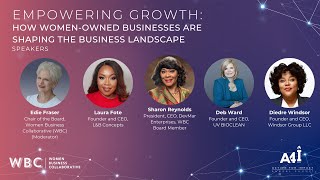
Empowering Growth: How Women-Owned Businesses Are Shaping The Business Landscape
WBC A4I 2023: CEO Excellence in Gender Equality and Diversity Awards Opening Remarks Day 2
WBC A4I 2023: CEO Excellence in Gender Equity and Diversity Awards Opening Remarks