Flagship Dialogues: Women Mean Business
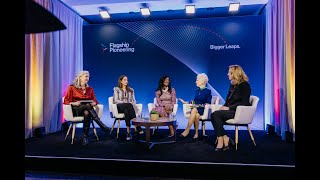
Panel recorded at a J.P. Morgan Flagship studio discussing Edie Fraser’s book Women Mean Business (Jan 2024). The panel — Edie Fraser, Margot Georgiadis, Cindy Kent, Audrey Greenberg, moderated by Christine — shares lived leadership lessons and concrete career advice: finding "soul joy," setting boundaries, creating followership, sponsorship vs. mentorship, negotiating entry/exit points, and practical steps to access board service. The discussion mixes personal stories (career trade-offs, mistakes, advocacy from male allies) with prescriptive guidance (set personal OKRs, ask for opportunities, build a visible resume/bio for boards, take time to be new).
Welcome back to the J.P. morgan Conference and the flagship studio where you're here for a conversation with an incredible powerhouse panel of women about a book called Women Mean Business by Edie Frazier, who is here. And when I say it's by Edie, it's really assembled by Edie because in this book you will find the voices and wisdoms of 100 plus women. It's an incredible read. Here to talk about it is Margot Georgiadis, the CEO of Monti Health, who is one of the folks in the books. Cindy Kent, who is also in the book, the chief operating officer of Everly Health. And we have Audrey Greenberg, who I'm going to remind myself is the CBO and co founder of the center for Breakthrough Medicines in my native Philadelphia. We were just discussing that. So very happy to have you all here. Edie, this is an incredible compendium of wisdoms, as you call them in the book, and advice. Some that are sort of like bumper sticker life hacks and some that are just really big think different ideas than maybe the average advice. Much of it is lived, experience based advice, I'd say. So first of all, tell me this is not your first book. What led you and inspired you to put this book together?
What led us to put this book together was the word we of the need to really pick women who are authentic leaders. And if we look at Margo and Cindy and now meet Audrey and others and we look at what we can do as we all work together to elevate and then celebrate other women. So in the book you'll hear from so many who are saying what have they done to persevere and get forward? But most important, what they're doing, as these women are doing every day, to uplift others, to reach up and to push with sponsorship and mentorship and then lift back as we see the future. And thank you flagship and to Margo. And let's just look, Margo is the epitome of all of that. And as you started at Google and as you went to Ancestry and Mattel and went to investing, Margo, every day you're helping other women. And I go to Cindy. We've known each other forever and you know, we bring along the best and the brightest, but we also bring along our sisters of color because as we look at the data, it's bad enough in terms of angel investing and venture capital, but when we look at women of color, it's less than 1%. So we know what you're doing. And Audrey, it's a dream to get to Know you of what you've done, not only in Philadelphia, but the whole Janine testing, et cetera. So I just open by saying all of us as we look at us and what we do every day. And my challenge is to say, can you support five other women every day? And what does that mean? If you skip a day, you got to make up for it because we've got to change things numbers and we've got to do that quickly. And that means we've got to have laser focus. Right. And have joy in our lives in doing it.
Okay, I was going to ask Margo the first question, but based on your point about joy in our lives, you know where I'm going. I know so far because Cindy. So the book is organized around five wisdoms from each of the women leaders featured in the book. And one of Cindy's that so interested me was the idea of finding your soul joy. And the question is your soul singing? And it's such an interesting question. And I would like you to interpret for us or explain to us what soul joy is and how you define it and how we'll know when our soul is singing as we get off. J.P. morgan Healthcare Conference.
Thanks, Christine. And just one quick correction on the bio intro. Former COO of Everly Health. No worries. I exited last July. But soul, soul joy is a concept or even a term that was coined by myself and one of my best friends from high school. There's four of us that befriended each other at 16, and we literally just had a girls trip in Miami about two weeks ago. So we're still hanging together. But soul joy was a quick way of checking in with each other. And so specifically we were busy with our lives early career. We had all graduated college and one of my friends, her name is Deidre, would call and say, I know you don't have time to talk, but is your soul singing? And that means are you doing your best work? Are you happy? You know, are you doing the thing that lifts your feet up off the ground? And in that simple, quick sentence, it would be a whole conversation, right? I could explain to my friends exactly where I was. And over time, I realized that sometimes in work, even if it's hard, but I really enjoyed it, I. I would still have soul joy. And so after a while, instead of stumbling upon it and recognizing it when it came, I start to ask myself the question. As I matured in my career, can I be intentional of going and finding it? Can I make soul joy? Can I stop doing the things and challenge myself? Can I Stop doing the things that don't bring me to soul joy. And that's personal. We can talk about that at some other point. That's a different conversation, whether it's personal or professional. And so I really, especially at this point, I'm at legacy stage now of run towards those things that really will make me happy. And it has nothing to do with the ease of the work. It's the enjoyment and bringing my whole authentic self to the party.
Well, you mentioned the personal versus the professional. And I would say one of the things that struck me about the book and Margo, I'm going to come to one of your pieces of wisdom next was, you know, women who ascend to leadership posts, generally speaking, know how to over prepare when work hard, share credit, do 110%. It's those things that also feed us as people. When I introduced what you had done and you immediately corrected and said what we have done together, it reminded me of working for Drew Faust, the president of Harvard, who every speech I draft that would come say I and I would come back, we and our and just that notion of the collective and of our shared work. And we would often have this tussle. A colleague of mine and I, and I'd say, oh, she has to do this trip or this speech. And someone would say, oh, it's her only three day weekend before commencement. Protect the asset. The idea being the asset is you. The asset is your family counts on you, your institution counts on you. And so, so much of that, that soul joy notion and Margot, that's where I'm going to go for you. This same notion to me you talk about creating boundaries to stay centered. Tell me the personal part of that and the professional part of that.
So the reason I added that as one of my wisdoms is I got married young and we had three kids starting in our 20s. And my husband also had a really successful career. And so we had to make choices from the earliest days. And I think so many people say you can have it all, but you can't have it all at once. And we took a slightly different approach, which is to make those explicit choices about what mattered to us at each stage so that we could actually find that soul joy but also do what we cared about. So it did mean that sometimes his career took precedence over mine. Or sometimes I would choose maybe not to take a job that traveled as much right when our kids were really young. And that was a really hard thing to do. But then I would find another way to develop capabilities and be happy within that choice. And I think for so many women, I think there's this conscious pressure that if I'm not a perfect parent or if I'm not achieving everything at the same rate as everyone else, I'm somehow falling behind. And I think the most valuable thing you can do as early as possible in your career is decide what matters to you, put a boundary around that, and then actually make those choices and just noise out all the rest. And it's interesting. I develop in my own companies, something we do. We all set goals every quarter. I'm really into okrs because I worked at Google for such a long time, but actually I think it's really important for everyone to set a personal OKR every quarter. And I call it one simple thing and it connects back to this. So everyone on the team can actually, whatever it is, maybe you just need to get in shape once more.
Like a quarter.
A quarter that you tell everyone else on the team that's really important to you and it gives you permission. Because sometimes I find the people that are single on the team feel like the people with kids can always, you know, find a reason why they need to leave and everyone's okay with it. But sometimes the single people also need space, but they don't feel comfortable, you know, and so whatever is important to you, being able to share that with other people and then commit to it, just like we do any other goal, I think makes us much more centered and enjoy work a lot more.
I want to come back to two things you said. One, the notion of noising out. And I want to relate it to the conscious decision at earlier stages of your career of foregoing an opportunity because of what you put boundaries around in those early stages, did you have the ability to put noise out or was there a party that said, what am I doing? I'm giving up this opportunity? And it could be, how did that work early? Was noising out something you matured into? Or did you know even when you were foregoing opportunities to protect that which was precious?
Yeah, you know, I looked at it as you close one door and you open another and the way others always see those opportunities. So, for example, a great. I was a partner McKinsey for a long time, and as I was about at the door of partner, I had my third kid and they offered me this plum assignment, but it would have meant I had to be out of town three days a week. Totally different state. Which as a mom with three kids at home, it's just not going to work. But they thought that they were putting me on a pedestal for promotion, but I knew that that was going to be ridiculous at home. And they were only men right at that time in most of these senior roles. And I said, I appreciate so much that you're offering me this tremendous opportunity, but I'm really delighted to take any client. Give me your hardest client. That's actually within one hour's drive the office. And, and I said, and I reminded them I'm at the leading edge and I've always been a data nerd. So these are all the things that I think I can bring into this and this and this client. And I opened up a whole bunch of ideas for them and ended up taking on two, really clients I'd struggled with for a long time, really building a relationship with and ended up succeeding. And what was great is I worked in a whole bunch of industries, including I worked for a big payer, which ended up helping me fall in love with healthcare. So I think again, where one door closes, another opens. And because I knew that was a boundary I needed to set, you just find another door. And I think as women, if we help each other step back and find another door versus thinking of it as closed and final, I think we can actually find a better way forward.
Okay, everybody, with your book here, write in a sixth wisdom from Margo. Find another door. And those of you who are going to buy the book after watching this, it's a really good one. I think it's so easy in early stage roles when you forego something, it makes a lot of sense to give up. You think, oh, have I taken myself off? And you know what? Talent finds a way, hard work finds a way. Speaking of talent and hard work, you are a maker and a creator. You've created something unique in Philadelphia, unique in healthcare. Can you describe a little bit about the work you're doing now?
Yeah, thank you for asking.
Sure.
Chief Business Officer and co founder of the center for Breakthrough Medicines. We're a cell and gene therapy focused CDM based in Philadelphia. As you said, we're very focused on expediting the path to approval for these curative therapies. There's new ways of treating patients with cancer and rare disease that actually cure as opposed to treat the disease. It can be quite expensive and complex to develop and manufacture and commercialize these therapies. So we are there to help with that and reducing costs and timelines. But for me, that's all interesting. That's the business side. Right. But, but the personal side is I spent most of my career as an investment banker and I worked in private equity and all that stuff was very exciting and a great foundational education for me. But doing this is something that in addition to joy, it makes you feel good about what you're doing. There's a greater purpose. When I wake up every day, I can feel good about the work that we're doing. So that's one thing on the personal side, but also there is something about creating an economic benefit for a city, the city of Philadelphia, where it's a minority, majority city. And there's an opportunity to create and change generational trajectories where you can have manufacturing operators in our GMP suites and create opportunities for folks we're building. We had 100 people at the end of 2021, 400 people at the end of 2022. We're now part of a 2000. We got acquired by SK Farm Techo, which is a Korean CDMO. And we are part of this 2000 person organization and we have the financial backing and now the infrastructure to really make a difference for the city and for these companies. And so I just see it as like a triple, triple transfection in a way.
I had to fly you from San Francisco to Washington and have you testify before Congress because these are also high paying clean jobs. There are paths for people with non traditional college backgrounds or educational backgrounds. I mean, it's really an aspect of the biotech story that is undertold and so important both from municipalities, for states and for the federal government. So there's my PSA for Washington. But let me. You mentioned private equity, you mentioned venture capital. You're now in biotech. Margaret was talking about when she was at McKinsey, it being all men. You are in a sector and have been in sectors in which there are fewer women than there should be more than there have been, but certainly still fewer than you should be. Any advice for when you are the one woman in the room or.
You'Re.
In a real minority in the room relative to who else is in the room. And I'm going to ask that of all of you because you've all been in situations where you look around and say there's not a lot of people around this table with my lived experience or my set of concerns. Exactly.
Yeah, it's a good question. I never really noticed it in my. I mean I obviously noticed that I was only one, but I didn't necessarily notice that there was a different dynamic between an all male room and an all female room until I got later and later in my career. But it's different to interact with all women than all men. And first of all, just having the level of confidence and comfort is the most important. And I do think there's a difference between generations and you know, the Gen Y and Gen Z and Gen X, I'm part of Gen X. And certainly the baby boomers just all have a very different perspective on gender. And you have to just be aware of your surroundings and what they're bringing to the table, understand any limitations that they may have and communicate where they and meet them where they can be met. But I do think standing in your confidence, feeling that you deserve to be there. So speaking your opinion, don't be shy. I mean, it's always part of sort of being successful.
There's a lot about that in this book, a lot about sponsors, a lot about mentors. But I want to hear because we've got a couple of those generation on this panel here. So let me just hear about your experience and your advice.
Yeah.
Well, I would say it still amazes me to be in situations where I'm the only. And it doesn't matter what you fill in the blank with. Most times it might be the only African American, the only person of color, the only female, but it still. And that is shocking when it does. But I would build on exactly what Audra says, knowing that you belong there because sometimes you can walk into those situations and it be overwhelming or intimidated, intimidating. And some of the classic stories that we hear is that your comments might be ignored. Yes, that still happens, but what part of it will you own? And so, you know, I politely re interject the point if I think that it was missed. And one of the things that I think is most helpful is what can you do, especially as we rise in our ranks, to not be the only one. Right. I would never be satisfied with opening the door and being the only one unless I know some of that power is leveraged to bring others along. And that's always been, to Edie's point, very important to me as well. The other thing that I would say about generations, and this is a really good one because when we were doing the preparatory call for this and we talked about sponsorship and I know we're going to get to it versus mentorship. One of the things that I can continue to recognize, probably for the first 20 years of my career, I only had old white boomer men as sponsors, not mentors. I had lots of different types of mentors, but as sponsors and probably because they were the ones in power and so therefore, they can leverage that political capital on my behalf. But a lot of times they saw me as their daughter or somebody that they, you know. And so I, I started to leverage that when I worked for someone new. I said, be the boss to me that you would want your daughter to have. And everything about the dynamic of our relationship would change. And then the last thing that I would say is building relationships. Whether it's the boardroom, whether it's the C suite, it's really important. And it doesn't matter who's around, whether you're the only or not. You know, I go to lunch with my. When we were in the same space, but go to lunch on my board. I fly in a half a day early so that I can meet with some of the board members ahead of time and connect outside of the boardroom because it really does facilitate support and collaborations. Once you're around the table, I want.
To get back to sponsors and mentors and boards. But let's stick on this topic of what to do when you're in a minority or you're the only. You probably dealt with that a lot.
It is all about building relationships without any question and building allies and staying focused on positive people. In fact, all the interviewing said in interviewing today, if you're not positive, passionate, purposeful, it doesn't work. So as far as those you want to be associated with. So I think it's really fun to think about men that are positioning, that are looking at succession planning of women that can be the CEOs. And it's not only the Fortune companies, it's the private companies, it's the venture capital companies right across the board. So what we need to do is champion those men that want to come in with us. We work with a guy that runs the CEO forum, and he wanted to come on the board of the Women's Business Collaborative because he said he only wanted to see equity for women. So how do we put those people out to be our advocates as well? And how do we celebrate when they are making change and as we're seeing it, and then we're seeing those that really build again those partnerships. Right, Margo?
Yeah.
What would you add, Margo?
You know, I think this has really been well covered. I think meeting people where they are is so important. Thinking about allies, I think silencing the noise in yourself about being the only is not productive. I do think turning it into energy, in terms of allies, turning it into energy, as I gave my example earlier.
It was not over indexing or over energizing the. But rather either channeling it or not.
I see it as an opportunity. I think it's important in that situation to realize that you are there. And somebody mentioned this on a panel yesterday, your job there is to represent the voices that are not yet in the room and to help them. And, you know, when I was one of the few partners in our office at the firm, I often tried to bring up, well, you know, when the inevitable situation would happen where, you know, they'd say, well, I'm not sure she'd want to do that because, you know, they remembered my situation, just had a child, and I said, but why don't you ask her first? You never know. It could be that that's important to her. But I think having the confidence to also be willing to actually offer options and alternatives in a really positive way. Because sometimes it's not that they don't care, they just don't naturally consider right certain types of situations. And they actually appreciate it if you bring it up in a balanced and respectful way, especially when you're offering options.
That is a unique offering, though, of what's been said. The idea of bringing others into the room through a perspective or through one of the pieces of advice in the book. I forget who said it was about. At the board. Speaking about boards, bringing the voice to the unseated. A really interesting notion about boardrooms, but I want to come back to this idea of mentors and sponsors and think about the structure of the book. So whether a mentor or a sponsor of yours, whether you want to name them or not, what is a wisdom you got that has stayed with you from a mentor or sponsor in your career? I will start. I had a mentor, Pug Winiker, who, when I was leaving a job in New York and thinking about also moving, he said, when you can, in your life and career, don't change more than one big thing at once. And I have. It's just such good advice, and I've put it into practice and I'm so appreciative. And to me, it's just a reinforcement of when you have mentors who are willing to be directive and give you advice and who you really trust, have your best interest at heart, and they know you and your particularities and the advice they give, it is gold. So give us wisdoms from your mentors or sponsors.
Yeah, I got a great. Leadership is taken, not given. You really have to. No one's gonna put it on a golden platter. Here you go. You know, that just doesn't happen. It's very rare. So you gotta really grab the bull by the horns and take ownership of your life and your career and know what you want and go for it with, you know, no fear.
Leadership is taken, not given.
Yep. I would say Alicia decoudreau, who was a young lawyer, right. And I was fresh out of college at Lilly, and one of the things she said, and it was personal and professional, and she was a mentor, and that is not relying on any one thing or any one person for everything you need. Right. Because I had this list of things that I wanted to happen at work and out of my job, and the same, you know, as I was getting engaged. And she says every, not one thing or one organization or one person will give you everything. And so building out my life plan with all the pieces that make me.
Feel whole, that's really interesting and great advice.
I think the wisdom that I was given, you can be big and bold if you really stay focused. And I just mentioned we started a movement 15 years ago called Million Women Mentors for STEM Professionals for Science, technology, engineering, math. And we said, how do we get to a million commitments to do 20 hours a year? Well, in five years, we got 2.5 million commitments to mentor, sponsor, make sure you had internships and make it happen. But that just meant we galvanize company by company, governors, others to step up. So always think big and bold.
That's a great one, Edie. And you are big and bold, and everything you do inspire us all. You know, for me, it's a little bit of a version of both of yours, one of my early mentors. And it's, you know, those things that someone says, you write it down and then you really remember it. And so, you know, we were in a session and she said, successful people don't get lucky. They make their own luck by putting themselves in the path of opportunity. And I think for me, it was so grounding because it's empowering. I think so many times people have ambitions of where they want to get to, but they kind of feel like they can't get there. But I think when you empower yourself to say you're the only one in the way. So where are the concentric circles around you that are most likely to give you exposure to that? What are the experiences? Are you actually taking risks to learn and grow? And that very simple idea of the concentric circles around you. If you think about where you want to be and the people who are most likely to help you there, do you have enough velocity in the circles around you that gives you the highest probability of success for that to be true. Because it may not only be one job or one place, but it's about that velocity. And I think when you all of a sudden realize. And so she literally had us dry draw circles of our relationships and how we thought about it, it was just such a really simple concept. And whether you're trying to get to an executive level or get on a board, those concentric circles are really, really fundamentally important. How many people have seen you in action? How many people know what you're capable of? How many times have you taken a risk to show that you can be in a new business situation and succeed, even if you don't have all the trappings underneath you? And those are the things that build that velocity under a career.
It really is such a blend because it has to do with a community that feeds you and has to do with taking and not waiting to be given. And it inspires me to think about. There was one piece of advice in this book that I really found myself catching on and wanting to get everyone here's opinion on, and it was this. Remember that leadership is action and not position. I'm okay with that so far. It's a verb, not a noun. Second sentence is don't measure success by title, measure by impact. In theory, I feel like that's true. But I also feel like that's so easily interpreted as, just keep your head down, do a good job, you'll eventually be noticed.
Don't worry that I actually don't agree.
Okay, good.
Don't either.
I think it's the opposite. Like one of the foundations of making your own luck is building followership, because followership is another act of momentum. And so when you're actually having impact, real impact on a business or on the people around you, that's also another propellant. And I think we spend too little time often as women thinking about. And that's how we also lift others up as we evolve. And I think by doing that, then leadership really is at a different level. That, to me, is when it's truly authentic that you are in that zone. Right. Because other people, the world is. The world is small and things go up. There's nothing more wonderful. You're a JPM and you walk down those streets and you run into people that you've known in all these different walks of life. But is that a. It's nice to see or is that an authentic. Oh my gosh, thank you. And immediately what comes into your mind about that person is what they did, the way they inspired you, how they helped you, the way they helped you see the world differently.
That's different.
Right. And I think that's what we should all, as women, be trying to achieve, because I think we're uniquely positioned. Right. Both as our natural instincts, but also in terms of the ways we can lead.
Okay, you also. Both had strong reactions. You go next.
I would say I don't think it's either or. I think it's both. And. And what I mean by that, in my experience is doing, you know, blooming, where you're planning and doing great work, gets you noticed, but that's to elevate and. But the reality is that you have more ability to impact greater populations at higher levels of the organization. And I think about that very operationally, I'm oper. Very operationally. You know, just the things that I have approval for, the checks that I can write, the things that I'm passionate about, that I can say, I want my company's foundation to support this organization because that organization is very important to me. Think about why we're with Flagship. It's because Margo is very passionate about that. And, you know, it's a really good cause, and Edie is such a champion. But the point is, you know, I remember this is another wisdom that somebody shared, you know, when I had all these ideas, which I've always had a lot of ideas as a. As a young engineer in my career. And it. It was when you sit in the chair, you can make those decisions. And so I think about that as, like, all right, what do I need to do to get in the chair? And the chair might be any chair that allows you to have the influence and the impact to feed the thing that's important to you.
That's really well said, Audrey.
Yeah, I mean, I do think as a younger professional, I like the last comment. Right. Because you feel empowered. Oh, I can make an impact, even if I don't have the title. But I think what you realize and what sort of hit me was this concept of women always getting loaded on the busy work. Like, oh, you plan the holiday party and you do all this stuff that doesn't generate revenue. But, you know, But I think, you know, you can be impactful with that kind of stuff.
So I agree with you.
It's an and or. Yeah, I just think you have to be careful. I think the most important thing, really, is to just stay in your sweet spot, figure out what's important, set your boundaries, and at the same time, there can be Things that have impact that bring you that joy that you want to do for personal reasons rather than professional reasons. Like, I'm running around this conference. It's exhausting. But, you know, obviously there's a good business purpose for being here, but I also love it.
I love it.
I thrive in this environment. Yes, exactly. And so you just have to find ways to make an impact for yourself in your life and on your business or within your career that ultimately leads you to the goal that you're trying to achieve and bring you happiness at the same time.
Can I add one more thing, Christine, to that? Just because it's sitting on me and I just have to, you know, when we talk about impact, you really can make an impact, even if it's one person. Right. So I don't want impact only to be in scope and scale context. But you know, we were talking about professionally, and so that was relative. But I also think about, like, I love coming here. It's like a big family reunion. I've been in healthcare forever, but to hear folks that say, can you have coffee? This one thing you said changed my life. Do you remember when you said that? And I know, right? But in that moment, you have changed the trajectory of somebody's life and or career. So I really do want us to have a holistic view of how we think about impact, of being good people, of how we touch lives. And that could be at every level. But when I think about what needs to change in healthcare, I think about scope and scale. So then, yeah, title comes up.
Say more about scope and scale.
Scope and scale, meaning to really, you know, I think about size of organizations, of ability to help in, you know, if I think about the billions of folks here in the US and the eight around the world to be able to touch. The reason I'm in health care is because it satisfies the wanting to do well while you do good, which I think is what Audrey referred to earlier. And yet to really get the momentum in health care to make a difference, you really have to have scale in order to do that. Right. I love curative things and rare diseases, but the reality is our goal is to get our therapies in the hands and in the bodies and in the lives of more people. So that's what I mean. And the ability to do that is coming with rising in organizations to be able to make that happen. I got it.
And I also think that in the digital age that we're in, with social media and everything else, you can have a huge impact sitting in your House. So just put positive messaging out there that can benefit people and have an impact on their lives. Share knowledge and information and I think it can be easier now than ever.
So here's a question I didn't think to ask, but I'm going to pick up on your in your house because there are a lot of women who are going to graduate college in May who think this is the best of all worlds. I can go for my run, get in front of my screen, change a load of laundry at lunch and I don't need to ever go in an office. And when you think about the mentors you've had, the sponsors you've had, what would your advice be to a woman with high ambition, high interest and impact who is drawn to a purely remote job and career track?
Yeah, it depends what they have going on in their life. I mean if you got young kids at home, it can be beneficial. I was just reading the Wall Street Journal on the flight here, I think where they were saying that the more senior, the more educated and the higher paying, the more likely you are to have a remote job. So I think at the entry level it's actually not great. Right.
And it's harder. It was interesting the woman at Google Ventures who I was urging to spend time in the office, she said everyone who would mentor me is not in the office. So I would, you know, there's not a lot of the women who I aspire to be in the company are taking the remote options. It's an interesting point.
Yeah.
Do you need to be face to face with someone to mentor? I know that this is also a general like My kid, my 13 year old daughter, she could, this wouldn't be a good thing, but she could spend the whole weekend in her room on her phone and feel like she was hanging out with her friends. So there's just a new way of interacting in society where I actually don't think you need to be in the office. And I know this is controversial and people disagree, but I really don't think you do.
I think it depends the job too. But the. I think if we look at all five of us mix internal and external and the internal is really our focus on what we want to do and what we want to achieve with others and the goals and the impact. The external, when we think about the boards, both private sector and non profit boards, college boards, et cetera, that we all have served on, including you, it's just been those relationships and if you don't have both, it's very difficult to be an authentic leader because so much of the external. But you have to limit what you can do depending on the time of your life. But the more that we get people all up the system to consider whether they're women's organizations or business organizations or the latest in tech organizations with AI, it's so important to be engaged in both.
I'm going to actually take your optimism and your sort of get with it modern thinking to adapt My question for the two of you, which is for someone who chooses for whatever set of reasons to work remotely more than not or completely, what should they be sure to attend to in building their personal and professional lives?
Yeah.
To compensate or supplement.
So I'm just going to start with the career stage. Early on, everything comes down to relationships. It really does. And in the early part of your career, nobody really knows you as well. You can't, you know, the women that you talked about are at the later stage, they know who they know, people know what they can do. And so they might have a luxury. I'm all about being, I'll be honest in the office. I love the chemistry. There is no substitute for person face to face chemistry. And that. And so what is important is when there are team meetings where you can go in and meet them. Take advantage of those opportunities if you can do. I know everybody's trying to figure out how to have fun time and do group gatherings, you know, remotely. I don't know how that works. But show up, turn your camera on. Something as basic as turning your camera on shows a level of engagement than sitting without having your camera on. So those are some little ones. But I am biased early in your career that you need to be with folks. All right.
Yeah, I really agree with that. And I think so much of it's because you still don't always know what you're going to fall in love with and is going to be your north. And I think it's those exposures and those accidental conversations in the hallway, the one you were talking about earlier when you said, you know, somebody came to you in that moment of truth for them, you may not have realized it, but you gave them a couple of pieces of advice or said, oh, I think you're really good at that. Why don't you do more of that? And you may not have seen that in yourself. And so I think it's hard to have those informal conversations or if you want them, you have to be super intentional. And so I guess adding to your advice, all of which I would agree with, I think it's Asking for one on ones with people. And I think there's a way to do that. I think you can. There's very few people that if you said, I would really love to learn from you, could I have 15, 20 minutes of your time just to get some suggestions on two or three things I could do to stretch myself so it becomes low lift for them. They don't feel like you're asking for a huge amount of feedback, but you're asking for their wisdoms. And I find if you get to know someone a little bit more personally, you can do that remote. And you know, I actually used to schedule those like 1520 minute segments for anyone who wanted to sign up on my team, you know, as a CEO. And I found people could do that. And we did it during COVID so that people didn't lose. And so all the senior people made little 15, 20 minute slots that anyone could sign up. They didn't have to be on your team, they could be from anyone's team. And I think it's those little, you know, encounters that are very powerful or that exposure or just asking, can I sit in that meeting? You know, I would just be interested in how that works.
Can I sit in on that meeting.
Is such a great, you know, and so many people don't. And it goes, you said it earlier, right? You have to ask for opportunity. And you always do it gratefully and thoughtfully. But in general, people actually want to be helpful. And what's the worst thing that happens? They say no, but it's at least on their mind. And you can say no. Okay, I totally get it. If there's another opportunity, I would love, all of a sudden you're in the path of opportunity because you're top of mind for them. I think that's the hardest thing for junior people to realize. Us senior people, we all know it, all the people in this room, we have a thousand things going on. And so if you actually have. And that's what the guys are really good at saying, I really want to do these three things. Right? I've literally, I cannot tell you how many women who've come to interview for a role who spent half the interview telling me why they weren't qualified. I've literally stopped people halfway through an interview and said, I'm just gonna pretend I had another meeting to go to. And I want you to come back because you are so qualified for this job. Could you please come back and just talk about, you know, what you want to bring to it and why you're confident? I'M okay. No one's perfect, you know, And I just think we just need to get more comfortable putting ourselves out there and asking for that exposure. And I do think that's something the next generation is a little bit more comfortable with or hopefully we're breaking down some of those barriers.
Both more comfortable in a way, and less expensive experience. In terms of the in person piece, it's such an interesting dynamic. But for those of you with your books, number seven, put yourself in the path of opportunity from Margo. Edie, you mentioned boards and the board service that has the experience of everyone on the stage and including presenting to boards, serving on boards. Boardrooms are an area where there's been a lot of research on the positive impact for organizations of diverse boards. And yet I think we all still have served on boards or know boards that are insufficiently diverse. So for women who are interested in cracking into board service or getting into the path of opportunity to serve on boards, what advice do you have? Edie, do you want to start?
Yeah, thanks. And I think everybody here has been on boards, but what's so important is to see the change that we're going through. And it was so positive after George Floyd's murder. It was really, it was time to say, let's look at women. Let's look at women of color. We work with Equilar and we put out a report at WBC once a month on women joining public boards. So you look at public boards, private boards, venture boards. And so we soared up to about 42, 43% women being placed on boards. A third of those women of color. For about 14 months, it was black women of the women of color were still really bad at Latino women, et cetera. But there are now 30 major board groups that we work with. So it's so exciting and you know that. And so it's whether it's the 5050 or basically the diversity alliance, women corporate boards, the national association of Corporate Directors, and all they're doing to get engaged and to get involved with those women. But we've never seen more women advocating others for boards than we've seen today. And I think Cindy, you've experienced recently, Margo does it every day. But think about just the one woman you could advance every day to a board, right? And to really make a difference in the boardroom. And if technology, the whole science, technology is just so new that we need that talent, what are the talents and skills? It's even in the HR space. We look at all these reports, as we all know it Used to be last on the agenda. But because talent is so important, it's being first on the agenda. Right.
I'll say quickly one, I'm going to say this. Build on Margo's point or borrow Margo's point. Putting yourself in the path of opportunity. My first board, which was Best Buy, came because the chair of Non Gov saw me giving a keynote at a executive luncheon. And I got a call from Heidrick the next day and they said, well, how do you know? I'm like, I don't. And I had no idea. But she happened to be at the table with one of my mentors. And when she says, who is that? My mentor waxed on and on and I got the call the next day. And then the second thing, uniquely, is when you say no, can you recommend five more women? So I get calls for boards all the time. Time of I can't serve. But let me. Based on your profile, here's some folks I think you should call and let them know that I sent you. So even if they don't get that role, they've now got exposure to the recruiter or to the team in a way they didn't before.
Really good, I think advice for what people can do, like that's what we can do. Definitely. But if you're a woman looking for board seats, there's two things you can do. One, create a resume, board bio and LinkedIn that support supports what boards are looking for. So do your research, whether it's, you know, HR and talent or governance or accounting, whatever your skill set is, and market that publicly. The second thing is tell everyone you know, in particular intermediaries like VCs, accounting firms, lawyers, that you are looking for a board seat. So those are my two pieces.
All right. Very concrete advice. Anything you'd add?
Yeah, I think those are great. I think the other piece that depending on where you live can be really helpful is if you haven't been on a board, boards do want you to have some governance experience. So I do think getting on a nonprofit board, and if you pick those thoughtfully, a lot of them in big cities have lots of other CEOs. And if someone's seen you in action, especially if an organization goes through transformation, they realize this is somebody that I can really see as a leader. Right. Because. Because what people want on a board isn't just that you have operating experience. You hinted at this in your comments. Boards are looking for very specific types of expertise. So I think it's really being able to demonstrate that in a setting. So if you are great at technology, that is a highly sought after skill. But it's technology in terms of the strategy and how you evolve a company and an organization to take advantage of it. It's not just that you've executed something and so are you able. And that's probably why when they saw you speak, they could say, wow, this is a person that really has perspective, that really can frame an issue in a different way. So volunteering to speak, actually, I had a similar experience on one of my big corporate boards. It was somebody that I'd known, but I was asked to do the keynote for this big event and the same kind of thing happened. And I think that we often don't, you know, make that effort. And again, that's that concentric circle around you, people who have been exposed to what you're capable of.
I'm going to turn to the audience for questions now, although I have reserved the right to jump back in if I can't help myself. Let me just turn. Are there any questions here in the audience? First question here.
Thanks for the great discussion. Can you guys hear me okay?
Yeah.
Great. Actually, I want to follow up, Margo, on something that you said, which was.
That part of creating your own luck is creating fellowship followership.
And so I'm wondering, what are some of the most effective ways that you found to create followership? Yeah, thank you for asking. You know, it's something that so interesting. When you ever think about someone being a CEO, et cetera, you really think about is this a person that will bring right talent with them and is this somebody that people want to follow from one place to another? So as you think about it, what are the things, you know, I think, I think depending on your personality type, right. I think some people are just the, I'm going to work hard and as long as I'm getting more experience, I don't need a lot of adulation. But I think the vast majority of people actually need to know they want that approval. They want to be appreciated. They want someone to say, that was a great job. And here's something I've noticed, that if you did even more of that, you'd even go further. And so I think followership comes from being visionary. Right. So many people actually get excited about the vision that you paint right for the future, but it's also the way in which you mentor people and enable them to become their best selves. You know, I always think great leaders get people to do bigger, harder things than they could have done on their own. And when you're doing that for people, they remember it. They remember that coffee chat, right, that you had with them where you gave that piece of advice. And I think it's leaving space for that and it's those things together. And you know, over time I think, you know, especially in bigger companies, people travel in packs, you know, and they do that because you build those trust based relationships with people. And when you're in the fire, you want someone that you can count on. And so when you're able to go to a new company and pull that talent that's hugely valuable, whether it's a big company or a small company company.
Next question. First of all, I just wanted to say thank you. So many wonderful voices and just really insightful nuggets that we've been getting throughout this whole panel. One question I had slightly more open ended.
I was curious if each of you.
Could share mistake that you might have.
Made during your career along the themes.
That we've been talking about that might be helpful for the rest of us to learn from.
Where do we start?
I know, why don't we go this way?
So I would say a mistake I made is I was at Google and loving it, but one of my kids was really, really struggling at the time. And so in that that's got to stay in balance. I made a choice to go and be the COO of another company because it enabled me to travel. And I convinced myself it was this great opportunity. And I think I share this example because I think what I learned from it was to be okay with realizing quickly that that was a wrong decision. So I went to become the COO of Groupon at the crazy heyday of the Internet. And Larry Page came back and knocked on my door like four months later and said, hey, I really want you to leave. This is your family. Come back and spend a weekend with the family and decide if that's really what you want. And I was like, I'm about to take this company public. I cannot do this. I committed. And then he's like, just come for two days. And he and Nikesha Roy both got me to come back to campus. And I was like, you know what, I should have like tried to find a way to make it work. But I think in that moment I became so focused that I needed to be there for my family at that time that I let other things convince me. You know, how like, I think sometimes as women we make these narratives and I think. But then I think being okay with realizing after five months that was not the right decision, handling it gracefully so that you supported the company, but realizing, right, what you really wanted and then finding a way to make it work. And they actually redid the job so I could do it in a way that made my family work. But I was kind of afraid at that time to ask for all that. I thought, oh, the company's so busy, I shouldn't do that. And if I'd just done it, they would have accommodated. But I don't want to be that person. Does that make sense? So I share that so authentically because I think as women, we're sometimes afraid to ask for what we really need and not feel guilty about it. But sometimes it's just important to do that.
I wrote a book early called Risk to Women Entrepreneurship in America. And we had talked when we planned about 13 million entrepreneurs out there. What we've seen is a drain in the C suite, right? They're going on boards, they're starting their own businesses because they don't see the pathway to the top often. But personally, I developed three companies and one of them I failed at because I didn't have all the right financial counsel. I used one of the big audit firms and I brought in somebody who said he had run a couple billion dollars in the Pentagon that he could handle it all without. What you've got to do is look at those talents and skills so you can. And it's okay to fail. All right. I think if we've all looked at how many successes we've had, but what did we learn from the other? Do we want to be in big organizations? Do we want to really be entrepreneurs? Do we want to be in this venture capital world, fast going, and make those decisions based on where we can succeed, but also learn from what we've done. If we have taken a risk that didn't work, great.
I would say owning your own narrative. And my mistake was that I didn't create a narrative for myself. When I exited, I was president at 3M, leading their largest healthcare business, and for personal reasons decided to take off ramp for a couple of months to take care of my family because I was slated to go on an international assignment and it was just the wrong time. But I'll be honest, I was in my lane, myopically, didn't think anybody in the world was paying attention to me and just I'm going to quietly exit out the back. It was a mess. It was a mess in that all the recruiters thought I was retired or something bad had happened. And then I had to spin When I said, I'm ready to be an operator because I'm like, why aren't I getting calls? They all were talking to each other and had a whole narrative around what had happened that then I had to spend time undoing to get kind of back on track. And so that intentionality of creating your narrative and then I did just the opposite this time. When I was planning to exit my last role, I started talking to folks in April. This is what I'm gonna do. Here's why I'm gonna do it, here's my timeline. You can call me in October and do you not know, literally a week to the day I had given them, my phone started ringing saying, you said October, are you ready to talk? So I just had missed, missed the mark. And it was really painful and probably cost me an extra six to eight months of time when I was ready to go back in last time.
Yeah, I'll echo that. Entry point and exit point, right? You're never at a stronger negotiated position than before you take a job. So negotiate as much as you possibly can then. That's the first thing. The second thing is when you leave, you gotta leave, right? And I think that, you know, the way you, you enter and the way you exit are very important in addition to your journey while you're there.
I'm pick up on entry point because that's what came to mind for me immediately. I went from running my own consulting firm to a role at Harvard university, which was 60 miles up the road. But it didn't occur to me that we wouldn't all move at the same time. I had two school age kids, my husband's job is in Rhode Island. But of course, if we're all doing this, we're all doing this. So new community, two new schools, and a monster new job. That was really, really hard. So many times I thought if everyone else had stayed put for a year, same school where their grandparents were, where I had five neighbors, I could call and say, could you let the dog out, my train's running late. Instead, everything new at once. I had not yet gotten the advice that was so important to me later on. But I want to pick up on the larger point of the hazards of being new. There is a lot of research on what's called the glass cliff as opposed to the glass ceiling, that leaders are always in a hazardous period when they're new in a role and it's harder for women, there's less tolerance for mistakes and you haven't yet built your posse. So orienting to A new role. Building that support around you is critical to succeed as a leader. Any specific advice on that?
No, I would just add taking time to be new. Right, that everybody gives you permission and shows more grace in the beginning, and yet you want to get in and make a decision and show everybody what you can do. The reality is when they gave you the contract or gave you the offer, they knew what you could do. Then. Take time to be new so that all of your decisions are more well informed than they would be otherwise. Coming in new to the organization, particularly at senior levels, we run that risk that we try to do too much too soon.
Take time to be new.
Taking time to get other people's counsel asking them questions. Building the strategic plans is important at whatever size of organization it is. To get the buy in, to galvanize, to ask others to support you is just nothing happens alone. So if we haven't billed that posse internally and externally, it just is not going to be as effective against the execution and the total focus to get the buy in and to be willing to pivot. I think what we've learned is just the need to be flexible in such a challenging environment, whether it's in the corporate world, whether it's entrepreneurs who are struggling often for contracts to get into the right businesses. First cyber, then AI, then. And what are we going to do in the new space? And how then do you really get the buy in when you're new at it and pulling all the right people in your board, which is so important and on your internal advisory is just critical.
This conversation could go on for hours. But I'm sorry, we have one more question and then I'll have a final question.
We all know the important role that.
Men can play as allies.
What are some specific things that you've seen that were really meaningful where men were great allies to all of you?
I think being aware of the bias, the unconscious bias that's in the room and pointing it out in a way that helps everyone that may not be aware of it become aware of it. I think just advocating for women in a quiet or loud but effective way that gets other men to understand it. Because as women, it's sort of hard for us to understand that perspective and present it in a way it can come across weird. But having it come from a man helps.
So that would be my pushing me, seeing more in me than I saw in myself and pushing me to take a role that I didn't think I was ready for. I can't check all the boxes. And he says yes, but you check more than most, even the person that's in the role now. And more importantly, providing a safe, safe space and insurance was a net, safety net when I was in the role of encouraging and supporting me.
Anything you'd add, Seeking great men as your allies is just so important in all we do. And I think in this book and everywhere we use the word gratitude, you know, and it is so important to really thank them for their support. All right. So we really build that support and always grateful.
Thea When I was in an operating role and would present before a board, there was one male board member who called me and said, is there anything you want me to ask you in the board meeting? It was so awesome. Something that wouldn't necessarily come up or an area of expertise or something my team had worked on that wouldn't naturally make its way into board conversation. It was a soft pitch over the plate you knew you were getting. And it was just so helpful for me in my own exposure and just building legitimacy with the board. We have not a lot of time left.
We're going to close.
We're in California and it's awards season, so I'm going to end with the Barbie movie. Did you see it? What did you think?
Margo yeah, it's just a great celebration of, you know, the cultural conversation that's happening.
Edie Yes, I think we all saw it. And when you look at that. We saw that and Oppenheimer. About the same thing. When you look at. Yeah, exactly. And both are so relevant now, I think for younger women in particular to look at what's new and difference and how they've got confidence about can do. And the joy is so important, fearlessness.
Right. Of making and being the change you want to see in the world.
Yeah, More. We need more of those. Definitely. And I love the music.
Billy Eilish 1 yeah, so we're going to end. I'm going to show you the book again because it's really worthwhile read. Women Mean business. Cindy talked about seeing yourself in the chair, putting yourself in the chair. These women have been collectively in so many important chairs in business and industry. We are so grateful that they were in our chairs here in the studio today. So we thank you, communications head of.
Flexington to Margot and to really for the book. We've done 35 events all over the country. We've got about 35 more. But we're just grateful to listen to women's voices and the wisdoms and as a key communicator. We thank you.
We'll end on Edie's beautiful note.
Thank you.
More from Edie
The Power of Purpose & Connection – A Conversation with Edie Fraser & Jan Duplain
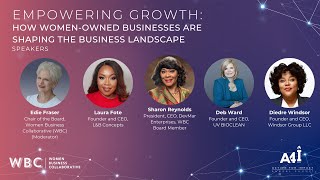
Empowering Growth: How Women-Owned Businesses Are Shaping The Business Landscape
WBC A4I 2023: CEO Excellence in Gender Equality and Diversity Awards Opening Remarks Day 2
WBC A4I 2023: CEO Excellence in Gender Equity and Diversity Awards Opening Remarks