DGTL Voices | Dr. Patrick McGill | I Don’t Have a Cloud Strategy
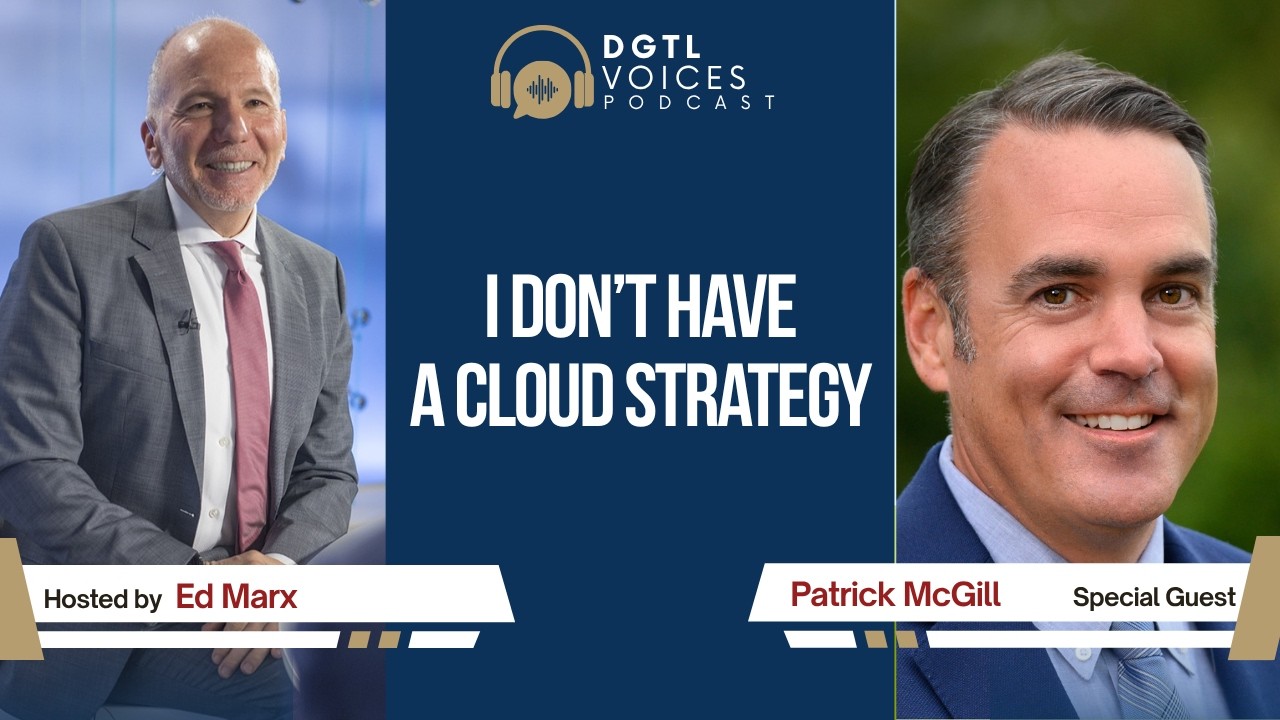
Dr. Patrick McGill, newly appointed CEO of Community Health Network, a $4 billion Indiana health system, discusses his path from family physician to leader. He emphasizes staying clinically active for credibility, building partnerships with Epic and Microsoft, and treating AI as a practical tool for automating repetitive work rather than chasing hype.
Chapters
We're a health system. We are people taking care of people. We have a healthcare strategy or a health delivery strategy. Yeah. AI is a tool in that health delivery strategy. My mantra has always been take care of today's work today and do tomorrow's work tomorrow. Every day it still is surreal that, you know, I'm responsible for 17,000 people in a $4 billion organization. We run a 24/7, 365 business and 99% of people don't wanna be here. It's not complicated. It's just be nice to people. And treat them like you want to be treated. It's not rocket science.
Welcome to Digital Voices, where healthcare and life science leaders explore the real work behind transformation. This podcast is about people, leadership, and the conversations that move healthcare forward. Now your host, Ed Marx.
Hey everyone, welcome to another edition of Digital Voices. Thank you so much for listening and watching. I know you have a lot of choices out there and you've taken some time to spend with me, and I'm super thrilled about that. Thank you, because I got another awesome guest, Dr. Patrick McGill. Patrick, welcome to Digital Voices.
Thanks for having me. Very excited to have this conversation.
Yeah, no, this is gonna be so cool because, you know, a lot of us have been in technical ranks or transformational ranks, CMIO ranks, and very few have gone on to become a CEO. Like, you're a CEO of a Like a pretty, you know, badass health system. And so, so I just want to talk a little bit about that journey because I know other people probably think to themselves, hmm, I wonder what it'd like be like to be a CEO someday, and can I do it if I'm a CMIO? If I'm a chief transformation officer, is that possible? So anyways, before we get too far into it, we've known each other probably over 10 years, you know, professional organizations, things like that. I've always watched you from afar. I've always admired you and You're a very profound person, so I always like taking notes and listening. That makes it double exciting for me to have you on. But the most important thing, Patrick, that anyone wants to know that follows Digital Voices are what are the songs on your playlist?
I'm an equal opportunity music lover, so I've got anything from country to pop to rap to R&B to, I mean, you name it. It's, uh, I use Spotify DJ all the time and it's funny because I'll get, A country song, I'll get a pop song, I'll get a rap. I mean, it's just all over the board. Sure, it would drive people crazy, but that's, yeah, that's why I love it.
Yeah, it's pretty cool. I, you know, we do have a playlist for on Spotify for Digital Voices, and we'll just add Spotify DJ because that, that's a nice little feature. Music-wise, like, did you ever grow up like playing an instrument or anything like that?
I did not. I am not mus— I am not artistically talented. I can't draw. I can't play music. I just, you know, I did my middle school band like you always have to. I think I played the drums because it was the easiest instrument to play and took no skill, or at least I had no skill. So playing the drums does take skill. Let me clarify that. But I had no skill. So no, but I didn't grow up in a musically or artistic family either. So I'm not surprised that I didn't inherit anything on that side.
Yeah. A lot of times, Professionals in the medical field, specifically doctors, have this music background. There was—
I know. Yeah. I have so many colleagues that play the guitar or play the piano or play other instruments. It's pretty amazing.
Yeah, that is cool. But you have other skills and we're going to get to that. What about life message or mantra? Are there sort of like quotes or words that you live by?
Yeah. And this is actually the quote that when I log into my computer, it's right there. It's the, it's the quote. It's always be better. And people, some people interpret that as a, Competitive nature. It's not meant to be competitive. It's always be better, always be the better person, always try to improve yourself, always try to improve whatever you're working in, the organization, the team, the project. Just always strive to be better. I mean, you know, it's kind of the 1% principle or whatever you want to call it. And my wife and I have been married 27 years, and she's the one that taught me that. Probably 27 years ago. And oftentimes, you know, you come home, you're angry, you're upset, or you're whatever. And she's like, just be better. Be better. Be the better person. Be the bigger person. And don't let things get you.
That's pretty cool, man. We should have your wife on and talk.
Yeah. Probably would be a much more interesting conversation than this one.
That'd be pretty awesome. All right. So you've told us a little bit about yourself already. Married 27 years. Sounds like a beautiful, spouse that you have. Tell us your story. Like, where did you grow up? Just take us from the beginning.
Yeah, I grew up on the north side of Atlanta, Georgia. So I'm originally from Georgia. I went to— I'm the youngest of 4 children. My parents didn't go to college. My father worked at the phone company. My mom was a bank teller. I have an older brother who actually got his PhD in chemistry. So that was kind of the first foray into higher education. My 2 sisters, You know, have various careers, and then me. So, you know, I went to University of Georgia, went to medical school in Augusta, Georgia at the Medical College of Georgia. It now has a different name. I still call it the Medical College of Georgia. So any MCG graduates that are listening will appreciate that. And then came to Indiana to do my residency in family medicine thinking I would go home in 3 years. And 25 years later, you know, Indiana has become our home. And so, you know, it's just kind of where life takes you.
Yeah. Have you ever thought about, like, with your siblings, because I'm in the same situation, I'm youngest of 7, my parents did not have any higher education. In fact, one of them had no high school degree until she got her GED when I was in high school. How did you all become so focused on higher education?
Yeah, I think because of my parents' background, it was always an expectation that we would go to college. And so from early in my career, you know, early in my childhood, I should say, we just always had the expectation that going to college was not an option. And our parents worked very hard to, you know, provide for us and give us the ability to go to college and go on to graduate degrees if we wanted. And it was just something that I don't remember it ever being a choice.
Yeah. Yeah. It was the same with us. It's kind of funny. It was like, you're going to college. I just knew that, like it was wired in. So it was very natural. And all 7 of us went off, you know, and got, Degrees like your siblings. That's pretty cool. Was there a pivotal moment in your life that fundamentally changed your trajectory?
I think there's 2 for different reasons. And so one was the first practice that I ever joined. I tell this story quite often. The first practice that I ever joined, I was working in urgent care after I finished my residency. I was actually looking for jobs back in Georgia, and there was a physician who had been a family physician for about 25 years or so, who was killed in a plane crash. And he was in a small town north of Indianapolis in Indiana, in Pendleton, Indiana. And the hospital that I was working at urgent care called me and said, would you cover the practice? And I said, sure, I'll cover it. I'm not doing anything else. I'm working this urgent care. Thought I would do it until they found a permanent person. And 6 years later, I guess I was the permanent person. And then that was when I came to Community Health Network. So I often tell that story because People ask, what's your greatest leadership lesson? And that was the greatest leadership lesson, even in the rest of my career. Taking over a practice with grieving employees, grieving patients, you know, learning— I didn't know the people, I didn't know the practice, I didn't know the physician. So kind of walking in thinking, I'm a new physician, young physician, I'm going to take care of diabetes and hypertension. And really, I had to learn to take care of people.
Who
had diabetes or had hypertension, but it was really taking care of people. So that was the greatest leadership lesson. I think that changed kind of fundamentally how I think about leadership and how I think about— now, if you ask career pivotal moment, Yeah. it was really when we installed Epic in 2012. I was a busy family physician. I was the medical director of a couple nursing homes, and, you know, had thousands of patients I was taking care of. And we installed Epic. I had heard these horror stories about EMR installations and how they ruin physicians' careers and burnout and all these other things. And I just said, it's not going to ruin my life. I got a good thing going on here. I got a lot of patients. I'm busy. I'm doing well. You're not going to ruin my life with this EMR. So I was asked to get involved in informatics. I became one of the early physician builders with Epic. And I think that kind of changed my career, obviously, because it put me on the path for informatics. And then that led on to other other things. And so, uh, just saying yes and opening the door to doing something different, I think, is probably the pivotal moment for me. Yeah,
that's very cool. So you were talking about your siblings. They chose— they went to higher ed, chose different paths. You chose healthcare. How did you come to that decision?
I often tell people, I— a lot of physicians have kind of the heart-tugging story of, of why they went into healthcare, why they went into medicine. I don't have that story. I, as a child, I wanted to be a high school student. I wanted to be a pilot in the military, in the Air Force. Got accepted to the Air Force Academy, and the liaison called me and said, congratulations, you got into the Air Force Academy, but you know you can't fly because you didn't pass the vision test. Right. I said, well, I don't know that I want to go to the Air Force Academy because they make pilots and engineers. And he said, well, what do you want to do? And I said, I have no idea, but maybe being a doctor sounds challenging. Going to med school sounds, you know, interesting. It'll challenge me, you know, academically. And that was it. That's how I chose. I didn't know— no physicians in the family, no nurses in the family, no really healthcare in the family. And I really chose it because I thought it would be a challenge. I chose family medicine for kind of the same reason when I was in med school. I did some rotations, especially in South Georgia, and experienced physicians that had taken care of people for a long time, 20, 30 years, multiple generations. Originally, I thought I wanted to be a neurologist and came home one day and told my wife, I said, I want to be a family doctor. That's the kind of doctor that I want to be, to take care of people throughout their life, throughout their career, you know, throughout their generations. And that's why I chose family medicine.
Did you meet your wife in college or did you know her before that?
Nope. I met my wife in college. We were on blind dates with other people and then just kind of connected and, yep.
Wow.
Connected and said, we need to dump these people and let's go out on a date together. And that's how we met.
That is awesome. Did you ever envision yourself like as a CEO? So here you are, young person, you know, you've You're doing— you became a physician and now you're family med. And then did you ever think, hmm, someday I'm going to be a CEO of a health system or this health system? Because you've been in the same one.
I've been here 16 years. And, you know, the interesting thing about Community is it's been in existence 70 years, and I'm only the 5th CEO ever in 70 years at Community. So I've been here 16 years. You know, the previous CEO was the CEO the entire time that I had been here. Never really thought of myself As being a CEO, that was never my career trajectory. But again, administration was never my career trajectory either. And so as I got higher and more senior in the organization, I think it became more and more of an opportunity, not knowing what was going to happen in the future. And to be quite frank, I mean, I've been in this role for 4 months. Every day it still is surreal that— I wake up and I'm responsible for 17,000 people in a $4 billion organization because I still see myself as that family doctor taking care of people in rural Indiana or rural Georgia. I mean, it's just, that's how I see myself.
Yeah, that's amazing. Yeah, you're very humble. That's what one of the other things I like about you, very humble servant-type leader and very caring. So that's, I really appreciate that. Was there a person in this journey that helped you see who you could be? You know, sometimes people talk about imposter syndrome and other things like that, but was there someone along the way that sort of like, hey Patrick, you, you know, broadened your vision maybe a little bit?
Yeah, I've had many people along the way that have been very supportive. I mean, I've had a lot of great, I, one of my kind of leadership mantras is like, surround yourself with great people and get outta the way.
Yeah.
And, you know, so I've had many, many people. I mean, the one person that it, you know, it sounds obviously it sounds staged, but I mean, the one person that's always believed that I could do anything I put my mind to was my wife. And I think that when you need to have that person in your life that when you have a bad day, when you're thinking, why am I doing this? Or should I even be doing this? They can kind of prop you up and say, you're doing the right thing. Stay strong, stay focused. You you can do this. You've got this. Whether it's your spouse, whether it's a colleague, whether it's a friend, whether it's a family member, doesn't matter who it is. But everybody needs that person that can help them stay grounded, but also stay focused because you've got some bad days.
Yeah.
No matter what role you're in, even if you're just a practicing family doctor, there's days you go home and you think, man, today was rough. But You know, somebody to remind you that you're doing the right thing.
Yeah. That's great.
But also somebody to be honest with you when you're not doing the right thing. Yeah. I think that's the other part of it.
Yeah. Oh, we're definitely having your wife on now, Patrick. Uh, she, uh, she sounds pretty amazing. So as I mentioned early on, you, you have this unique sort of career trajectory where you were in informatics, you know, physician practicing informatics transformation. And how have those roles helped you now as a CEO? And I know you're early in your CEO tenure, but how have those roles helped you, you know, in your day-to-day?
Yeah. You know, so a couple of things. One, it's funny when I, when I've seen people after I've been in this role, you know, at meetings or what, they'll come up and be like, wow, CEO. And I'm like, I don't know. I'm not sure how to interpret that. Should I interpret that as, wow, I can't believe you became the CEO, or Wow, I can't believe they gave you the job, or your background. So you always kind of have to take that with a grain of salt. But I think most of it's positive. I think, and I do still practice, I see patients on Mondays. And so I think all of that background, the informatics, the analytics, the transformation, the seeing things different, the continuing to practice, what it does is it gives you a lot of credibility. When you're talking about change, when you're talking about some of the challenges that we have in healthcare today facing us, you know, I was at a meeting on Monday, we were talking about a topic and, you know, I was the only one who still practiced clinically. I wasn't the only physician in the room, but I was the only one who still practiced clinically. And it was very powerful to say, this is what's going on in the exam room. This is what people are dealing with. This is what it's like to still deal with prior auth or, you know, AI at the bedside or whatever it might be, I think it gives you a lot of credibility, but it also, that background with everything that we talked about with what we need to do with AI and transformation and doing more with less, I think it does give you a very powerful seat and a very powerful perspective on what needs to happen. And again, finally, it allows you to talk the talk and walk the walk. And I think that's very, It creates that authenticity that people are really looking for in their leader.
Yeah, no, I love it. You're very unique in that position, being a practicing physician and then having that background you just talked about, because you could be on stage and I've heard you before and you'll sound like the most learned and eloquent chief digital officer, chief transformation officer, and you understand all that. And now you're bringing all that together in a CEO role. That's pretty powerful. So not to discount other CEOs who come through more of a traditional, but it is very unique and I think very cool for your organization and the community that you serve. So speaking of your organization and community that you serve, tell us all about Community Health Network. You mentioned already $4 billion, 17,000 employees, but tell us a little bit more.
Yeah, we've been in existence 70 years. We really were started and founded As a community-based health system, it was a people went door to door on the east side of Indianapolis to raise money to build a hospital because there was no hospital services there. So that's how the name came about. People confuse us with as a community center. It's not. It's I mean it's again it's four billion seventeen thousand. We got five soon to be six hospitals. You know we're the market leader in women's. Our our north hospital delivers the most. Babies for 11 years in a row. We were a market leader in oncology, CV services, primary care, behavioral health. We've got a lot going on in a very competitive market in Central Indiana. We're not an academic center, but we do have residencies. We're engaged. We're one of the 7 or 8 MD Anderson partner members for cancer. So really innovative when it comes to clinical care. And the thing that I'm most proud of, we have, I would put our patient experience scores literally up against anybody's in the country. We didn't, we have not always been that way, but about 12 to 13 years ago, our scores were not good. And that's just not who we wanted to be. And we put energy and effort and we turned that around. And I think that's at the end of the day, We can talk about margin, we can talk about size, we can talk about how many buildings we have, but it's, are we taking great care of people, the people that we serve? That's really what matters. And that's where, quite frankly, we excel. We've been named the number one large employer in Indiana by Forbes. I think we're very proud of that. So we're a great place to work. We're a great place to receive care. I think we're number 29 in the country. When you think about all the companies in the country, that's pretty amazing for a health system in Indiana to have that designation. And we're very proud of that. We've put a lot of focus on our caregivers. That's the last thing I'll say.
Yeah.
We call everybody at Community a caregiver because whether you're laying hands on people or not, or whatever role that you have at Community, you are involved and you promote and take care of people. Whatever function it might be, it might be food service or environmental service or billing or IT. You're a caregiver because your role is important to take care of people.
Yeah, no, that's well said. And that's super impressive. I'm definitely going to come visit you someday.
Okay, let's do it.
I'll be knocking at your door. So, yeah, any other clues how you build that kind of a culture? So whether it's the patient experience or the focus on your caregivers, What sort of things happen there that maybe like someone listening who's where you were 12 years ago and scores weren't so great, what are maybe 1 or 2 tangible practical things that you think about?
I think the message and the focus is a lot of people get it, and I get this question quite a bit. We need to change our HCaPs or CGCaPs, or what do we need to do? Just chase a score. It's like we're not chasing a score. We're chasing an experience and an experience that people expect and deserve. The score is just a yardstick of how we measure that, right? But at the end of the day, we're really focusing, and I think it comes back to the message, right? It comes back to how you deliver care, how you take care of people with respect and dignity. We often say we run a 24/7, 365 business. There's not many people that can say they do that. And 99% of people don't want to be here. 99% of people are having the worst day of their life. They're either at the end of their life or they're getting a terrible diagnosis or no news. Unless you're having a baby, that's about the only time that you're really excited to be at the hospital. And I think that's difficult. So it takes a different mindset and a different culture, and you have to frame it that way. We're dealing with people in some of the worst experiences of their life and trying to create an experience to treat them with dignity. So at the end of the day, it's not complicated. It's just be nice to people.
Yeah.
And treat them like you want to be treated. It's not rocket science.
I know a lot of times where I will spend millions and millions of dollars on a consultant and it's just not—
Just be nice to people. Sit down when you're talking to them. Listen when they talk to you.
Yeah.
Make eye contact. I mean, it's, this is, these are basic human principles.
Yeah.
That people want and desire. And I think that's, we often lose that.
Yeah. So you are also known for these partnering, and you mentioned one of them, MD Anderson. So tell us about sort of that philosophy of sort of partnering outside of yourself in order to do the best, make the best experiences as you're talking about.
Yeah, one of the things we learned a long time ago is we can't be all things to all people, the best of the best of everything. So let's partner with the best of the best. So we went out and partnered with MD Anderson. We obviously went with the best EMR of Epic. We partnered with Microsoft, which I argue is the best in that world. When we wanted to improve and really up our game with experience, we partnered with Qualtrics. So we really have tried to kind of go with the best of the best to raise our own standards and raise our own game. Now, that's not to say that we don't— I think one of the things that we have and that we do well is we also partner with early digital companies. And we'll obviously, this is Digital Voices, so we'll talk about digital. You know, we don't have an investment arm, we don't have a venture fund, but what do we have? We have 17,000 people that are engaged in taking care of people. We have a million patients. We have the right mindset. We're big enough that we can be meaningful, but we're small enough we can still be nimble. And I think what we bring to the table oftentimes is the sweat equity, the sandbox, the learning. And I often say, if you can solve digitally, if you can solve the problems at Community Health Network, you can solve them at 95% of the health health systems in the country. If you solve it at one big name, you've solved it at one big name. If you solve it at another, you've solved it at another. We represent kind of where most care is delivered in the country. And I think that's a unique perspective that we can bring to the table. And we've leveraged that, right? We've leveraged partnerships, we've leveraged the ability to get technologies that we otherwise wouldn't be able to afford or otherwise would be too early for us to deploy.
Patrick, you already used up all the white space on my notes. I don't know that we might have to end this early. You're like just blowing me away here. No, those are some profound things. And again, yeah, majority of care is delivered in places like community health network. And so yeah, what you're saying is spot on. Oftentimes I think people get intimidated. Well, because we're not so-and-so, you know, some AMC or something, but no. And like you said, those are one-offs and we love them to death and everything. But they're one-offs. And so if you're an early stage or any stage really company, places like community health is where you want to be. You opened up the door on the digital, so I have to ask one question around AI. And so again, you're uniquely positioned given all of your background. So what is your strategy around the adoption of AI?
Yeah, we are bullish but also cautious, right? We are realistic about what AI can do and what AI cannot do. We've launched ambient listening, we've launched AI in RevCycle, we've launched agents for phone, and we've done all the things that everybody else is looking at or doing. One of the things that I have tried to change the narrative on is let's stop talking about AI. What's your AI strategy? We're a health system. We are people taking care of people. We have a healthcare strategy or a health delivery strategy. Yeah. AI is a tool. In that health delivery strategy. We have a workforce component to that. We have operational components. I don't have a cloud strategy. I have a healthcare strategy. AI is just one tool. Cloud is one tool. So I think if we lose sight of that, that we are still people taking care of people, that's the first thing. The second, but again, it's not to say that we've shied away from AI. We've actually leaned in. The second thing I tell people is we have reframed how we think about messaging of AI in that when you talk to people about AI and what can it do or where can AI help you, people really clam up, which is interesting to me because AI is in our world everywhere we go, right? From GPS to our phones, to Alexa devices, to our TVs, everything. Even the digital Spotify DJ is AI-driven, right? Don't shy away from it, but let's reframe it from that human aspect to say, tell me the things that are repetitive that you have to repeat every week, right?
Yeah.
What takes you an hour, 2 hours, 5 hours, 10 hours? Or what are the things that when you open your computer, you're like, oh my God, cannot believe I have to do that again. Perfect for automation or AI. And I think that's where For our workforce, if we can reframe, we get a lot more engagement and insights and opportunities versus, hey, Ed, tell me where AI can help you.
Yeah, that's a really good perspective. I remember you speaking on that before AI was so in vogue a few years ago, and you were just talking about, yeah, it's a whole, it's a strategy. You have one strategy and there's different subcomponents or pieces or tools. How do you, I wanna switch now sort of leadership and back to a little bit personal. How do you manage multiple priorities within work, play, family, and stuff like that? How do you do it?
Focus and don't procrastinate. So be present when you're present and focus. Obviously, I keep lists, I keep calendars, I keep to-do lists and all that. But I think procrastinate— I've never been a procrastinator, and I think that has enabled me to stay ahead. When you've got multiple priorities, high priorities, The more you procrastinate, it's just going to put you behind. And so my work mantra, when I took over running a— when I went into practice, people would get upset and they would say, well, we've only got 30 appointment slots today, or we've only got this. Or my mantra has always been, take care of today's work today and do tomorrow's work tomorrow. So if people need you, if they call you, if they email you, if they, whatever it is, take care of today's work. See patients that same day and see the patients tomorrow, right? Tomorrow's patients tomorrow.
I like that a lot. So, Patrick, speaking to non-clinician leaders, Digital Voices reaches the entire C-suite now, but, uh, so it doesn't have to be specific to a tech person. But speaking to non-clinical leaders, what, what is something that as they're raising themselves up, you know, eventually maybe, uh, your C-suite, in the C-suite with you, what, what is one thing that you would share with them that would help them be the best executive they could be?
I often share this with new emerging leaders. People ask, what's your leadership advice for people coming up? And what I often tell them is influence, and influential leadership means way more than any title that you have. So what do I mean by that? We have 17,000 leaders in this organization who can influence others or influence behavior, influence patients, influence Whatever. We don't have 17,000 CEOs. We don't have 17,000 chief operating officers. We don't have— so people sometimes get hung up on this hierarchy of authority, but it's really, at the end of the day, it's about influence. It's about leadership and all of that type stuff. I think that young leaders often think, well, I've got to be a director. I've got to be a VP. I've got to be this to be a leader. No, you can influence and lead And oftentimes even be more powerful as a leader by a, by a, you know, kind of a grassroots leader.
Yeah. So true. Hey, this has been so fascinating. I have so many more questions to get to, but sadly not enough time. But we covered a lot of ground, everything from the playlist and the Spotify DJ capability, and then always be better. Always, you know, improve upon yourself. Your mantra when you open your computer every day. Pretty awesome. We talk a lot about you growing up in Georgia, eventually getting to Indiana. Meeting your wife on a blind date, but she wasn't your date, she was someone else's date. But married, it's worked. It's been 27 years, 4 kids. Parents were pretty awesome, it appears. Didn't have an education, but definitely raised you and your brothers and sisters to have an education, and that kind of formed who you are today. We talk a lot about your pivotal moments in the transition that you got to, really about leadership when you were given an opportunity to lead a practice, and then you not only had to deal with that, but grieving patients and grieving staff and kind of work through that. Great leadership lesson for you early on. And then we talked about a whole host of things, but your wife kept coming up. So you should definitely give her a copy of this podcast.
I will. I will.
She'll be, thank you. Thank you. Thank you. And then we talked about how the roles, your previous roles have really influenced what you do today. We talked a lot about the organization, Community Health Network, and how you partner and do great things for your community. I was really impressed with The phrase that you use that you don't chase a score because we're talking about patient experience, but also talking about employee experience or caregiver experience. But you said don't chase a score, but experiences, and the score will be a natural outcome. Be nice to people came up multiple times, which is so true. That's really key to everything in life. Can't do everything by yourself. So you're really big into partnering with other organizations that have helped you along the way. And then talking a lot about influence. Influence. Has no title. There's no boundary to influence. You can influence from any role in the organization. And then we talked a lot about priorities and, you know, be present, focused, don't procrastinate. Another key thing that you said is do stuff for today for today and tomorrow stuff tomorrow. So all brilliant things. What did we miss or what do we need to double down on? Patrick, I'll give you the last word.
I think you summed it up. The one thing I would say is there's a lot going on in healthcare, right? We have a lot of headwinds. We have a lot of challenges. We have a lot of priorities. We have a lot of things that we have to address, but I'm 100% confident that we can do this. We've weathered storms before when this was going to be the death of healthcare, as we know, and everything else. We got this. We know what good quality, high-quality healthcare looks like. We just need to keep striving and we need to keep looking forward and we can do this. We just need to do it together.
Patrick, you're an amazing leader. I'll say one last thing. I just happened to sit next to some people in your organization, some other caregivers in your organization. And so I was talking about you, and they had nothing but positive and glowing things to say about you. So I hear from so many different people. Thank you for being our guest and sharing yourself on Digital Voices.
Yeah, absolutely. It's my pleasure. Thanks for having me.
Thank you for listening to Digital Voices. We hope today's conversation Sparked ideas, reflection, and connection. Subscribe on YouTube, Apple, and Spotify Podcasts so you don't miss an episode.
More from Edward


EdTalks | Episode 185 | The Power of Executive Storytelling | Clifton Blue Parker



EdTalks | Episode 184 | What If Being a Misfit Is Your Superpower? | Kevin Johnson