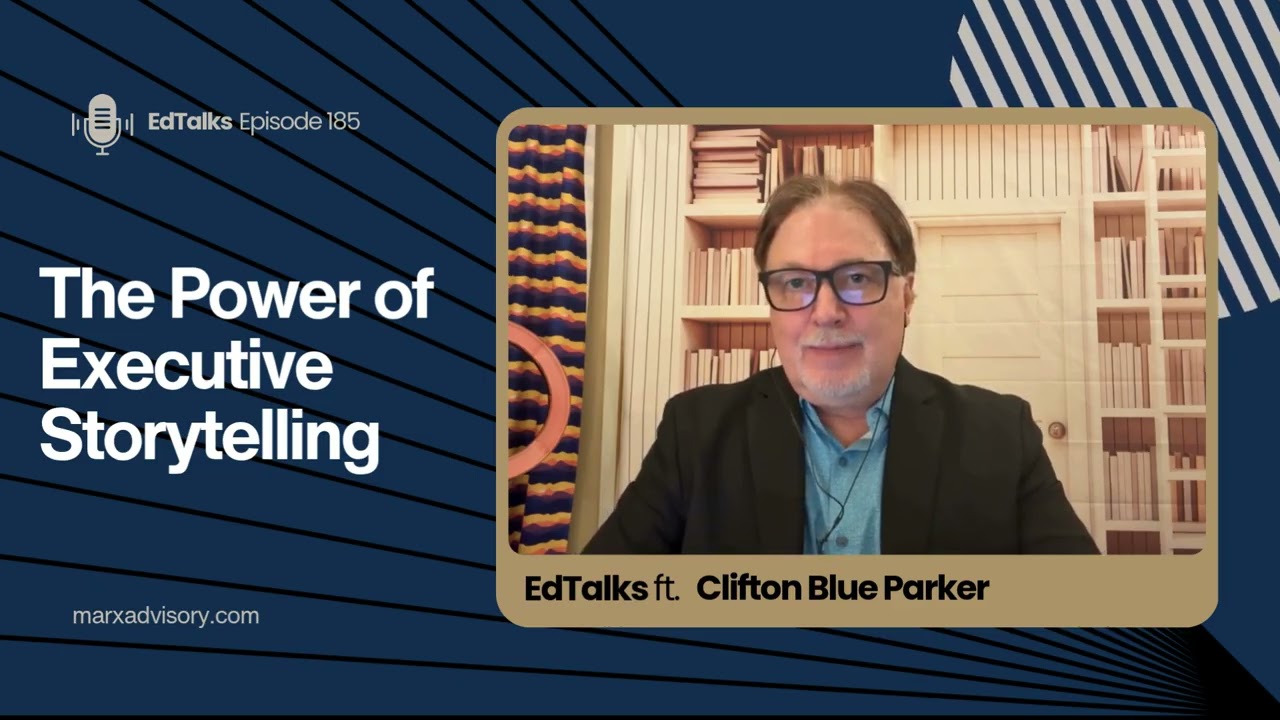
In this EdTalks interview, host Edward Marx welcomes Clifton Blue Parker, an executive communications consultant at UC Davis Health and author of three baseball‑history books. Parker outlines his career path—from a Capitol Hill press secretary to a Stanford communicator and now a health‑system storytelling strategist. He explains his philosophy that executive communications should give leaders a distinctive, human‑flourishing‑focused brand, moving beyond routine institutional news to patient‑journey narratives that enhance reputation and community impact. The conversation explores the tension between personal branding and institutional loyalty, with Parker advocating freedom of choice but emphasizing the value of a leader’s “extra gear” in shaping national conversations. He advises executives to adopt an innovation‑driven, startup mindset, quoting Benjamin Franklin: “write something worth reading or do something worth writing about,” and to tie that innovation back to humanity. The interview also touches on Parker’s side passion for baseball history, highlighting his research‑intensive books on 1920s‑30s players, and briefly mentions his two daughters. The episode concludes with a call‑to‑action to access Parker’s contact info and book purchases.
Chapters
Welcome to another edition of Ed Talks. This one's super fun. Clifton Blue Parker, welcome to Ed Talks.
Thank you, Ed. Great to be here.
This is super fun because we're gonna delve a little bit into what you do today, what you're doing sort of on the side, but also kind of like a little bit about your authorship. You, you write these books and it's like super interesting. So we're gonna unpack all that in 5 minutes or less. So I know that you're an expert in executive communications and that's how we met. So I had your CEO, UC Davis, on a podcast. He was great. He was super well prepared and it was probably because of you. And, uh, and I know you have a passion for storytelling that probably comes with, you know, storytelling with substance, and that probably gets wrapped up a little bit in some of the baseball things that you do. But tell us about yourself.
Well, I've worked on Capitol Hill. I did that early in my career as a press secretary in Congress and at Stanford University as a communicator. And now At UC Davis Health. And I am opening up an executive communications consulting operation. My passion, mentioned it a little bit, is in terms of like baseball history. So I've written 3 different books on baseball players from the 1920s and 1930s, and which involved a lot of research and into old newspapers and so forth. And I have 2 daughters. One is at Harvard in their MBA program and another one's on the beach in Charleston, South Carolina. I don't know which one should we pick to
Yeah.
And spend time with. So I'm proud of them and great to be here today.
Yeah. I love this topic because I think it's a need for every executive. And for whatever reason, we kind of rely on the success of our past and don't continue to hone our ability to communicate or tell stories with substance. And so that's why I really wanted you on. So what's your philosophy on executive communications?
So when I look at executive communications, I look at it as a way to set that executive apart and make them distinctive in their marketplace. So I think the concept, the larger, the next level concept is human flourishing and what that means for patients, the communities that we serve, our employees that we work with, our teams that we work with. And it's about shifting the larger narrative from the routine kind of institutional news, which is an obligation of every leader to be part of, and that's totally okay. But what if we go beyond to aim higher and reach higher in terms of their branding and talk about things beyond what always takes place in the hospital and what the technology can do and kind of focus on the ultimate outcome for the patient that we're caring about and how that care helps help them go on with their lives and live in a in a more enhanced and empowered way. So stories about the patient journey from the beginning to the outcome, the positive outcome, are, I think, really important in shaping a health system reputation and brand among the different people they serve. So in terms of the executive, I think it gives them a distinctive edge in the marketplace that they're thinking about And talking about things that mean a lot to them and how what they're doing to help that human flourishing come about.
Yeah, I love that clip, Dan. And I think about 70% is my guess of executives would be, yeah, I should have a brand that's sort of my own, that's distinct, definitely complementary, but distinct from my organization. But there's going to be about 20%, and they're typically in powerful positions because I've run into them, and they're like this.
Yeah, right.
Crossed arms for those who can't see. And very resistant in saying, oh, you should never have a personal or professional brand. It's all about company XYZ. What would your response be?
Well, it's perfectly okay if an executive sees their role as being a caretaker of the institution and to follow a more risk-averse kind of strategy in that way. That's totally an individual choice. So Certainly, like, my type of philosophy should not be imposed on anyone. But I think what executives who really want to make a difference and get into the national conversation on healthcare, and I've worked for people like that, and I admire their love to go out, to talk to people, to have these conversations that mean so much. And I think that Ultimately, people are happier and I think more productive when they feel their leader has that extra gear to put into motion for the entire institution. So I think it's reflected down onto the employee workforce and can be a very positive attribute. And they know they have a game changer at the top. So if you're a game changer and no one knows about it, that's not going to do much good. But if you're a game changer and you're doing terrific things as a leader, then let's get the word out. Let's tell everyone about it. You can tell the world and people will welcome that. People embrace that.
Yeah. That's what I'm picking up from your comments is that it's okay to be either or, but give the other person the freedom to be who they are. And there's advantages to both. Yeah, I think that's great. Okay. I'm going to put you on the spot. One more quick question. So you've worked with a lot of executives across all different industries, but what is the one thing that you might counsel, like throw out there for our audience that's watching or listening? Like what's one thing that they should be thinking about that maybe the average executive doesn't think?
I think, I think our market is driven by innovation. So I think companies that are changing, doing things new and different, health systems that are offering something new and different and innovative. That is going to drive that company forward and that executive forward. So I think it's really important to have that type of dynamic startup mentality in a health system or in a tech company or in a local elementary school. So I think we always have to be self-critical and look inside. How can we do things differently today? We don't have to be wedded to doing things that The same way for year after year and so forth. Benjamin Franklin had a very good quote on that. He said, either write something worth reading or do something worth writing about. So when we're doing things that are worth writing about, there you go. That's the material that an executive can shape their brand with. And it's happening all over this country. We have a very dynamic, robust marketplace in many different areas, and healthcare is one of them. And I think that that focus is important in our day and age. And then tying that back to the humanity of the human flourishing too. Like what does this mean for human beings, for our patients and our communities? And tying that innovation back to humanity and how this is going to be a positive thing. And that, I think that is the next level type of executive communications that I would advocate for.
Yeah, I love that. Super practical. Clifton Blue Parker, we're going to put all of your contact information, including how to buy your books on the history of baseball stories in the show notes. Thank you for being my guest.