How I Prepare for a BRUTAL Euroleague Season - Off-Season Plan
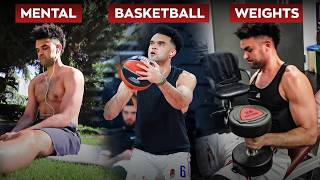
In this 20‑minute video Elijah Bryant, a EuroLeague and NBA champion, walks viewers through his seven‑year‑refined off‑season system. He splits the summer into two phases: Phase 1 – Rest & Reset, where he prioritises mental recovery, family time, film study, light active‑recovery and nutrition; and Phase 2 – The Ramp, a six‑week progressive program that blends weight‑training, low‑impact cardio, and basketball skill work. Bryant details a weekly template (basketball, weights, cardio on specific days), explains why he chooses movements that transfer to the court (trap‑bar deadlifts, Bulgarian split squats, lateral lunges, landmine rotational press, depth drops), and describes his cardio strategy to boost VO2 max while minimizing joint impact. He outlines his skill‑work methodology – 30‑45‑minute focus blocks, high‑repetition habit formation, shot‑mechanics analysis, and simulated game‑fatigue shooting drills. The video also covers mental‑performance habits (meditation, yoga, ice baths, confidence‑building systems) and how he tapers into preseason with explosive, low‑volume lifts and concise, high‑intensity basketball sessions. Throughout, Bryant emphasizes confidence as a skill built through preparation, repetition, and embracing discomfort, and invites viewers to sign up for a free newsletter with detailed workouts and nutrition guidance.
Chapters
Hey guys, just wrapped up my EuroLeague season and Turkish League season and finally have some time to breathe. I wanted to share with you guys exactly what I've learned over these last 7 years of playing professional basketball. I understand that a lot of people see the flashes and the lights and the big scoring games or the big performances, but all this happens during the offseason. So I'm going to share exactly what I've learned over these last 7 years that have helped me become the player that I am. I have already achieved some huge milestones in my career, like becoming an NBA champion with the Milwaukee Bucks in 2021, and then a EuroLeague champion with Anadolu Efes in 2022. But for me, there's always room for improvement. There's still a lot I can do to learn from and improve each year. During the season, we play so many games that there's hardly any time to focus on real skill development. That's why for me personally, the offseason matters so much and is so fun because it turns into like a video game for me. It's when you get to work, really work on becoming a better version of yourself in the weight room and on the court. This summer, I wanted to bring you with me and teach you all the tips and tricks to eat healthy on the court and be able to peak during your season. Whether you're trying to make the jump from D2 to maybe D1, maybe get more minutes in high school, a recreational hooper, or a fellow pro early in your career, I hope these insights can help you in your basketball journey and maybe even in your life too. So let's get into it. Here's how I set up my offseason in two main phases. Phase 1: rest and reset. Phase 2: work. It's super simple, but the work ramps up slowly during the summer, allowing me to be able to be ready for preseason and use that preseason as a way to get ready for the season. So the work consists of weights, basketball, cardio. In this video, I'll be breaking down the following: how I structure my weeks in terms of basketball, weights, and cardio, which exercises I do and why, and how I ramp up, what I'm focusing on mentally, and most importantly, the goal behind each phase. And stick around till the end. I put together everything that I know up to this point to build your confidence on and off the court. And of course, yes, it's free. All right, now to phase 1. The first things first is people don't understand basketball is very stressful mentally. And physically. So you need to decompress, eat the junk food, watch the TV shows, play the video games, relax, go on vacation, decompress. My body and mind are beat up after a long season. Yours are probably too. So the first 2 weeks back home are all about this right there. My wife, my kids, that, that's my rock. That's what gets me through the season. So I need to refill their cups and refill my cup. This time is for family and friends and honestly mental health, which is so big. Now, I honestly don't pick up a ball for probably about a week, don't touch a weight for a week. I do use this time to study film, reflect on what I do well and what I can improve on next season. So for example, on the flight back from my last team, I'm watching film and digesting exactly what I want to work on during the summer. And I'm also doing that during the season, watching NBA games. But specifically, once the season's over, I can actually digest and break down percentage-wise what I did well, what I didn't do well, what I do most to really hone in on my workouts. So during the summer isn't just about basketball. I want to use this time to reflect on all aspects of life, like mental, physical, spiritual, because all those things add up, allowing me to have the bandwidth to perform at the highest level when I get on the court. I still have some low-intensity routines like light jogging, yoga, meditation, or maybe some other activities golf, swimming, just to kind of active recovery, keep the body moving. But most of this stuff is more for the joy, to refill my mental health cup, not for the gains. Phase 2: the ramp. So when we hit the ramp, we're starting to, in the beginning, develop a base. Most athletes go into the summer thinking, I'm just going to kill myself every single day. No, you have to give yourself time to reset. So as we're ramping, the first few days, you know, push-ups, sit-ups, pull-ups, all basic stuff to get the base. So what does a week look like this for me during the ramp phase? Monday, basketball, weights, cardio. Tuesday, basketball, weights. Wednesday, off completely. Thursday, basketball, weights, cardio. Friday, weights, Basketball Saturday, shot mechanics Sunday, all for the Lord. But you get it. My ramp-up phase in the offseason is typically, I would say, around 6 weeks. And I keep this schedule the whole 6 weeks, give or take. Obviously, of days like last year, flat tire or emergency situations come up. But in order to get consistent gains, you have to be consistent in your systems and your routines. I strongly advise you to keep a calendar like this. I do my work in the mornings and keep my afternoons free for, you know, refilling my cup with family and developing those long-lasting relationships. But I know my mornings are for preparing my body for next season's success. So how does it change over the 6 weeks? Early on in the offseason, we're doing the basics. We're developing the foundation of your house. Push-ups, pull-ups, lunges, all the basic stuff to shock the body before I move in for the gains. Cardio, I like to do bike or VersaClimber, but it all depends on where I'm at or working out. The main goal is to get off my feet but limit impact. The season provides so much impact on your body that when you have the ability to do a cardio that is not pounding your body, do it. Mentally, I'm just focused on resetting and enjoying every day as I get into my offseason rhythm and actually just being back in America. For basketball, I'm doing a lot of shot mechanics along with spot shots to start the offseason, along with specific things I want to work on skill-wise. For example, I want to really focus on being more efficient this, this next season. So I want to be able to master the turnaround jumper like Shea or Jalen Brunson. And the reason is, is I want to be able to identify my mismatch and get to that to make the highest percentage, not only shot but read. So if I have a smaller guy on me like Shane in the post, then I want to get a turnaround jumper knowing he's going to possibly swipe down. So bump him to get away, get to the shot, or bump him, go middle, know the help's going to come, and then throw it away. You see what I'm saying? Like, so being very intentional in the basketball skill workout, knowing what I have coming for me in terms of who's guarding me, who's hedging, Are they in drop pick and roll? That type of— so simulating that in workouts. So I'm doing this type of stuff for probably around the first 2 weeks, you know, getting the foundation, building it up, laying the cement and letting it set, right? Being sore— these are the days when you sit on the toilet and you're sore, and that's perfect. That means the foundation is being laid. So now we're about to hit the ramp-up phase where we can actually start getting gains, and this is where we start, you know, adding weight and the soreness is gone, and now it's time to really get it going. So now I'm starting to look for actually gains in the weight room, trying to become more explosive, I'm trying to get stronger, all of that. The goal of these weeks physically is to gain muscle and VO2 max. A higher VO2 max means you can work out harder and longer before getting tired. Cardio, I'm doing anything off my feet like we said before. I want to save all my pounding for my body on the court. This can consist of bike, swimming, VersaClimber. I want aerobic exercises to help boost my VO2 max, basically make me run longer than the next person. In the offseason, I like to focus on lifting movements that actually transfer to how I move on the court. So I'm not going to be doing back squats because that doesn't transfer to how I exactly move on the court. One of the staples in my training is the trap bar deadlift. It helps build kind of strength and power I need when I go for rebounds or finish strong at the rim playing off two feet. I also put a lot of emphasis on rear foot elevated split squats or Bulgarian split squats. Since so much of basketball is played off one leg, like attacking the basket or absorbing contact. The single leg work helps me stay strong and balanced for when I get bumped off my line or jump to go and finish. Another key movement I focus on is lateral lunge, which helps me build strength and control in side-to-side movements, especially when guarding or changing direction on defense. For core and rotational strength, I use the landmine rotational press. It helps me generate power when I'm turning midair or finishing through contact. I also make sure to include depth drops and stick landings to train deceleration, which is so crucial in basketball. Because if you watch Luka when he plays, everyone says he's not athletic, but watch how fast he can stop. Him and James Harden, according to P3 data, are one of the most elite at stopping. They're anomalies. It's crazy. Go and check it out. For basketball, I break my workouts into focus blocks, usually 30 to 45 minutes where I'm doing the same move over and over and over. So we talk about, oh, we want the Jalen Brunson bump to the shot, or the fade bump to the shot. We're going to rep that out for 30 to 45 minutes straight, no break. After that, we're going to shoot some free throws, get some water, and then we're going to come back and do a counter move to that. The reason I'm doing that is I'm trying to connect new neural pathways to form new habits. That's what the science says. In order to form new habits, it's repetition. So I'm not in there doing a bunch of crazy moves. It's more so to rep a move, because when it comes to crunch time, you revert to your habits, and I'm trying to build new habits. So I changed my training about 3 years ago, and I felt that that was better for me. It was more intentional and it had more purpose, and I got more out of it when I came to the season. And mentally, I'm basically just focused on being more present, sticking to the systems, and creating better habits. For instance, when working on shot mechanics, it's not only about actually making the shot, but knowing what system is creating this shot and what is the result. So if I shoot it and it goes back rim, Why did it go back ramp? Did I not have my index finger out? Did I not hold my follow-through? It's seeing the pattern and noticing the result and trying to change the pattern and change the result. If the result was back ramp, okay, let me try to get it swish. Oh, it's front ramp now. Hmm, why was it front ramp? Did I do this? Did I do that? And then trying to create the same pattern over and over. I think when we're result-driven, it doesn't allow us to grow as players. It's more so I shot it, it felt weird, but it went in? No, because you can't repeat that over and over. How about you shoot it, you missed it, but you know exactly how you missed it? Now we get to the game, okay, we can focus on the results. But during practice, we are trying to fail fast so we can improve even faster. So now we get into the preseason play where we're a week, 2 weeks out from leaving to head to wherever we're going. And here the sessions become shorter but more high intensity. So you start trying to mimic gameplay. And remember, you can never get in game shape until you start playing. So don't feel crazy if you get to preseason training camp and you feel out of shape. That's normal. Just try to show up in decent shape so you don't get injured and you actually look like you care about your job. So the goal in preseason prep is to start mimic game-style basketball while increasing VO2 max. For cardio, I'm doing the same off-the-court bike, swimming, burst climber, but now I will start adding shooting conditioning drills. So mimicking and being intentional with my basketball workout, not just running sprints but doing something that mimics the game. In the game, you're tired when you're shooting, so let's mimic that. Let's not just do sprints for no reason. Let's get you tired and then make you have to shoot, because then it's a whole different shot. Heading into the final week before training camp, I focus on both the weight room and on the court is to stay sharp without overloading my body. In the weight room, I cut down the volume but keep everything super explosive. I'm doing things like trap bar deadlifts or squat jumps for 3 sets of 3, just focusing on speed and power. On the court, I'm keeping it tight. I'll work on one move and one counter, usually for 30 minutes max, and going full speed but with control. Then I'll finish with a few free throws under light fatigue. Some days I'll hit quick ball handling and reaction drills or light 1v1, just to stay in rhythm. By the end of the week, I'm not chasing really fatigue. I'm more so like finding my body to feel fast and fresh and confident going into camp. It's all about being efficient and explosive, not sore or run down. And honestly, going into camp healthy, feeling like yourself. This finishes my offseason plan, and this whole thing leaves me going into preseason training camp with gains, with confidence, and feeling refreshed, ready for the season. And confidence is such a big thing for basketball players, whether you play in the NBA or you play in middle school. Confidence is everything. A player with confidence looks like he's the best player in the NBA. A player without confidence could look like he's the worst player in D3, but they're the same player. One just had confidence, one didn't. So I put together everything that I've learned about confidence, and I put it in the description below, and it's free. Speaking of confidence, confidence is a skill. It's not a gift. And not only— it's something I struggle with in my career, learning how to gain confidence and understanding and building the systems to get my confidence back when you lose it. And for me, I'll tell you a little bit: practice, preparation, repetition, systems. All that are things that I think will help you maintain, and even get your compass back when you lose it. So that's the plan. The greatness, the consistency, the faith— all that is built in the offseason when no one is watching, when you're imagining you hitting a game-winning shot in your game. So what you do in the dark will always come to light, or what you don't do in the dark will always come to light. So understand that in order to be great, you have to do things that people do not want to do. Get comfortable with being uncomfortable, and I promise you, I promise you, you will go places that you never imagined. So if your friend doesn't want to get in the ice bath, get in the ice bath, because that's one person you just passed. If your friend doesn't want to do an extra rep, do the extra rep. That's another person you just passed. And watch, you'll start checking them off the list, and you'll look back and like, dang, what happened? Get comfortable being uncomfortable. And as always, remember, faith plus consistency, love. Also, be sure to sign up for the newsletter. There is a more personal relationship where I'll share my workout guides, all my workouts I'm doing off the court, and what I'm eating, what I'm dieting, what I'm cooking in the kitchen, what's best for you on and off the court. And it's free.