This Will Make You A Better Basketball Player in 2026
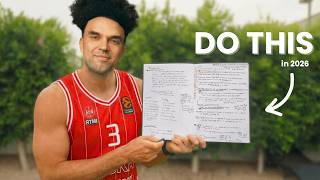
Elijah Bryant explains why journaling is the most powerful habit for basketball players. Writing down game observations, goals, and reflections builds memory and consistency. He breaks down three approaches: performance journaling for game notes, gratitude journaling to boost mood, and future-manifestation journaling, then demonstrates post-game reflection using a two-things-well, one-thing-to-improve framework.
Chapters
All right, I'm about to show you the one thing that all young hoopers need more in their life. And no, it's not shooting more, it's not dribbling more, it's not training harder. It's journaling. I know it sounds simple, but every elite athlete does it, and I've been doing it personally for 10 years. It allows me to be more consistent, bounce back from bad games, and express my emotions and let go of them. Number 1, exactly how can journaling make you better on the court, and how could a 5th grader use it today? Number 2 is I'm going to show you which pro athletes journal so you can see that it's not just me, elite athletes use it too. And number 3, if you stay to the end, I'm I'm going to reveal the secret that nobody talks about in journaling that can actually make you better on the basketball court. So basically, your brain is like your basketball bag. If you shove everything in— shoes, socks, snacks, clothes— it gets jumbled up and it gets messy. And you literally can't find anything inside the bag. That's the same thing that happens in your mind. Everything is jumbled up. Thoughts, stress, emotion, mistakes. Journaling helps you empty the bag and put it where exactly it belongs. And when you write, your brain uses your eyes, your hands, your language, and your emotions. When all 4 things work together, you remember things deeper and learn faster. That's called multisensory encoding. It's a big word, but it has a simple meaning. More senses, stronger memory. Oh, and sorry if I forgot to explain. Yeah, today we play Real Madrid and they have a bunch of stars. And speaking of stars in the NBA, Jalen Brown actually journals. He journals about his future. So a lot of people journal about their past, understanding what happened in the past, but he journal what, what he wants in the future. So basically manifestation in his journal. We live in such a world that it's just fast-paced, everything from social media, from encountering relationships to everything. When you're writing, you're allowing your brain to slow down and really catch mistakes. So you see this a lot of times when, for me personally, when I'm doing something really, really fast, I'll mess up. That's why I don't book vacations at night or rush when I'm having to do something really, really fast. But when I slow down and I'm writing slowly, it allows me to see everything. Cross your T's, dot your I's. So you can avoid a lot of mistakes when you're journaling. And journaling has become a big part of this process. As you know, I'm always watching film. In the film, I could take notes exactly on my phone, but no, I want to write it down so it slows my brain down and thinking, and I can really digest exactly what I want to get from the film. So let's watch. As always, when we're watching film, we're watching— dang, he got straight to it— watching the first play action of what Madrid is doing, just to see if they can roll back screen immediately. And if you notice here, the reason number 15 helps so much, because this guy's not Got not a shooter, but what he could do on offense is if Campos passes it here, then he goes straight to a DHO, which makes him a 15 late, and now they're in a bind. But they'll probably just switch, but Deck will have a wide open shot. Going along with watching the film situation is also my workout. So for example, if there's a specific move I want to work on, I'm going to write it down so I do it with intention. I'm just not going to think about it or put it in my phone notes. I'm going to write it down. On a piece of paper, my journal, so then I can come back to it after the practice and grade myself on how I did well. Essentially, journaling cuts through the noise. How the team are playing, super experienced, super well coached. Tavares, Yule, Campazzo, all these guys. It's not gonna be an easy game. And on top of that, it's the game right before the break, which is, can be very dangerous to say the least. Meaning some guys can be thinking about the break, so not focused. You gotta lock in. We gotta lock in. Now most of the time what I'm talking about here is performance journaling or journaling for your daily life, but one thing that's helped me a lot, especially you feel it the most during adversity, is gratitude journaling, is saying what you're grateful for. So for example, that is I'm grateful for my health, I'm grateful for my family, I'm grateful for having a job, all those type of things. I'm grateful for food on my table, because what it does, it takes you outside of yourself and gives you a bird's eye view and gives you perspective on life. So if If you're feeling down, if you're feeling like coach doesn't like you, write down what you're grateful for and actually see how you feel. I challenge you to do it for 3 days and see how you feel. I guarantee you'll feel a lot better. And it's not just what I'm saying, it's literally science. More dopamine and more serotonin, the chemicals that make you feel happy and good, are released when you're grateful for things. So try it. So what journaling does, it allows you to be more consistent on a daily basis. When you're more consistent, consistent, you can see more patterns. When you see more patterns, you develop systems that allow you to be more consistent in your everyday life. So try journaling. Don't get me wrong, this is a lifestyle. Just like we talk about nutrition and diet— it's not a diet, it's a lifestyle— meaning there's gonna be some days you do it and some days you don't. So for me personally, let's say I do it 90/10, but that other 10% is okay. I give myself grace. But you have to understand, in my journal, when I'm writing stuff, I'm writing stuff I'm grateful for, I'm writing tasks I have to get done for the day, I'm writing things that I could have done better in my game. I'm writing how I could be a better dad, a better son, a better husband, a better disciple of Christ, how I could serve others. Because when you're in the service of your neighbor, you're in the service of Christ. So just try to do it as best as you can. If you miss a day, it's okay. Just be better the next day. All right, so there's one more thing I want to tell you guys, but I gotta take a nap and actually get ready for the game. But stay till the end, I'll share you something that no one's telling you this about adrenaline, telling you it's gonna help you on the court. It's game time. Pack up because we go straight from the game to home, then it's break. So don't forget after we got 2 to 1, 2 things I did well and 1 thing I could work on. Let's get it.
So the opening tip controlled by the home team, Hapoel IBI Tel Aviv with the opening possession in this round 13 fixture. Met by Chuma Okeke, step back beyond the 3-point line and strings it sweetly to bring his team back. Garuba back out, has to beat the shot clock, off left, solid hop. That's dope. Now 3 of 5 from downtown, his 11-point So offbeat, slapped away by Danaturu, who says touché. Elijah Bryant coast to coast, Colin Malcolm fadeaway J is short. My goodness, what a feed! Real Madrid, tell me that Maladon has lost his footing. Turnover straight into the hands of Elijah Bryant. Chris Jones down the left side, Alex to pour things out. Motley looking for his second 3 and he strings It from the wing, there's a rebound. Antonio Blakeney, it's a 1-point game. They push it up to Mitzic, pulls up for 3, off the mark. So Real Madrid—
well, that didn't go as planned, but that's life. You win some and you lose some, but you never lose, you only learn. And the thing I'm going to tell you about journaling, I'm about to do it now, is it builds your basketball IQ. So I'm about to learn from the mistakes I made in the game and I'm not going to make those again. So your basketball IQ increases as you journal. Two things I did well, one thing I could work on. Stayed aggressive, should have been more aggressive in the first half. Rebound okay. One thing I could do better, my turnovers. I had 3 turnovers, so that's something I can work on. I'm going to watch the film, then I'm going to wash it because I just like to watch it when it's fresh in my mind. But as always, faith plus consistency.
Love.