4 Biggest Mistakes When Running Ads
Eric Deeran, who has spent $5 million on ads, breaks down four mistakes that kill ad profitability. Vague hooks confuse Meta's AI matching. Unqualified leads teach the platform to find worse prospects. Poor delivery tanks performance even with good scripts. Constantly tweaking budgets resets the algorithm before it learns.
Chapters
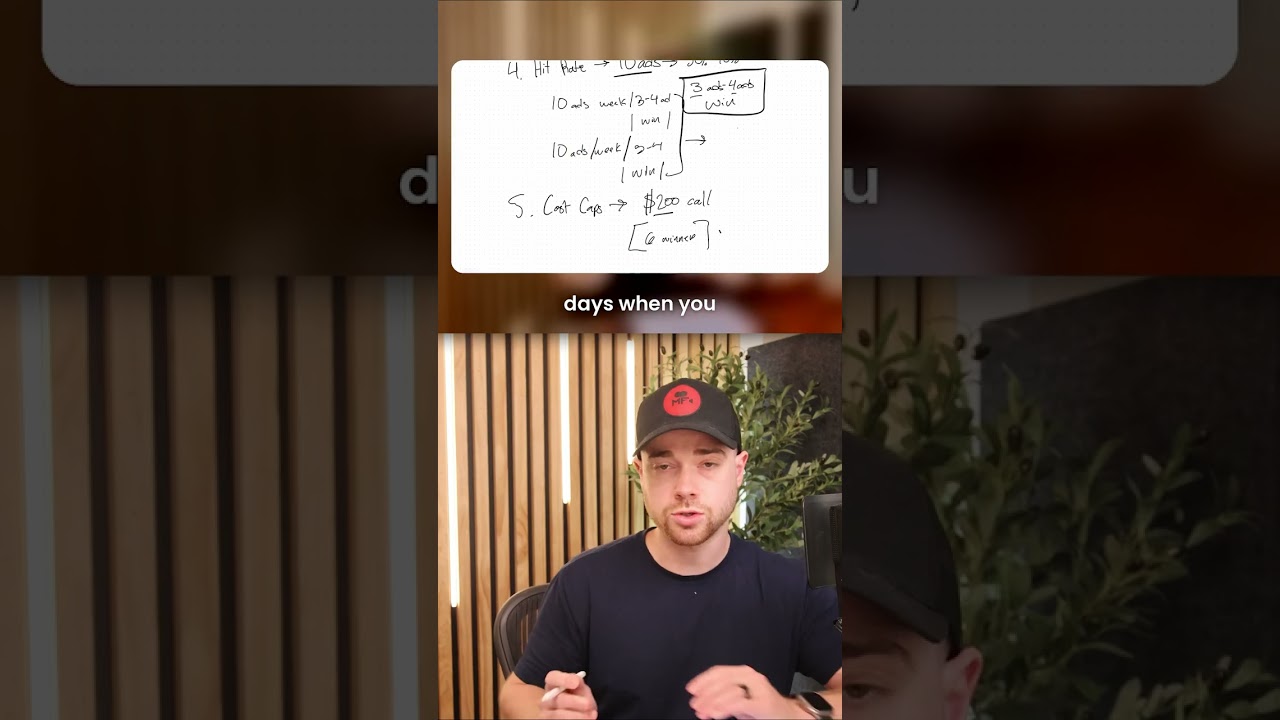
Most high-ticket businesses can't scale on paid ads because they're making these 4 mistakes. And if you don't know me, my name is Eric Deeran. I've scaled my business to 8 figures, spent over $5 million on paid ads for my own businesses, and have consulted thousands of other high-ticket business owners and helped them successfully run their ads so they can sign more clients and get more qualified calls. And in this video, I'm gonna break down the 4 biggest mistakes that I see that most advertisers are making that are killing their profitability and absolutely tanking their ad results. Number one, the first mistake that most high-ticket business owners are making is they don't have any sort of callout in the hook of the ad. And so Meta actually made an update to its targeting a couple years ago to where you can't target as effectively with the actual targeting settings in the Ads Manager. And because of this, what Meta does now is it uses AI to read the actual script of your video and who you're talking to, to then match that with the proper person in the targeting. And because everything is based off of what you say in the ad script, if you're not saying the correct person or your script is A lot of times what happens is, is you're not matched with the right person and then your ads are not as profitable as they could be because you're too vague in the actual ad. And this forces Meta to guess basically who you are targeting or who you're trying to target instead of you clearly saying who it's for. So if you wanted to target med spas, you'd say, hey, if you're a med spa doing over $30,000 a month, this is for you. Very simple example. Another way you can do this is by actually saying the pain points that that person struggles with. So you could say something like, most med spas are struggling because they're tired of XYZ patient coming in the door, and because of that, we've developed ABC Solution. And so when you do this, you can talk about what they're actually thinking at a deeper level, and then you're able to also use that for your targeting. And 9 times out of 10, this is one of the main reasons why you're not having success with ads, because I've talked to a lot of clients, and if I ask them, who are you trying to target? And then they say, well, I don't really know, I'm trying to target business owners. Well, you're too vague when you say that. And what you want to do is make a hook for each specific ad. So you do like, if you're targeting home service companies, you do a roofing hook, you do an HVAC hook, you do a pest control hook, and you would segment it that way to where the hooks are different for each person. And then Meta can then use that hook. It transcribes the video and what you're saying and then match that with the proper person. Your messaging is your targeting. There are no more targeting options within the actual Ads Manager. Mistake number 2, most people have absolutely no friction on their form whatsoever. And so they're sending back bad data to the ad platform and then expecting to get better quality. And what you're really teaching Facebook is that you want more broke people. Every time you send back an unqualified lead back to the platform, you tell Facebook that you want more of those people. And Facebook is designed to get you as many of what you want— your campaign objective, leads or calls— at the cheapest price possible. And when you tell it and you send back any data that's coming through, whether it's qualified or not qualified, you run into an issue where you're constantly sending back bad data, and then Facebook continues to optimize for that bad person. This causes most of your results to tank, and then it gets into what we call the death spiral, where it's constantly optimizing for these bad pockets of people, and it's very difficult to get out of that once you get into that. So you need to make sure that you are adding friction to the form, having 1 or 2 qualifying questions on your form so you can push out the people who are not the right people to be there. And bonus tip on this, you need to make sure that you have questions that are not obvious, because most people know what they're supposed to be selecting on the form. And so when you have non-obvious questions that are essentially saying it's not like a yes or no or a simple answer, it makes it harder for the people who are not the right fit to get through. And so you want to ask contextual questions that only the right avatar would know the answer to. You don't want $27 leads, I promise you. You do not want low-quality leads. The cheaper the lead, typically the worse quality it is. And so if you see a campaign that you're running currently and it's working really well, and then all of a sudden the costs just drop, and you're probably thinking to yourself, hey, that's great— it's not, because what's going to happen is typically the quality tanks with it. And you need to make sure that the people who are disqualified never fire back to the pixel because then it won't continue to optimize around those types of people. And we're doing what we call withholding data from Facebook. So Facebook essentially doesn't even know that that person was a lead or came through the funnel. The 3rd mistake that I see is simply just bad delivery in the ad scripts. 50% of the success of your ad comes down to what you say, like the script, and then the other 50% comes down to how you deliver it. And so if you're not delivering it with enthusiasm, if you're not engaged, if you don't have on-camera presence, Those are all things you can learn. I learned them and I was really bad when I first started, but those are all things that you have to learn and that can tank an ad performance. If you're reading a script like this and you say, hey, if you're a med spa, you want to get more clients, then click the link. Like if you say it like that, then what happens is, is it just doesn't perform as well. And I'm not saying you have to be the most polished person when you're reading these scripts, but you do have to engage a little bit more on camera. So like if I was going to be talking to someone normally, I wouldn't be talking necessarily the same way that I'm talking to the camera right now. And so if I was talking to someone normally, I'd be like, hey, what's going on? Yeah, cool. Okay, that's, that's cool. Okay, got it. Makes sense. What are you doing with this? Like, the way that I'm talking is very lackadaisical. And the problem is, is when you're recording yourself on camera, you have to almost go a little bit higher on energy to come across as normal on camera. And something that I learned and had to learn, anybody can learn it, that's fine. But you have to almost go a little bit over what you would normally, how you'd normally enunciate or be enthusiastic about or like your tone, because then when it's processed through camera, it's It comes across as like a normal energy. Don't ask me why, it just is what it is. Like, that's just the way that I've taught people and coached people to essentially come across better on their ad scripts. And the number one way that I find to read scripts is to look at the script, memorize a line, think about it, deliver it, and then go back, look at the next line, memorize it, deliver it, and then you just jump cut through all of those cuts, which is totally fine. And those ads work great. It's okay if you mess up. No one's expecting you to memorize the entire script all the way through, but I do like to look at it, see what says, memorize it, deliver. And then I repeat that process over and over and over again until the entire script is done. And when you deliver it this way, it saves you a ton of time from having to memorize or trying to be perfect all the way through. None of that really matters as long as you deliver the line well, and then you go back and look at the next line and then deliver it again. But the delivery is half the battle, right? And you can hire a spokesperson, but the problem I've seen with spokespeople a lot of times is that they don't feel as genuine as the actual founder. Like whenever you're watching like a UGC style ad, You can always kind of tell that it's a little bit off, but you can't really put your finger on it. And the reason typically is, is because it's not coming across as authentic as the founder or the actual person in the business would be delivering it. And so there are ways around this. You can coach talent, get better talent, you know, train better talent. But a lot of times I don't want to start with a spokesperson when someone's starting to run their ads simply because it just doesn't always perform as well. And then finally, mistake number 4, the biggest thing I see is you are touching the budget every time you have a feeling about something and you're not actually letting things play out. So when I launch a campaign, I give it 5 full days while it's launched to then see what the data is. Now obviously, if something catastrophic is happening in like, you know, day 2, day 3, turn it off, duplicate it, reset it. But I always duplicate and reset something when I launch it again. Try to avoid these little tinkers and little changes that you're making on the account because it always sets you back every time you make a change. Think about every time you make a change on a launched campaign that it brings you back to zero, right? And so you want to make as few changes as possible when you launch something to give it the highest chance of success. And so when you do launch something, do not change it every single day. Don't touch things. Don't get hyper-focused on exactly what's happening. Like, you have to look over longer time horizons to give Facebook the time to find the right person from your ad. And if you have leads, I've seen this time and time again, if you have leads that are dipping for like 3 days, like you're just not getting anything, you freak out, you touch things. If you had just let that run for 4 or 5 days total, typically see an uptick on day 4, day 5. And so don't touch things too early because it can reset things back to zero every time you do that. And then a bonus tip is once you find winning angles, you take that winning angle— angle being what you're saying in the ad and the messaging you're using— and then you make it into every other format. I have other videos that are covering that, but that's a bonus tip once you do find those winning ads. And that's how you actually scale an account. So if you want our help doing this and setting this system up for your high-ticket business, click the link below, schedule a call with our team. We're happy to help. We'll see you in the next video.