You Can't Scale Because Everything Is Custom
Eric Deeran explains why video agencies can't scale: custom client journeys that aren't documented. He recommends productizing services with a repeatable journey (onboarding to renewal), writing SOPs for each role, and organizing teams into pods so you can duplicate capacity instead of reinventing it each time.
Questions this video answers
June 17, 2025
Almost 700
About 30 to 50 clients
About 20 clients
About 20 clients
Chapters
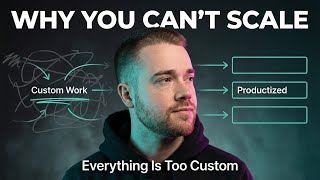
The number one reason that most video agency owners cannot scale is because their client journeys are completely custom for every single client that they work with. And this is a little bit of an illustration here, but we have worked with almost 700 video business owners, creative agencies, at this point. And the number one reason why they cannot scale is because they don't have a productized service. And I'm going to go through today what a product service looks like, how you can start engineering yours, and then how you can start building out a pod structure so you can start hiring people to, to buy back your time. So this is what most people's client journeys look like. It's basically, there's nothing documented. It's custom for every client, and it's not scalable. And they say, people say, oh, well, we're a boutique creative agency, and that's fine if you do not want to scale. And the reason that boutique. And there is a reason that boutique agencies and people like that cap at 50, you know, 60K a month. It's because everything they do is custom. They become bottlenecked on the fulfillment film inside. And the reason is, is because every single thing is in the founder's brain. So, like, if you're like, oh, you know, it's not scalable. I can't hire anybody to do what I do. They're not good enough. It's because everything's in your brain. Nothing is documented. So there needs to be like, a conveyor belt system to where when you get a new client, you sign them on, you put them on the conveyor belt, and then they move on. Right? And then it's step 1, 2, 3, 4. Like, think about it from, from the perspective of like a Ford factory, right? Do they custom make every single Bronco? No. There is a specific outline or Bronco journey for every single client that comes in or every single car that goes on the, the, the, the line. Right? The conveyor belt. And, you know, step one is this, step two is this, step three is this, step four is this. And your fulfillment process needs to look like that. And I, I talk to a lot of creatives. They're like, ooh. But, you know, I don't want to, you know, you know, I don't want my clients to feel like it's not custom to them. It's like, it is custom to them, but it's the same process every single time. And if you don't have that client journey processed out, you're always going to get capped because you're going to, you're going to be putting out fires and fulfillment. You're never going to be able to hire a csm, an editor, a videographer, because everything you're doing is custom and it changes every time. And a good litmus test for this is, if you had a hundred new clients tomorrow, would you be able to fulfill on those clients? And, and if the, if the answer is like, oh, my God, no, I have no idea what I would do because every single client has a different thing, then like, that's your problem, right? So what you really need to have your, your fulfillment process look like, and we've gone through this in different videos is this, right? So it's like, client comes in, they. They close the sale sales call, like the actual. The. The closer or whoever is closing it puts them on an onboarding call with the CSM manager, and then it's 1, 2, 3, 4. And you have your whole journey mapped out, right? And everything is completely mapped out. And it's activation point 1, 2, and 3. And these activation points are basically things that are milestones in their journey with you. We've talked about this in different videos. And then from there, once they reach activation point three, there's a choreographed point where you do a case study with them, right? And then you renew them and ascend them into paying you more money over time. And then what you can do here is you can have a CSM guide them through the process. And because everything is templated out and choreographed out, when you get a new client, it's as simple as making a new Slack channel and then making and making a copy of your Monday board. So it's like, okay, great, new client, copy the Monday board, plug in their information, put them on the activation belt, right? The client journey belt. And then it's boom, off to the races next. And then each person on your team, whether it's a social media manager, videographer, editor, graph designer, anybody who's within the company, right? They know exactly what to do. And because it's the same thing every single time, right? And a lot of people struggle with this because they don't know how to scale because everything's custom, right? How are you going to teach a CSM or videographer, an editor or social media manager what to do if the process is not documented? Like, it needs to be documented. There needs to be a specific, like, SOP or standard operating procedure on every single thing that you do, because then you don't become the bottleneck anymore. And you can relax and sit back and be like, oh, okay, great. They know what to do, because I've made the roadmap, right? It's like trying to go to a destination and not having any idea where you're. You don't know which way to turn, you don't know how to get there, right? It's like you're literally not giving your team a map. And when you have a client journey, you're giving them a map and you're like, cool, here's our first stop. Here's our second stop. Turn left here, turn right here. This is where you go this way and you give them that roadmap so you can empower them to be their own leader and you don't have to micromanage every single second of the day. And you're gonna hate your life if you do that, right? And then also when you get too many clients, like, CSM can handle like 30 to 50, right? This is just examples. A videographer can maybe handle 20 clients. An editor can handle 20 clients. It's a great. Once I reach capacity, just duplicate it and I do another pod. That's it, Duplicate it, do another pod, right? And you build out SOPs and something we help our clients with. We build out these SOPs on each single role, essentially. So this is just a little bit of like a kind of a zoom in on. Most people have this over here where it's okay. Client journey. And then your team comes to you like, okay, what do we do for this client? You're like, let's make it custom every single time. You're like. They're like, oh, my God, this is terrible. Whereas here it's like, what do we do? It's like, Monday board. Everything's in the Monday board. It's boop, boop, boop, boop, boop, Big checklist on what we're doing for each client, right? It's like, and I'll leave you with this. It's like if you have an AC technician come out to your house, like, they're not winging it. There's nothing custom there. They're going through a checklist on their iPad. They're like, okay, what's the problem? Oh, my AC is not working great. I'm going to go through a diagnostic checklist. We're going to do this and this and this and this and this and. And this. Okay, cool, it's fixed. Done. And then they go to the next house, right? You have to think of your video services and your creative services the same way. And then we'll get into other videos how you can plug in AI to start automating some of that to take the human element out of it. So hopefully this is helpful. If you want to learn more about what we do at Master Filmmaker, you can click the link, book a call below. If not, hope these videos are helpful for you. And stop making everything custom. Make your process productized so it's a choreographed dance. It's the same thing every time a new client comes in. We'll see in the next one.