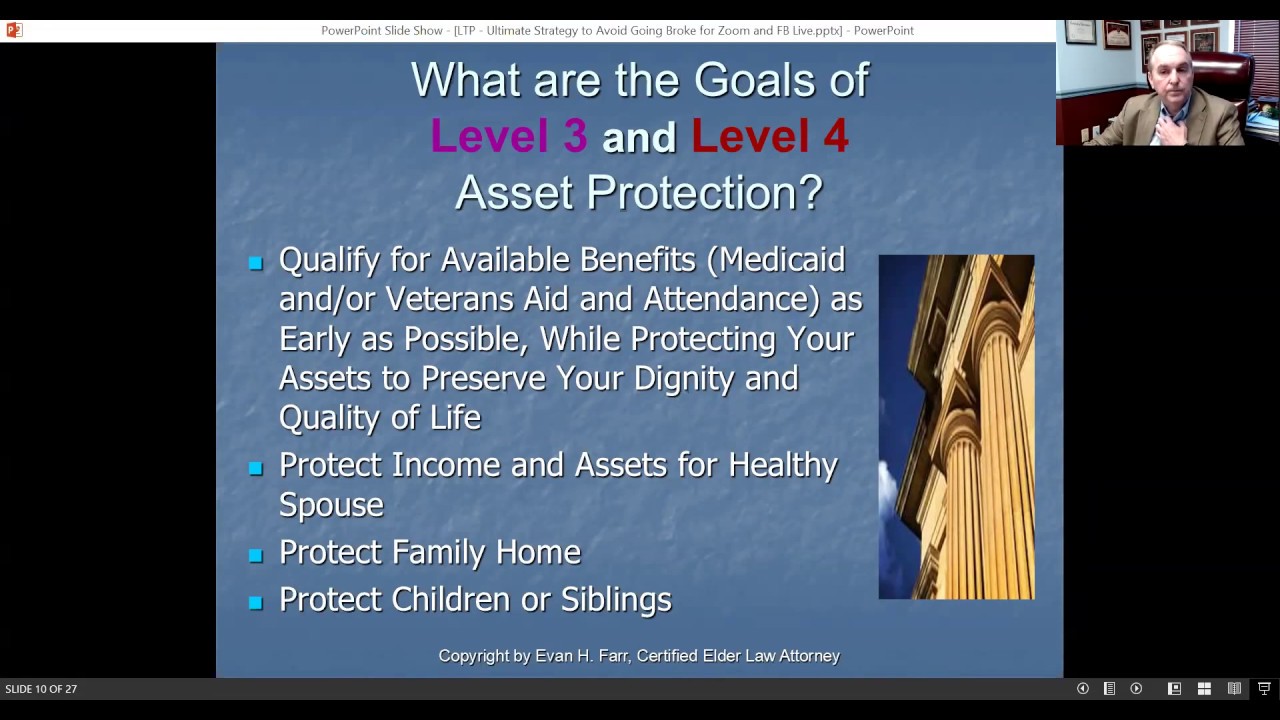
Certified elder-law attorney Evan H. Farr explains how to protect assets from Medicaid spend-down. Medicare only covers 100 days of care after hospitalization; Medicaid pays for long-term care but can force you to deplete savings. Proper planning can prevent the 70% of singles who become impoverished within a year of nursing-home admission.
Chapters
¡Hola!
Americans are living longer. Within 20 years, the nation's age profile will match that of Florida's current age demographic, with 1 in 5 Americans older than 65, and many of them will have one or more chronic illnesses requiring long-term care.
With the aging of America, there's a greater need for long-term care for the elderly. As a geriatric care manager, I work with elder law attorneys to assist elders in making the best possible long-term care decisions.
Long-term care can take place at home, in adult day centers, in assisted living facilities or special retirement communities, and in nursing homes.
Activities of daily living are the activities that we do daily in our homes. Examples of activities of daily living, or ADLs, are bathing, dressing, grooming, eating, mobility, and answering the call of Mother Nature. Instrumental activities of daily living are the activities that keep us independent in the community. Examples of IADLs, or instrumental activities of daily living, are money management, housekeeping, medication management, and meal preparation.
The cost of long-term care can be overwhelming. The national average cost for a room in an assisted living facility is approximately $35,000 per year, but can be higher than $100,000 per year in some parts of the country. The national average cost of a room in a nursing home is approximately $75,000 annually, but in many parts of the country, the average is well over $150,000 per year. The national average for 24-hour in-home care is approximately $166,000 per year, but can go as high as $300,000 per year in several parts of the country.
Well, there are 3 ways primarily to pay for long-term care: either out of your own income and your life savings, or out of long-term care insurance if you were fortunate enough to pay for that while you were still healthy, or for approximately 70% of the population, Medicaid winds up being the main source of payment for long-term care. There's a common misperception that many people have that Medicare will pay for long-term care in a nursing home. The truth is that Medicare only pays for short-term rehabilitation in a nursing home, and that's only in the limited circumstance where someone has been in a hospital for at least 3 days and goes directly into the nursing home for rehab. If they continue then to get better, Medicare will pay for up up to a maximum of 100 days of short-term rehab care. But once they've used up that very short period of Medicare, the only governmental option for paying for that care becomes Medicaid.
With proper planning, families can obtain Medicaid assistance without having to deplete their life savings. Money that is protected through proper planning can be used to provide an enhanced level of care and a better quality of life while in long-term care and still receiving Medicaid benefits.
There are two different types of asset protection planning for people who are concerned about protecting their assets from the expenses of long-term care. The first type is done by healthy people. They may purchase long-term care insurance, or they might use a special type of irrevocable asset protection trust that's done by many elder law attorneys. For families who have a loved one who is already in a nursing home or is about to go into a nursing home, there are dozens of different asset protection strategies that elder law attorneys can implement in order to protect assets from the expenses of long-term care. The goal is always to enable earlier Medicaid eligibility while the family still has assets that have been protected that can then be used to enhance the quality of care care of the person in the nursing home.
70% of Americans who reach age 65 will need long-term care. Of people over 85, 97% require long-term care. Long-term care is the biggest risk to our income, assets, and independence.
For a married couple, asset protection planning can help the healthy spouse who's able to live at home by protecting all of the couple's financial assets and providing extra income for the healthy spouse to enable that spouse to live at home while Medicaid then pays for the spouse in the nursing home. Proper asset protection planning can allow parents to protect their home and some or all of their life savings while still allowing them to qualify for Medicaid if and when the need arises. With the right type of planning, Medicaid, SSI, and other government benefits don't need to be forfeited when a disabled child or adult receives an inheritance or personal injury settlement.
As we age, the need to protect what we've earned becomes increasingly important. Elder law caters to the needs of older clients and persons with disabilities. Evan H Farr is a certified elder law attorney and a certified estate advisor and has been recognized as a Super Lawyer in the field of elder law in Virginia and Washington, DC.
Nursing home care is an expensive reality for most Americans. In some areas of the country, it can cost even up to $90,000 per year, and many Americans are unable or ill-prepared to pay this cost.
According to the AARP, 70% of all nursing home residents receive Medicaid benefits. For many families, Medicaid comes in only after forced impoverishment. Tragically, 50% of married couples and 70% of single persons become impoverished within 1 year of entering a nursing home. Rather than facing forced impoverishment, many families turn to a certified elder law attorney such as Evan H Farr for help. Mr. Farr helps his clients legally protect their assets and still qualify for Medicaid nursing home benefits.
The reality is that individuals can obtain Medicaid to cover their nursing home expenses without having to spend down their life savings. Even if they have significant assets, provided that those assets have been legally and properly protected under the law.
No one knows what the future may bring. The law firm of Evan H Farr can help you plan to ensure that whatever happens, you will be prepared for it.
Structuring your assets in a way to qualify for Medicaid nursing home benefits is no different than trying to maximize your income tax deductions or trying to minimize your estate taxes. Under our current system, Medicaid planning is not only ethically justified, but it is often imperative to an individual's survival.