A will doesn't avoid probate; it actually triggers it. To skip probate, use a power of attorney during life and a revocable living trust at death. The trust requires retitling assets and updating beneficiary designations, but lets you manage everything in one document instead of juggling multiple forms.
Chapters
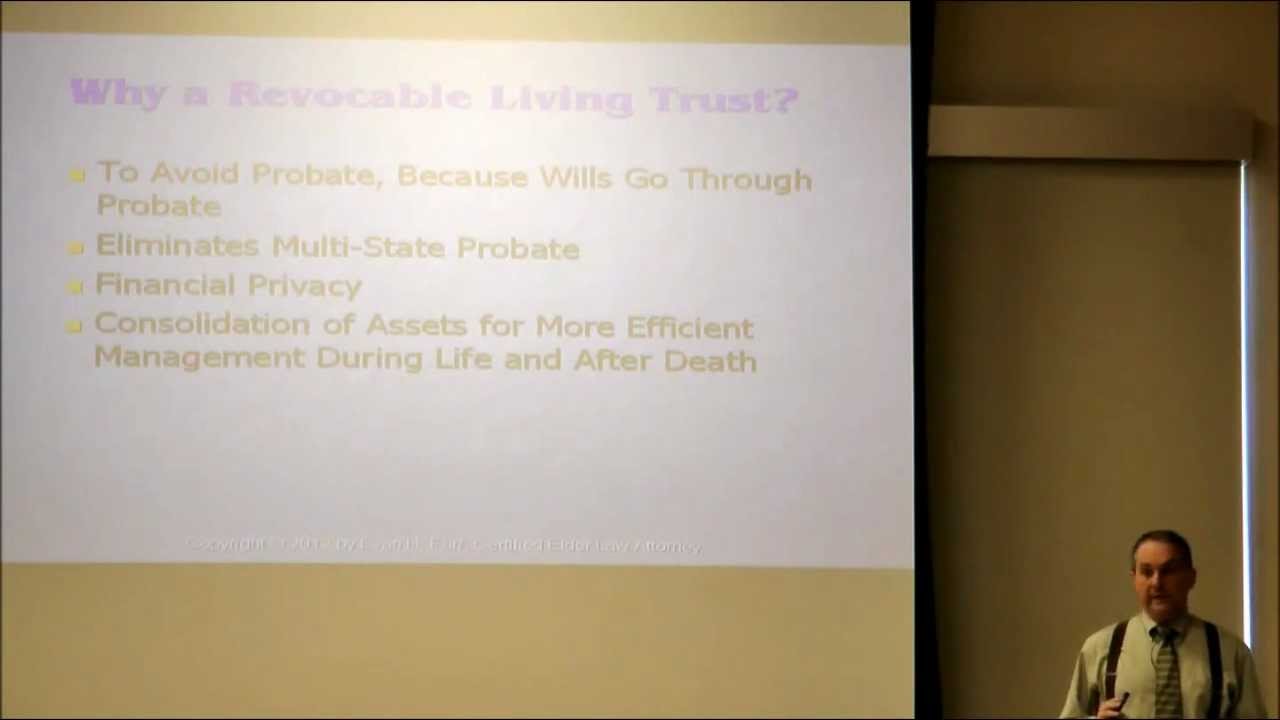
Okay, another pop quiz. We've talked about probate, both the living probate and the postmortem probate. Who thinks a will avoids probate? Anybody? Awesome. So you're all— you've been paying attention, that means, or else you knew this to begin to begin with. But the answer, of course, is no. A will does not avoid probate. A lot of people mistakenly think it does, and— but the reality is, as you all understand, a will actually causes probate. A will is a set of instructions to the probate court telling the probate court after your death, here's how you want your assets distributed, here's the person you want as the executor to execute your wishes, and that's what a will does. It puts your estate through probate. So, how do we avoid this? How do we avoid probate at death? Okay, remember, to avoid probate during lifetime, you need a general power of attorney. That's our level 1 incapacity plan. To avoid probate at death, what you need is our Level 2 planning, and this is our estate planning that uses as its core document a revocable living trust. This is typically for clients in their midlife, 35 to 65, and the whole idea of the living trust is to avoid your assets having to go through that dreaded probate process. Avoiding those nasty accountings that I spent so much time talking about. So why do people do a living trust? Of course, the main reason, as I just said, is to avoid probate, because wills put your estate through probate. Living trust also has some other benefits. It eliminates multi-state probate. That's something that happens if you have real estate in another jurisdiction. Real estate that's owned by an individual has to go through probate in the state where it's located. But if it's in the trust, it avoids probate. Financial privacy. This is more and more of a concern for many people in this age of identity theft and con artists and scams, internet scams, and what have you. A will, because it goes through probate, becomes a public record. A trust is a private document, never gets filed with the court, so you don't have your financial information and your beneficiary information spread all across the public records where any con artist can come in and search them. You've got a completely private document that only your family sees, and your financial institutions who might want to look at it to see what's supposed to happen after your death. And lastly, a revocable living trust is also a very good tool for efficiently consolidating your assets and managing those during your lifetime, and also for managing your wishes upon your death. The way the trust works is you create the trust while you're alive, and then you retitle your assets into the trust. That retitling or the funding process doesn't happen automatically. We have to prepare deeds for your real estate. You have to contact your financial institutions for them to send you the forms to fill out to name the trust as the owner or as the beneficiary of of your assets. And upon your death, then everything winds up in the trust, and the trust has the provisions in it that say how to distribute your estate, like, like the will normally would, but those provisions are in the trust. We do have a will that goes along with the trust, it's called a pour-over will. So in case you have any assets that did not go into the trust during your lifetime for whatever reason, those will pour over into the trust after your death. But the goal is to just have everything in the trust, either through ownership or beneficiary designations during your lifetime. And this makes your— the management of your wishes much easier, because let's say you change your mind, you want to change your beneficiary distribution at some point. With a trust, you just do an amendment to the trust. One thing, every— and it affects all your assets because all your assets are already directed to the trust. A lot of people who try to avoid probate the careless way or the easy way, they will put beneficiary designations to specific individuals on their bank accounts or their life insurance or retirement. And while beneficiary designations are not inherently bad, they work great if the trust is the beneficiary, but if an individual is the beneficiary, you've got a problem because if you change your mind, now you've got to go back to all your institutions. You might have 6 or 12 financial institutions and fill out a new change of beneficiary form, every single one. Whereas if you just had a trust, you're amending one document, the trust. Much, much simpler to manage while you're alive.