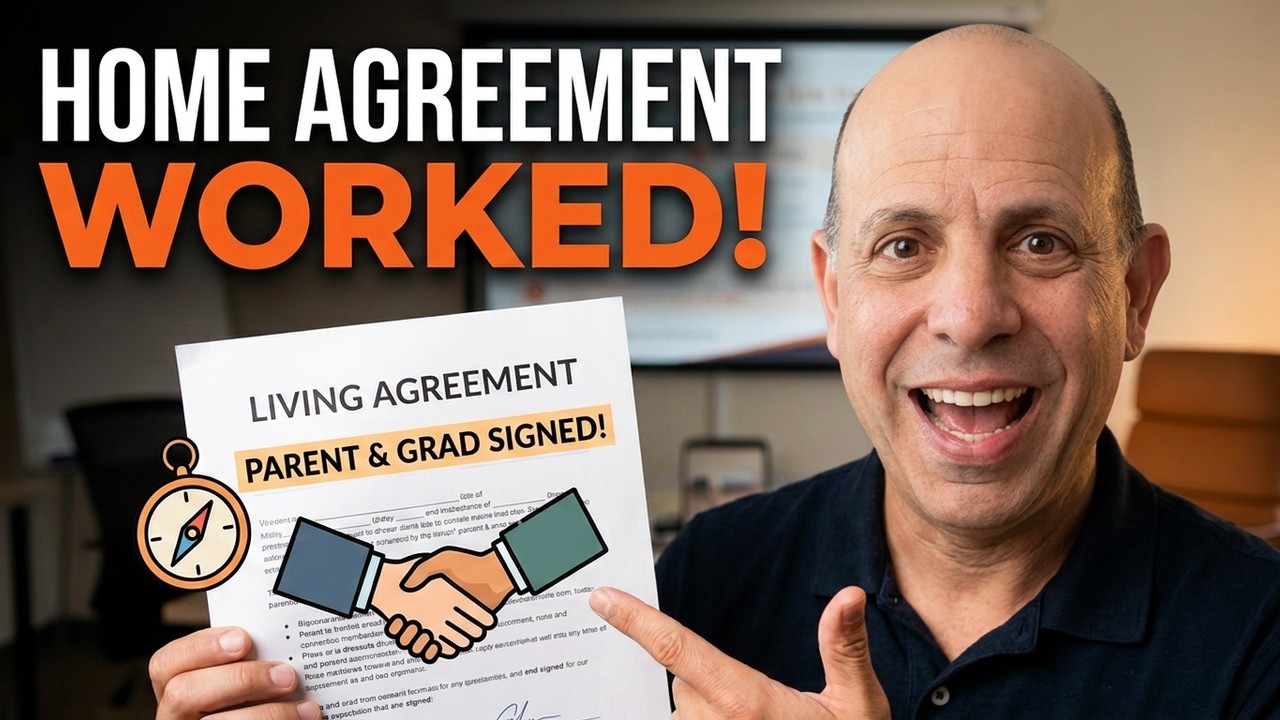
Evan Sanchez walks parents through creating a living agreement with adult children at home. The workshop covers three types of stuckness (value mismatch, lack of skills, analysis paralysis), three conversation rules (listen more, read before you react, let go to move forward), and seven agreement sections including household expectations, consequences, and a restart clause.
Chapters
So now what we really want is we want to open the conversation with our young adult because they're probably resisting and not open to a lot of input at this phase. So let me go ahead and share my screen. Oh, and let me just tell you what we're building tonight, by the way. So I hope everybody has a pen and paper. Because we're building an actual agreement. I call it a living agreement for two reasons. One, it is about how you live and cohabitate with your college grad. But two, it's a living document. So this is the first draft, and we're going to do it together, and I will walk you through every phrase of that. So three things you're going to get by the end of tonight. Okay, first, you're going to get a first draft agreement, something you can actually use with your kid. They're going to have measurable outcomes, and you're going to be able to talk about it and work with them together on it. Second, we're going to get your commitments on paper, because the whole thing about doing this living agreement is you have to be willing to shift how you show up. You have to be vulnerable first. If you just go in there and you say, hey, you need to change, that's not going to work. They need to show— see that you're being vulnerable and that you're willing to change. So you have to go first. Super important. And third thing is we want their voice in the agreement, because an agreement isn't very useful if only— if it's only one-sided. And if they don't feel a part of the process, they're going to feel excluded. So they need something that they shape, that they validate. It's not imposed on them. Is this all making sense? Put a 1 in the chat if this makes sense. I got some thumbs up. Just go ahead and put a 1 in chat for me. Awesome. Yep, yep. Let's get started. So Let me go ahead and share my screen and just make sure everybody can see it. Can everybody see that? Thumbs up. Okay, awesome. Okay, so this is what we want to do is we want to open up this conversation and we want to guide them without pushing them. Okay, so here's how tonight is going to go, and these are times that I think are accurate. But I'm not sure. But there's 4, 4 stages here. What we're going to go through, we're going to go through the diagnose phase. We want to know what type of misalignment is in your household right now. That is vital. So we're going to spend a few minutes doing that. Then we're going to give you the 3 rules that the agreement runs on. And these are really important. And then we're actually going to work on the agreement together in real time. So I'm going to pause and give you time to work on things, and then ask me questions if you get stuck. And then we're going to have a plan for how we're going to have the conversation, because we need to have a plan, because we know that they're not going to be like, oh, thank God you put this in front of me. I don't think that's going to happen. So is this all making sense? Put a 1 in chat. Excellent, excellent, excellent. Okay, so I'm going to go to the next slide and we're going to look at 3 doors. Okay, so look at this slide for a second and you're going to see 3 types of blocks or 3 types of doors, right? These are the reasons why your kid might be getting stuck. They're not character flaws, just where they're getting stuck. So I'll take you through each one real quick and you can follow along. So the first one is values. They do not— what, what you— they do not want what you want. So it's a lot of messages like, I'm figuring it out, or if they eye-roll you That's a big one. And any sense of timeline feels like an attack on them. What you see from your end is you see laziness. What's actually happening is that they have different values than you do, or they haven't figured out their values yet, and they can feel like you are pushing your value on them. So that's number one. Number 2, maybe they don't know how to do things. Maybe they don't know how to do the applications. Maybe they feel overwhelmed just by the thought of doing an application. They have the will, they just don't know how. And this is something I find with my kids as well, is like, they— Gen X, we were just told to figure it out. Right? So if we had to go get the oil change, we just had to figure it out. But this generation, they need more help than that. So they want to move forward, but they don't have the skills or the systems to actually do it, and they're afraid to try. So it stays stuck. Okay, so that's number 2. Number 3, they can't see a path. I don't know what I want, because life is coming at them so hard and so fast that they're overwhelmed with options. Analysis paralysis is what I call this one. So they're not lazy, they're just paralyzed. There are too many options and they don't have a clear north star. And what Type 3 looks like in real conversations are Vague answers and no follow-through. So if you get the, hey, yeah, I'm working on it, I'm looking into some things, I have some leads I'm following up on, but then you push just a little bit, you say, which jobs, by when, what's your next stop, and the answers get more and more vague. Is any of this sounding familiar? Okay. So they aren't being dishonest. They're being— yeah, very— they're avoiding. They're stuck. And being vague feels safer than admitting they don't know what to do. But vagueness also keeps them frozen, because as long as they don't commit to anything specific, they don't have to face the fear of failure or success. They're non-committal because they don't know how things are going to turn out. So the question for everyone on this call is, which one are you in right now? Now, some of you may say, Evan Sanchez Sanchez, I'm in all three. So when you think about this, which is the primary one? It may be all three. It probably is all three, but which is the primary one that they're stuck in? So I want you to reflect on that for a second, and then when you're ready, put the answer in the chat. 1, 2, or 3. Now, it can be all 3, but which one is primary? 1, 3, 3, 2 and 3, but 3 is primary. So they're overwhelmed. That's different from laziness, right? Overwhelm is just they don't know what to do. They cannot, they cannot see the path. And the problem is, at this age, if you remember back to your 20s, every decision feels heavy and permanent. And one of the things that a lot of kids are afraid of is disappointing their parent. They're not going to tell you that, but in the back of their mind, that's what they're thinking. So Now there's some people, and some of you emailed me before this call, so thank you for doing that, right? Now some of you have kids who are angry and they're taking the anger out on you, and I want you to gently push back on that. Because if your young adult is stuck in the blame, blaming you for their decisions, blaming the system, blaming people who are succeeding, they're stuck in that victim mode, right? That's not actually about your expectations being wrong. That's them being stuck in a story where you're the reason they can't move forward. And here's the thing, as long as you don't accept the blame, as long as you keep defending yourself or trying to prove you didn't know you didn't do what they're saying you did, they stay stuck because the story still works. Does that make sense? So yeah, it's— so you cannot accept the blame for that. And Catherine, you are not responsible for releasing their anger, okay? You are responsible for changing the dynamic that keeps it alive. But you cannot take responsibility for their anger. Those are very different things. Yeah. Okay, so now that we've identified which one you're in— you may see it that way, but I see it differently— that's not accepting blame. That's good. So the thing that— what's— let me ask you this: what's the one phrase that pops out of your mouth the most often? Write it down in your notes. I would love to— if you put it in the chat too. So if it's something like, when are you going to apply for jobs? The, the question that I want you to ask instead of that, it's what's getting in the way of applying? So you want to have curiosity questions, not something with your agenda, not what's wrong with you, you don't want to do, you know, or why would you think that? Those are terrible questions. You want to say, what have you been working on? How can we help? Exactly. But you can also frame it as, what feels the heaviest right now? But I like those questions, Janet. So for example, you need to figure out what you want becomes, what do you think you might be interested in exploring? What seems like an achievable next step that's not overwhelming. Curiosity is the way in, and it has to be genuine curiosity. Yeah, so Janet, I would probably be— what have you been working on? Actually, when I think about that, that's probably a little more of your agenda, right? I think that you should go with what's the hardest thing you're dealing with right now. I think that would make a little more sense. I think you're right on to how can we help, and this is what this agreement is going to talk about too. So great. Okay, so now here are the 3 rules we build by. Okay, so there's 3 rules and they aren't complicated, but they're easier said than done, but they do require that you show up differently. Let me talk about the first one. You see the screen, megaphone to microphone. This is the biggest shift and one of the hardest ones to make right now. Most of you, and I mean this with love, you're talking at your kid. You're explaining, you're justifying, you're defending, you're fixing, you're giving advice, unsolicited advice. And when you're explaining or justifying, defending, fixing, or giving advice, You're the megaphone, and that's really loud. And what happens when any adult gets unsolicited advice? What is our normal reaction to that? Our normal reaction to that is to resist, push back, tune out. Exactly. If I give you unsolicited advice, you're going to be like, no, I didn't ask for that. And why are you putting this pressure on me? For them, it— when you give advice, it feels like pressure, it feels like judgment, it feels like shame, it feels like criticism. When you're explaining, justifying, defending, fixing, all of those things, that's tapping into the fear part of their brain, and they're protecting themselves. So the natural thing that they do is they resist and they shut down. Okay, this is just getting to be too much. That's not— that's why megaphone to microphone is the biggest shift, because you have to listen more than you talk. You need microphone energy. You're listening, you're curious, you're leaning in, you're asking questions. They need to talk more and you need to talk less. And I got this from— I don't know if you guys know Chris Voss. He's a hostage negotiator, a former FBI hostage negotiator. And he says the same thing. He says the first thing you have to do is when you're listening to them and they say something like, 'I want to be a YouTuber,' and you think that's the worst idea that you've ever heard in your whole life, you think that's awful, right? You cannot respond with that energy. You have to acknowledge and validate what they said. So the 3 phrases that I like from Chris are: it sounds like, it looks like, it feels like. Yes, I will see if I can mute her. Is that better? Yeah, thank you. Okay, awesome. So those 3 phrases— it sounds like, it looks, it feels— whenever they say something, say, it sounds like you're really interested in becoming a YouTuber. It feels like this is really heavy for you, and they will either acknowledge that statement or they won't. Either way, it's fine. But then you ask a curiosity question: what or how? What would an easily achievable next step look like that doesn't feel overwhelming? Is this all making sense? Put a 1 in the chat if this makes sense, or thumbs up, that's good too. So That's— yes, everybody but Evan, please mute. And I'll see if I can mute some people too. Okay, I think everybody should be muted except for me. Okay, awesome. Okay, so no problem. Thank you for letting me know, I appreciate that. So the rule is if you're talking more than 30% of the conversation, you're megaphone mode. Flip it. Ask more, listen more. Okay. And whenever they say something, acknowledge and validate it. Just repeat their words back to them. You can repeat the last 3 words they say. You can say, "It sounds like, it looks like, it feels like," any one of those phrases. Just validate what they said, because the second that you validate and acknowledge that those are the words that they said, they feel seen and heard. And when people feel seen and heard, they grow. One of my favorite phrases: when people feel seen and heard, they grow. Okay, so I have on the slide here, read before you react, right? We talked about that a bit. Before you respond, pause. Try to understand what they really want. What are they actually worried about? What do they need? Because 9 times out of 10 you react to the surface thing. If they say, 'I'm not going to the family dinner,' what they're really saying is, 'I don't feel welcome there,' or, 'I'm scared of this or that.' So when you react to the words, you're missing the meaning, right? Get curious about what's underneath before you respond. That's really important. Okay, and let go to move forward. This is really hard as well. All of these are hard because this is where we let go of being right. We are probably— parents are right about a lot of things. Your kid is making some mistake, and here's the thing: you can be right and also be alone, or you can be connected and also be confused about whether you're right. The rule is this: the relationship is more important than winning the argument. So let go of the need to prove your point. You need— you let go of the need to fix it, and that's— and you let go of the control. And again, that's really hard because that's all we've done as parents. We've always been in fix-it mode. We've always been in control. We've all been in charge of keeping them safe, right? So you have to let go a little more, and that's very hard to do. That doesn't mean you don't have boundaries though. You absolutely have boundaries, but you hold them differently, okay? You hold them with them, not against them. Does that make sense? Okay, okay. So Now we build. Okay, now how am I doing on time? Okay, so we have a diagnosis, we have 3 rules, now we actually make this work. So we're gonna— I'm gonna walk you through 7 different sections, so please have a pen and paper handy if you don't already because this is crucial. Each section is a conversation you're going to have, or a conversation you're going to try to create an agreement for. Now, here's what's important. These aren't lectures, these are conversations. And what you're going to leave with is something written down, an actual document that you can hand to your kid and say, here's what we're building, here's what I'm committing to, what do you think? Sound good? Okay, scared, nervous, excited? Okay, let's do the first section. So in the first section, I want you to write Section 1: What I'm letting go of. Okay, so write that down on your paper, and this is your honest read of where things are. This is your first real section, and it's intentionally first because it's what your kids need to hear before you before anything else can shift. This is about you being willing to let go of something. Not everything, not your boundaries. It's something that's been in the way. It can be something like, I'm letting go of trying to fix your life. I'm letting go of your sleep schedule being my problem to solve. I'm letting go of needing you to be at the family dinner. I'm letting go of being right about your decisions. And there's some centered starters on the screen that you can use, but you can't use like lazy, wasted, always, never, potential, anything like that. For some of you, what you need to let go is defending yourself. You've been trying to prove that you didn't set unrealistic expectations. You've been trying to explain your intentions. And every time you do that, you're saying, your anger at me is valid, I just need to explain why. One of the phrases you might want to look at is, I need to make him understand I wasn't trying to hurt him. That's what I need to let go of. You can say, I'm letting go of my expectation— of defending my expectations. I'm letting go of accepting responsibility for his anger. I'm letting go of trying to fix this for him. I'm letting go of the belief that I just need to explain better. He'll get it, or she'll get it. So take a few moments, let me know if you get stuck. Okay, make sure you have at least a couple written down and put a 1 in the chat when you're done. All right, Janet, we're going to get to that. My situation is I feel we need to have actually more of a concrete plan We've given him time to navigate it on his own. That's good. So I think that this is going to be addressed in the other parts of the— our parts of the agreement, but maybe you're letting go of having a concrete plan. What do you mean? We're thinking of letting go on the bills he has to pay, needs to pay. Is he paying bills now, or is he not paying bills? He's not paying bills. Gotcha. Yeah, cell phone, not so much. Just insurance for a car. We're going to get to the part of the agreement that's going to be the consequence part. That's where that's going to fit in. Marty, I'm letting go of trying to make the job search easier for you due to bad economy. Sure thing, Janet. Yeah, Marty, maybe it's like you're letting go of You're trying to make it easier for him, but he might feel pressure. Is that what's going on? Or— and if you want to come off mute, you can. Yeah. So yeah, if you provide a lot of resources for him, so you're going to let go of providing him resources. I think that's what you need to do. Yeah, it's very hard to— it's hard because that's what you're really good at. Right? But you need to let go of doing that. Now, that's not to say if he asks for your help, that's okay, because he knows that you can do that. Yeah, no more to that. No, no more of that. That's coming across as pressure and making him shut down, Janet. That is— that's the megaphone right there, sending the job listings all the time. Okay, so does everybody have Section 1 done? Okay, I'm assuming silence is a no more resources until you ask for it. Exactly, exactly. Yeah, okay, I'm gonna assume everyone's done with Section 1. If you're not, speak now or forever hold your peace. Put a 1 in chat if you're not done. Okay, so here's what I'm saying yes to is Section 2. Oh, I'm sorry. Wait, did I do that right? Now this is what I see. Oh, I'm sorry. What I'm letting go of. I'm going to stop giving you job listings, forwarding job links without being asked, asking about applications every day. This is section 2. I'm letting go of this. Sorry, we did this one already. But yeah, that's what you're letting go of. Let me go to the next one. Yeah, that's what I meant to go to. Sorry. So section 3, what I'm saying yes to. Okay, so you've named what you're letting go. Now you're going to name what you're stepping into. What are you saying yes to instead? This is different because this is not what we're trying to make them do. This is what you're committing to. I'm saying yes to asking you questions before I give advice. I'm saying yes to letting you make mistakes and learn from them. I'm saying yes to be curious about your life even when I don't understand your choices. I'm saying yes to showing up even when it's awkward. I'm saying yes to being a person you can actually talk to. So these are examples of things that you can say yes to. You can also say, I will present you options when you want them. You're a research librarian, you can do that. But I'm only going to do it when you ask. When you ask. So everybody write down what you're saying yes to and let me know when you're done. Do a thumbs up or a one in chat if you're having problems. Let me know. I'm saying yes to being curious about what's really going on, not what he's angry about, but what actually he's stuck on. I'm saying yes to having a real conversation instead of defensive ones. I'm saying yes to being a person he can talk to, she can talk to. Even if she's angry with me right now, I'm saying yes to believing they are more cap— they are capable of filling this, figuring this out. I'm saying yes to asking questions instead of defending my position. So what you're shifting is you're shifting from defending your past choices to creating space for their future choices. Okay, all good there? Thumbs up. Okay, let's keep going. Ah, this is a fun one. Why you are living here. So Section 3, right? Why you are living here. This is where the rubber meets the road, right? This is about practical day-to-day things. What's the agreement for how you live together? There's some examples here on the screen. If you expect them to get their own meals, if you expect them to do their own laundry while you're living here, you are in charge of your laundry. You are in charge of your meal planning. Right now. They can— now, if they're living at home, they can— they— there's two ways to contribute: chores or money. And they can do a combination of that. But you also want to be specific here about how you want to communicate, right? What do you want the communication to look like? So the language isn't, you need to do X. It's more of Here's what I need to feel okay in this space. What do you need? How do we make this work for both of us? So what's the one thing that's been a friction point in your living situation? Not a character flaw, not they're so lazy, just practical thing that comes up again and again. If you're like my clients, a lot of it's like a flipped sleep schedule, right? Sleeping too much or too late in the day to avoid things. Yes, it's very common, extremely common, but they still need to contribute, they still need to communicate, and they still need to respect the shared space. So this may be a longer section because there's a lot to go through here. If you don't have expectations, then that's what restarts the fight. The thing is that we haven't had this on paper. Not cleaning up after herself. Yes. Saying she'll do it and then it doesn't get done. We'll get to consequences later, but yes, exactly, there will be consequences. What does respecting the entire space mean? Does that mean— that means the whole house, obviously, but does that mean they're not making a mess? Or if they are making a mess, they're cleaning up by the end of the night? What is she— what is What are they doing? And so you have a column of the things that you are going to say, and then you say, what do you think should be the rules of living here? And you're saying, it's— here's what I need to feel okay in this space. What do you need? How do we make a sleeping like this? And it's like, that's probably letting go. And I know I have that same problem. Give me a thumbs up or put a 1 in chat when you guys are done. Yeah, exactly. If they bring a girl home for tonight to spend the night, you can say 24-hour notice for guests. You can say just notice, like 2-hour notice. Okay, everybody good? Okay, excellent, excellent. That's a hard section right there. Okay, Section 5: Here's What You Own. Now we're getting clear on responsibility. What's theirs to own? As they're getting older, your job is shifting. You're not supposed to own their life anymore, but a lot of parents are still trying to. The section is where you name— here's what's yours to manage, here's what I'm no longer responsible for, right? This could also The sleep thing could be, your sleep schedule is yours to own. I'm not your alarm clock. Your friendships, those are yours. Your career decisions, your body, your spiritual and political beliefs, those are yours. How you spend your money, if you earn it, it's yours. So think of, here's what's yours to manage, here's what I'm no longer responsible for. Could be making meals, could be doing laundry. And this doesn't mean that you don't care. But you're not the one managing it. They are. And here's why this matters: the more you own of their stuff, the less they develop the ability to own themselves. So they're not expanding, they're getting smaller. You don't— here's what doesn't belong to you as a parent: whether or not they actually applied for jobs, what jobs they apply for, whether they go for interviews. How fast they move, and that's hard, but they need to own themselves and own their follow-through. So what you're saying is, instead of, I'm going to help you figure this out, you're going to— you figure this out and I'll support you. And so if they're giving you those vague responses of, I'm applying to jobs, and you ask, which 3 companies are you targeting this week? If they can't answer that, they're not actually doing it. They're being vague. So your job is to see the vagueness and name it, but not in a judgmental way. I'm hearing you're working on it, but I'm not hearing specifics. Help me understand what that actually looks like. Help me understand is a great phrase, by the way. Okay, put one in chat when you're done. Anyone need more time? Okay, I think we're all— I think most of you are done. Okay, this is the fun section, right? The real consequences. So it's great if they own some things, but what happens when they don't own them well? What are the actual consequences? Not punishments, consequences. There's a difference. So this is the part where a lot of parents get nervous because they think, oh, I'm about to be the bad guy. But here's the thing: the conversation you have before the consequence, that changes everything, because you're not surprising them. You're not secretly plotting. You're being clear. A consequence is not, 'You broke my rule, now so now I'm going to punish you.' A consequence is, 'Here's the reality of the world. If you do X, then Y happens. That's not me being mean, that's life.' So if they don't show up to work because they're sleeping and you're not waking them up, right, that's on them. So here's some examples of consequences that you can do. If you don't do your laundry, you'll run out of clean clothes, then you figure it out. If you don't contribute around the house, we have a conversation about whether you're able to live here in a way that works for everyone. If you're living here and you're not actively looking for work, we need to talk about what that looks like financially. If you say you're applying to jobs and you're not, and I find out, we lose trust. And trust matters in this relationship. If you don't show up for interviews or commitments you make, employers won't take you seriously. That's on you. That's not on me. This is a hard part because If they fail, that's part of it. But here's what I've seen from being in this field for a while, is that if you don't let them own their consequences, what happens is they don't trust in their own decision-making. I was talking to a mom last week, had a 32-year-old returning to the house, and it's because the mom now realized that she was giving advice and not letting her daughter own any of the, the consequences. And so the daughter didn't have any sense of self. She didn't understand that there were consequences to her behavior, or if she understood it, she didn't do anything about it. But she didn't trust in her ability to make decisions. This is a real hard part because we have to let them fail. And I've done this with my own daughter. She had to flip sleep schedule. She lost her job. Consequence, right? Too many absences. Those are consequences. So does everybody have some consequences written down? A consequence can be like, if you don't do XYZ, then I'm not paying your cell phone bill this month. Right? If you're living here, not actively looking for work, right, then we have to have a financial conversation, right? Maybe you do start charging them rent or paying for their phone bill or paying for their car insurance. That's a big section. How are people feeling about it? Put a 1 in the chat when you're done. Okay, let's go to the next section, the restart. Okay, this is the last section but maybe the most important one because this is about what happens when things go sideways, and they will because you're human and they're human. Okay, here's the thing, we're human, we're going to mess up. You're going to slip back into microphone mode, megaphone mode. You're going to react instead of read. You're going to try to control something, and they're going to try to shut down or lash out. And I want you to see that as— that's not a failure, that's just a Tuesday in a real relationship. This is just what happens. So things are going to go off the rail. The restart clause says if we find ourselves in the same— back in the same pattern, here's what we do. We pause, we acknowledge it, we get curious about what went wrong, and we recommend. So it may sound like, hey, I noticed we're slipping back into the old thing. Can we reset? If you're giving advice, you're like, ah, I'm so sorry, let me try again. Or, I'm noticing you're shutting down. What do you need to hear from me right now? One of my favorite questions is Do you want to be helped, heard, or hugged? If you can't read the situation and you don't know what's going on, that's a great— yeah, it's a really good one. Do you need to be helped, heard, or hugged? And really, we should ask that of our spouses and everyone, right? Because I know as a guy, I go into 'I'll fix it' mode with my wife, and that's not what she's talking about. She just wants me to listen, right? Because that's the way guys are programmed, just— and women vent, and that's just the way it is. So you can— so it's really important to understand if somebody needs to be helped, heard, or hugged in the moment. So if you're struggling with your kid and you don't know what to do, that's a great phrase to use. And also, again, we need them to— we need them to see us as vulnerable. We need to see them see ourselves as fallible, right? Because it really makes a difference. But if you don't plan for the restart, then that's going to be the problem. You have to plan for things to go off the rails. Okay, okay. So now that we have all of this, and this is a lot, right? This is a lot. So you're like, great, Evan Sanchez Sanchez, how am I going to present this now that I've written this all down? So you have all the 7 sections, you know what you're building, the lesson. Yeah, so how do you do it? You have to set the frame, okay? You say, hey, I want to talk to you about something. I've been thinking about our relationship and I want to make it better. Would you be willing to hear me out? You don't want to go in with the energy of, I've fixed out— I've figured out all our problems and here's how to fix them. You want to go in with the energy that's like, I'm trying to make this better for both of us, but I need your help. I can't do it alone. You always want to do it in a calm moment, probably on a weekend, right? Tony Robbins talks a lot about state. If you're in a calm state, if you're in an energetic state That's going to be better. If you need to go for a walk first— everybody feels better after a walk— go for a walk and then have the conversation. Okay? Yeah. And in this slide, I've been thinking about how I show up in conversations, and I want to do this differently. Again, that's you being vulnerable. I wrote some things down. Can we walk them through together? Okay. And when you walk them through them, you're like, all of this is up for editing. And when you go through it, obviously you want to talk about what you're letting go of, what you're saying yes to. After all of these, listen, don't defend yourself. So if you're— tell me about what you're saying yes to. Instead of, I'm committing to being more curious, or stuff like that, I want to actually listen to you. Pause, let them— let it land. Invite their input. Say, here's what I'm thinking. We need to agree on these practical things, but I don't want to just tell you this. I want to know what you think. What's not working for you? What do you need out of this relationship? And then you say, I'm going to write this down so we can actually remember it, and we can add to it, we can change. Again, it's a living agreement, it's a living document. And you want to revisit this as well, right? Maybe it's a weekly check-in, maybe it's a monthly check-in. Might need to be weekly at first and then go to monthly. So what do I say if they say, I don't want to talk about it, right? The most common response is you say, that is okay, we don't have to do it now. This isn't a lecture. It's mostly about what I'm willing to do differently, not a list of things about you. Whenever you're ready, you pick the time, and then walk away. Okay, whenever you're ready this week, you pick the time. Now, if a week passes and they don't mention anything, then you need to go with giving them choices. Tonight or Sunday, which works better for you? Is this all making sense? Excellent. Yeah, and if they shut down or they walk away, just say, I get this feels like a lot right now. I'm not asking you to agree with everything today. I just need to hear what I'm— I need you to hear what I'm saying. Can you listen for 20 minutes? Make it a low commitment, because the thing is, you can't force them into this conversation, and the minute you try, it's over. They'll see it as another thing you're trying to control. So you extend the invitation, you make it low pressure, you let them come to you. Okay, so you can say it out loud right now. You can keep your mute on, right? But I want you to read your opener. You can use this opener or you can use something else, right? So go ahead, read your opener out loud alone twice and let me know when you're done. I want you to practice it to yourself. You can also say, I want to listen more than I want to be right. You can also say, I know I'm going to mess up sometimes, but I'm— let's keep trying to figure— keep trying to do this differently. Okay, now in the chat, type the word from the opener that feels the hardest to say. The word, just a word. It can be the whole sentence too, though. Yeah. Can you take some time to work through this with me? Yeah, that's hard, but that's a good one. Exactly. That's what— that's where you're like, oh my gosh, you're gonna say no. And that's going to be awkward and uncomfortable when they do that, if they do that. But you can express to them how important this— how much you love them and how much So what if they still say no? So yeah, if they still say no, right, try it at another time. Okay, now if you get repeated nos, if you get repeated nos, if every time you bring it up and even if you change your approach and they still say no, again, try that that tomorrow or Tuesday, which works better? That will usually work. Now, the break glass emergency part of this is that there can be a consequence, right? If they are stubbornly refusing to sit down with you, you can say, you're gonna have to— you're gonna have to get the new Wi-Fi password from me now. 'Once you sit down with me, then I'll give you the new Wi-Fi password.' Again, it's not— that's a break glass situation. But if your kids are anything like my kids, the second the internet goes out, I know within 0.02 seconds. But try those other approaches first. We don't want to resort to that one. Okay, so before you log off, I want you to commit Incentivize. Yes, you can do that too. I'll take you out for a nice meal, right? And we can talk about it together. So I want everyone to put in the chat right now when you're having this conversation, ideally when— soon after this call because it's fresh in your mind. This weekend, Saturday. Awesome, Janet. Who else is going to commit right here? Sunday tonight. Love it, love it. Who else? Who else is going to commit? Okay, next Monday, great. Friday evening, can I bribe them with dinner out? Absolutely. But you can't decide— you can't go in there and being like— you can't do a bait and switch. You can't say, let's go out to dinner and then throw this at them. So I have a few things I've been wanting to talk to you about, how we can improve our relationship here. And I have some things written down and I wanted your feedback. But I think, Marty, that's a great way to do it. See, this is a part of parenting that no one really understands, is like when they move back in home, back home with you, it's a complete change. I was even talking to a professor at a university today and she was saying, Evan Sanchez, you could do the living agreement for freshmen going back home because that's a change after their freshman year. So what I am going to do is I have my emails out. So on day 7, I'm going to do a check-in with everyone, and I want you to be honest. If you've had the conversation, just respond back, yes, I had the conversation, or no, I did not. Okay, so when you get that email in 7 days from now, Right. And if there's— first of all, you should all congratulate yourself for being here, right, and doing this hard work, because none of this was easy. None of it. And I can't tell you how many parents I know who are in this exact situation. One-third of 20-year-olds are living at home right now. One-third. And it's— it is very hard for the— I have to give them some latitude because we didn't have it this hard. We didn't have AI coming in. Hell, I didn't even have social media when I graduated from college. So I just want to say how proud of you I am for you showing up tonight and making this commitment and taking the time and doing the hard work. And the fact that you're going to have these conversations is absolutely huge, absolutely huge. So now some of you may need to reach out to me, which you can, right? I do have one favor to ask of everyone, and I'm going to send this in an email tomorrow too, but I would love to know from everyone, and you can do it now too, is I'd like to— I'm— I'd like to know what you learned tonight. I'm looking for video and text testimonials. I'm also looking for feedback. What did you not like about this? What could have been better? Because I had some setbacks every once in a while throughout this evening. But the point is, I want you to be honest with me about feedback because that means I can help more people. And if you do a video testimonial of what you learned, I would love to use that for marketing because there are so many parents who need this help. I can't even tell you. I did a webinar last month. I had over 400 people sign up, and that was just a week of me running ads. Over 400 people signed up for the webinar. It wasn't this webinar, it was a different one. So yes, if you could do testimonials for me, that would be— I would love that. If you need to speak to me, here's my Calendly information. You'll get this all in an email as well. So does anything— anybody have any questions? Or what do you think the biggest win of tonight was? Let me ask you that. What was the biggest win for you personally? Put it in the chat. Listen, don't defend yourself. Thank you, Jana. Yes, practical, doable steps help create a great framework to begin from. This isn't perfect. You have a template for the agreement, the specific language? Do I have a template? Yes, I can work on that and get that out to you. Yeah, the specific language to use. Yeah, that really helps, right? Because it's hard in the moment to think of these things and to be matter of fact because it is so personal with you and your kids. I'm a big believer of you got to put it on your own oxygen mask before you put theirs on. Whatever you have to do to take care of yourself mentally, emotionally, physically, I think that's the biggest thing because they There's— anxiety is contagious, right? And if you've all been in the corporate world, you've probably run into two types of bosses: one that's unflappable and calm and confident all the time, right? And one that runs hot and cold and you never know what's going on. I think leadership is calmness and confidence. Yeah. Yeah, and Catherine, you're right. Yes, this is not a one and done. It's not a one and done. Please email me or set up a meeting with me to talk about how it went, because I would love to hear from you guys, because I think this is something that's really important to do. Okay, so yeah, right about 90 minutes, right? Not too bad. Any, any other questions? Otherwise, we'll call it a night. And yeah, feel free to reach out. Yes, please do, Janet. Happy to help, Marty. I'm glad to hear that, Catherine. That's wonderful. Yeah, that's very— it's actionable steps. Thank you. Yeah, please reach out. And if you have time, video testimonials. Yes, I'm, I'm really glad to help. This is, this is the funnest part of my job. Is doing this. Even though I don't hear you all, I feel the love, and I really want to relay this information to everyone. Okay, everybody, have a great night. Keep in touch. Let me know what happens. I'm glad you're committed. I'm glad you did this. You should be really proud of yourselves tonight. So have a great night, and I'll see you later. Take care.
More from Evan



How To Enforce Household Rules With Your Adult Children #parenting #family #chores

Why Gen Z Isn't Broken: What Parents of Stuck Grads Are Missing (with Ryan Vet)
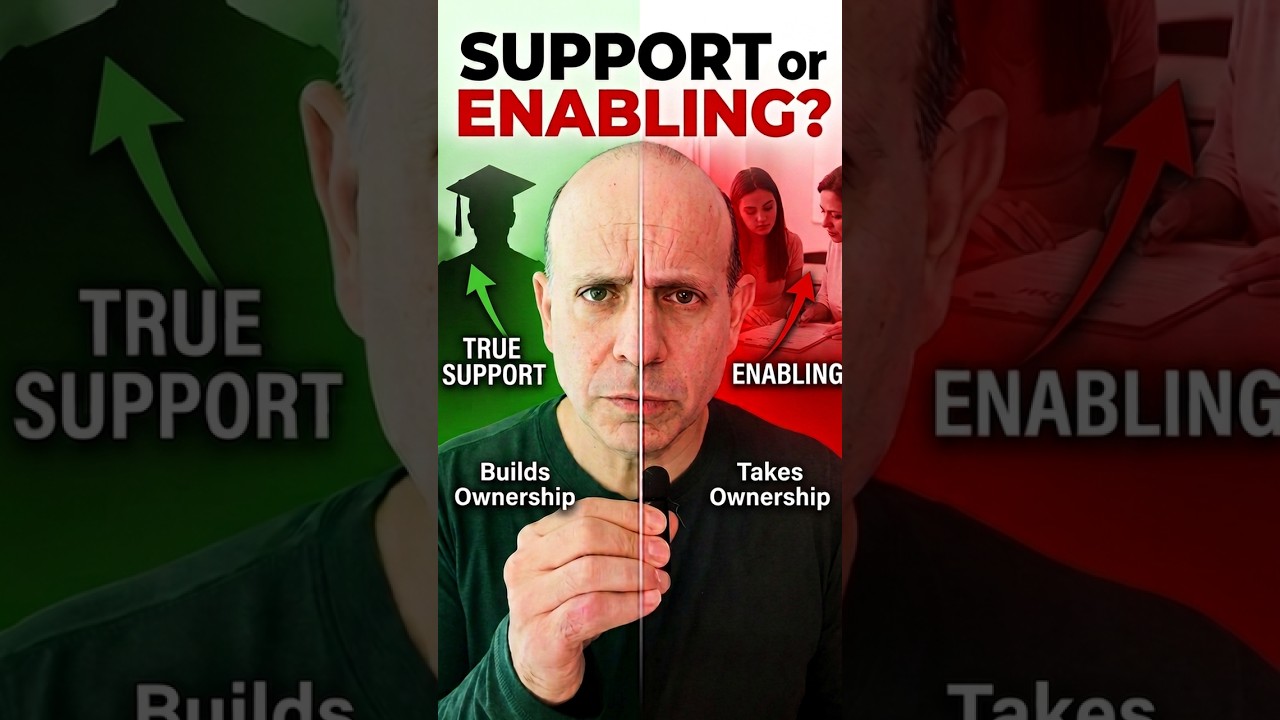
When Helping Your Adult Child Becomes Enabling #parenting #family #relationships
Don't fight over their gaming habits—try this instead #parentingadvice #boundaries