Grocery Store Salad VS. Home Grown Salad
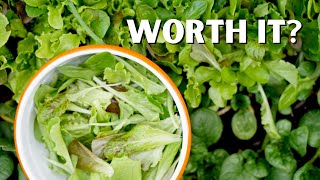
Nicole Johnsey Burke (with team member Sydney) compares the cost of eating a 16‑oz salad daily for six months from grocery-store prepackaged salad boxes versus growing the same amount at home in a small raised bed. Using conservative assumptions (organic salad box = $6, three salads per box, 30 days/month, 6 months), she calculates grocery cost at $360. For home growing she estimates seeds ($20), soil ($80 for ~8 cu ft at $10/cu ft), raised bed ($100), and water ($5) totaling $205. Over 180 salads (30 days × 6 months) that yields ~ $1.14 per homegrown salad versus $2.00 per store-bought salad. The video also demonstrates planting technique (row spacing, staggered rows), recommended soil blend (sandy loam: topsoil:sand:compost ≈ 1:1:1 plus worm castings), light (≈4 hours/day), watering timeline (daily-ish for first 2 weeks, then 1–2×/week), and time-to-harvest (25–30 days to sprout; ~40–45 days to daily harvests).
Questions this video answers
$6 per 16‑oz box.
3 salads per box.
10 boxes per month.
60 boxes.
$360.
Chapters
Is growing your own lettuce at home actually worth it? Today, we're going to break down the actual prices of both. We're going to cover the cost of building a raised bed using organic soil and lots of seeds and water, and compare those prices to grocery store lettuce. These numbers are going to surprise you and just might change the way you eat salad forever. We're going to be doing a ton of very complicated calculations for this video, so I had to ask one of my lovely team members, Sydney, to come and join us.
Hi.
Sydney's our head of content, and I've been trying to get her to grow her own lettuce for at least a year. So I'm hoping that today's video will convince her. We'll see. All right, so to get started, we're gonna add up how much it costs to grow your own lettuce at home, because everybody at home thinks that it costs too much. Did you think that when you first started here? Yeah. Yeah. Cause it can. I mean, I think it takes a.
Lot more to grow your own salad.
Yeah, everybody that. That hasn't gardened yet, they're pretty much assuming it's just too expensive. All right, so I'm gonna give you this pen, and you're going to do the hard math for us, all right? I don't know if you're right. Did you bring your calculator?
No, it's all up here.
All right, so we're going to start with something we all know we're familiar with. And this is the famous lettuce box. Have you ever bought one of these?
I'm familiar. I've bought lots, and they've rotted away in my fridge.
Yeah, I mean, let's not. Let's not talk about all the lettuce that's gone to a sad place to die. Each of these costs, if you buy organic, a minimum of six bucks. I'm not even adding tax or whatever other fees might be associated, like the stress of walking through the grocery store and checking out, but just $6 alone. So we're going to say each salad box is $6. We're keeping this very conservative here. So six bucks here, probably depending on where you live in the United States or outside of the US Might be a little bit more or less, but I think six is a good, safe number.
It's a good medium.
Yeah, yeah, yeah. So this is for 16 ounces of salad is six. Six bucks. Now, what we're going to assume here is that you're eating a salad a Day, Sydney. Is this.
Sure, I am.
So let's pretend that all of us are actually, like, the flavor of this salad, and we're. We're digging in and eating three. One salad a day. And I'm assuming I've kind of poured these out onto salad bowls, and you can get three pretty good sized salads from one box. Now, would you want to eat that much? I don't know. But it's. It's possible, right? It's possible. So let's assume all of us at home, me and Sydney, we're being our healthiest self, and we're eating a salad a day. So if we can get three salads out of one box, then to have a salad every single day for a month, let's assume there's 30 days in a month. We know there's February in there, but 30 days in a month, this means you need about 10 boxes to get through one month. Okay, Are you following me?
Yeah, I am.
All right, so 10 boxes a month to get you one salad a day. Following me? Yes. We got it. Everybody at home, you're with us. I know, I know. This is math. So now what we're going to do, if we need 10 boxes a month, and it's six doll dollars per box, we're gonna do a little bit of, you know, multiplication here, right? So total boxes, we're gonna need. If we're gonna cover six months. Six months times ten a month, that gives us. 60. 60. We need a total of 60 boxes, y'. All. Oh, my gosh. 60. Can you imagine these adding up? No, I mean, 60 boxes so far. I'm only at four. And. Oh, my God.
And can I just point out what everybody's thinking also? Look at all this plastic.
60 boxes. So this is four. Imagine this 15 times as high.
It would be, like, crazy. Four of you.
Yeah. All right, so 60 total boxes.
60.
And now this is gonna. I mean, I hired you for skills other than math, but let's see, can you do it? 60 boxes times $6 a piece. 6 times 6.
6 times 6 is. Oh, my God. 36 out of 0.
360. $360. My friend and I did not cheat to eat a cardboard salad a day for six months.
Wait, that's a lot.
360. Plus tax, plus shipping, plus stressful grocery shopping.
Yeah, and that's just the leaves. That doesn't even.
Yeah, you didn't do any dressing.
The other stuff, you didn't even get any. Cruising the nuts and the seeds.
All right, so $360. We covered that. So now let's talk about the other alternative, which is growing your own. Okay. I wonder which one I'm gonna like better. I don't know. Okay, let's start with seeds. So to grow six months of salad, this means to have a harvest a day for six months, you're gonna need at least right around four packages of seed and salad seeds. If you're buying gardenary seeds, they cost less than this. But in general on the market, let's round up to like $5 a seed package. So four packs of seed at $5 a piece gives us $20. 24 times 5, 4, 8, 12, 16. Do you remember those songs? No. Okay. No, I didn't have those. That was my homeschooling days. All right, so $20 for seeds, and that's a pretty good conservative number. Now let's talk about soil. So we're going to be growing this garden, this little salad garden in about 16 square feet. This little gardenary salad box is a great example. I think this one is actually more like 12 square feet. Okay. But I'm using around 16 square feet to think through the soil measurement. You can grow lettuce. I don't know if you knew this, but you know how my beds are like really deep. You don't that kind of depth. To grow lettuce, you only need 6 inches because the roots are so small. Exactly. The root systems are. She has picked up on a few things.
I've learned a few things.
So the root systems are so shallow, you really don't need a deep bed. All right, so all we need is about 8 cubic feet of soil. And you're going to use the gardenary soil blend, which is not inexpensive. This isn't like a fifteen dollar bag of soil. So it's sand, compost, topsoil all mixed together. That works out to be about $10 per cubic foot. Okay. And we've got eight, $80 exactly. So we're spending about $80 on soil. This is for a 16 square foot garden that's six inches tall. So a nice little, short little bed. Or you can do the gardenary style bed here like this and just fill it up with about $80 worth of soil.
You could do that in a little herb container like we have too.
Yeah, I'm making this as expensive as it could be so that people at home don't think. I kind of rigged the system, you know, like, this is for a nice garden. This is for a big good size that is pretty easy to take care of. Got it. Yeah.
All right, got it.
Raised bed. We have a gardenary raised bed that we teach you how to make for how much?
Under a hundred dollars.
Under a hundred dollars? We just got back from Home Depot, like, two days ago. It's possible. And the receipts were less.
Yeah, it was like $60 to get everything.
Yeah. So we're gonna call it a hundred dollars. And this is for a 4x4 bed. The bed we built is a foot tall, but you could build the same bed for six. At six inches, it would work perfectly well. So $100 for the raised bed, and then the water is pretty minimal. We're talking like a sprinkle. I mean, it's not. We're not heavy watering here. So I put it about $5. Now, if you live in California, it might be 50. I don't know. But in Tennessee, it's less than $5 you're going to use over this time period. So now it is time to do the calculation. Oh, God.
Is it.
20 plus 80 is 100. 100. 100 plus 100 is 200. 200 plus 5 is 205. 205. All right, so $205 to grow your own. Got it. So 360 for grocery, 205 to grow your own. So now let's pull this all together in my handy dandy chart. You're doing great, by the way. Oh, thank you. Yeah, I think you're gonna. You're gonna be able to stay on the team for a little while.
I feel like Vanna White.
Okay, let's bring our calculations from the other page to this one. So our total cost we had was 205.
Two oh five.
Right. And then our store bought. Do you remember? 360. 360. 360. All right, so total salads, we're assuming there's about 30 days per month over six months. So 30 salads a month for six months. 30 times six is 180. 180. That was good. That's fast math. Yes. 180 salads. That's right. So then we want to get our cost per salad. You can do this one, too, for 180.
Okay. Same thing.
Get the same amount of salad. Yeah, it's just different. So for a homegrown, we're going to divide $205 by 180. And don't worry, I can't do that. We did it ahead of time. And it is a $14.
Oh, okay, $14.
There's a cheat sheet down there, but.
I didn't hear that.
Yeah. No, we never looked. Never ever paid attention. A dollar.
Oops. That's a time stamp. A$14.
You can do it. Sydney. Vanna. What's going on? Fancy. With her? Yeah. Yeah.
Just ignore that.
All right, now, $360 divided by 180 salads, and that is 2 bucks. I need a bucks. So $2 a salad if you get it from the grocery store. So there you have it, my friends. If you ate a salad every single day for six months, you would pay almost twice as much. Yeah. And you would also get way more plastic. Yes. Way less flavor.
Yes.
Way less variety.
Yeah.
And way more trash.
Yeah.
Because let's be honest, who's going to finish this entire box of salad before it goes bad?
Not me. And that was what I was going to bring up is like, that's speaking about if you actually get a chance to finish the whole box. Who actually does that?
It's so hard. Because lettuces weren't meant to be shipped. No. That was something I realized when I started gardening is. And I started growing my own is. I was like. I would cut it from the garden and have it in the bowl. And I'm telling you, within like, an hour, that lettuce had wilted. Yeah. Like, it was. It was not even. I didn't even want to eat it, even though I'd grown it myself. Yeah. And I'm like, how is this stuff holding its structure after it's gotten shipped from Salinas, California? Right. It's crazy.
And it makes it sweaty. Like, the plastic literally does make it sweat, which makes it go bad quicker.
Yeah. So I don't know. I'm feeling like we should plant this box up and show the people how they could save money, grow their own lettuce. Skip the plastic, skip the trash, skip the stinky salad and start growing their own. What do you think?
I would love that. I need to be schooled on how to do it because I failed last year.
Oh, no, no. That will not be happening again. Okay. All right, let's dig in. All right, Sydney, I'm going to show you how fast and easy it is to grow your own lettuce. I'm going to get you planting and then tell you all the things you need to keep these plants alive. There'll be no more salad growing failures in your. Especially this year. Yes, ma'. Am. All right, so we're going to start with some lettuce seed, and we're just working in this small raised bed. Right. Before you plant, you want to rake it out and just be sure that it's nice and level. These seeds are tiny, and they will tend to move with water on a slope. So you just like to make sure that your soil is mostly leveled out and that there aren't any big clumps, no big, you know, pieces of wood or anything like that that are going to impede the salad seeds from growing. Because as you know and as you've seen, these guys are tiny. Tiny. All right, we're going to be using a seed spacing ruler. And what I want you to do is you're just going to. You're just going to move this down in rows. So we'll plant all the lettuce in rows, and you're going to. I'm going to empty a few seeds into your hand. And I know it seems impossible, but if you can, try to just put one seed in the hole, and you're actually going to skip three spots in between each one. Okay. So you'll drop a seed. So skip two spots and then drop another one. So 1 inch, 4 inch, 7 inch, 10 inch. And then we'll move the seed spacing ruler along. Got it.
And I'm going to move in rows this way.
Exactly. You're going to go all the way down this line. And then once we finish that one, you'll lift this up and you'll start the next one. The next one you're going to stagger. So instead of being right in front, you'll be one over. Ah.
So 2, 5, 8.
Yes. 11. You got it. And you'll do it one more time, and we'll go all the way down.
I see, I see.
All right, so as you do that, we're going to talk through the needs of lettuce. Okay. Okay, Go for it.
Here we go.
One or two. If you have to do two, I'll forgive you, but. Oh, you're doing great. Amazing.
It actually is really hard to just put one.
It is. I actually saw a friend, she did this where she licked her finger. Oh, I don't know if you're into that sort of thing.
That's what I do when I'm reading a book.
Maybe do it before you touch the dirt. All right, so let's talk about the five needs for growing your own salad. All right, so the first thing you're going to need, obviously, that we've already introduced, are seeds. I highly recommend growing a spring mix. That's what you're used to buying from the grocery store. These are flavors you're accustomed to. You can branch out and grow other greens later. But starting with a spring mix is going to feel so familiar and it will definitely feel like that replacement. And now you're literally taking something you were buying from the grocery store and you're skipping past it and going home, going out to your backyard and grabbing it instead.
That's my favorite part of growing your own food is just supplementing the small things.
Yeah, small things. I mean, I used to text my husband and be like, just save $6. And he was like, all right, 5,000 more to go. But anyway, it really does start to add up. And there's something that feels so good about just walking past it at the, at the grocery store. So you need the seeds. I love the spring mix. We have this in the gardenary shop. You can check out our seed collection in the link below this video. The next thing you need is a container. So I do highly recommend growing lettuce not directly in the soil. Most of us have really thick clay soil just right, you know, in our backyards. And it's just so much easier to tend and take care of. And as you can see, even from today's, this planting, you're just starting fresh. You've got everything you need right in this little spot. It makes it really easy to harvest, really easy to tend. You don't have to start with a bed this big. We outlined a hundred dollar raised bed you could build. But you could, as you said, even start with a small pot. Don't have a pot that's less than 2 square feet total because the lettuce will dry out and it's a lot harder to take care of. A lot of people start with small containers. Have you ever done this and you think it's going to be easier? It's actually harder. So the bigger container you have, the easier it will be to maintain. Once you've got this space, you do want to make sure your seeds have enough space. So what you're doing right now is, is you're giving every plant, every seed about 3 inches to grow to full maturity in the garden. And you want to do that as you plant your seeds. You want to think about, you know, like a lettuce head. You ever bought those little like butter crunches where it's like in this big plastic thing.
If I have to buy lettuce from the store, that's what I buy.
It's so much tastier, right?
Yeah.
And a lot of times it's even attached to its roots. So that size, that's what you want to picture as you're planting these seeds. You need to let every seed grow to that size. Got it.
And that was honestly the biggest mistake I made last year.
I tried.
I literally took a. A pack of these and just, like, kind of threw them in a bed, and they all grew in, like, beautifully, but they got tangled and mangled with each other. And then I was like, this is just too much. I can't even tell which one is which. So this spacing is, like, the. The top tip for me today.
Awesome. This year we will have. No, none of that. No, none of that. Mix up. No. All right. Transformed. Okay, so space. And then the next thing you need, obviously, is soil. So the kind of soil I recommend growing in is a sandy loam. And this is my 103 blend. It's topsoil, sand, and compost all mixed together. A third, a third, a third, and then a little bit of earthworm castings. So you need a light, fluffy soil. As you can see, these seeds are really tiny. They don't want to grow in a really thick, heavy soil, but you don't need a ton of nutrients. These plants aren't fruiting, they're not flowering. All they need is a really good source of nitrogen, and you'll get this from the sandy loam soil. Beautiful. We're almost done. You need some sunshine, but not too much if you've got a shaded yard. If you're on a patio or a porch, you can still grow lettuce. All you need is, like, four hours of sun a day. Oh, that's not much. Yeah. So right now, this is going to work up here on this deck because it's spring and it's not going to be too hot. But this would actually not be ideal in the middle of the summer because it would just be too much sun for the lettuce, which is kind of crazy to think about. Most people think they don't have enough sun, but for lettuce, there's such a thing as too much.
This is one of the things you can grow if you have shade.
Absolutely. So four hours of sun is all you need. And then the last component you need is water. And the most important time to water your lettuce is literally right after Sydney finishes planting this garden and then for the next two weeks. So keeping these seeds pretty much saturated with water is important for the first two weeks of planting. Then once they start to grow in and give the soil some coverage, you can back off and really just water. If there's no rain, you're just going to water Maybe once or twice a week. Watering becomes a lot simpler once the seeds sprout. But you do need to be sure you're at home and able to water every single day at least a little bit to get those seeds to sprout from the beginning. And that's it. So these start to grow in 25 to 30 days after planting, and by about day 40, 45, you're gonna start getting that one harvest a day from your salad garden every single day. So just imagine those little salad boxes we had and pretend like that box is sitting right here. And instead of having all that plastic and stuff from the grocery, you're just literally cutting a little bowl of salad, eating it, and then coming back the next day and cutting the next little salad.
It sounds like a dream, honestly.
All right, Sydney, tell the people what you learned today.
Well, I did say my top thing is that you have to space these out, even though these seeds feel so small. And like, it was really fun to just kind of sprinkle them wherever, but the results, you know, spoke for themselves. So I'm excited to go back to my planters and plant them in rows nicely like this. Also, I learned that, yeah, it actually does save a lot of money if you grow your own salad. And it's possible in a small amount of space. I love the. The point about how they don't. You don't really need that much soil. You just need a little bit six inches. Wait, that's not six inches. It's like more like this.
Yeah.
Yeah, those are. Those are the top things I learned.
Yeah.
Yeah.
So twice the price to buy grocery store salad and a lot less variety, a lot less nutrition, a lot less flavor. Flavor and a lot more plastic and fuel. So for me, I don't know, the math is mathing.
Yeah, it's mathing for me too. It's kind of a no brainer.
Yeah. So I think all of us, you, me, Sydney, we should all start growing our own lettuce this season. I would love to help you do just that. We've got seeds for you. We'll put the link for my favorite salad seeds. And in the description, do you have some gardenary seeds? I do. All right. Yeah. So you got yours, I got mine. We'll get you yours. In the description. I also have a book called Leaves, Roots, and Fruit, and it teaches you how to grow tons of greens in the first section of the book, all in the leaves section, because leaves are actually the easiest thing to grow in the garden.
Yeah, I've heard you say that multiple times.
I say it pretty much every single day. Now, if you want to just plug and play our entire gardenary salad system, you can actually get this entire kit sent to your doorstep. So the cedar raised bed, you can get a standing variety. You can get one that goes right on the ground. You can get the seed spacing ruler, the seeds and our salad gardening course, all of that is in our salad garden system. And we'll put a link for that right below the video for those people who just like to make it easy on themselves.
Yeah, that course, I mean, don't walk, run.
Thank you guys so much for hanging out with me and Sydney and our salad garden today. I hope that we have convinced you that. That the math actually proves that gardening is. It's. It's worth it. Yeah, it's absolutely worth it. Don't forget to subscribe and tell us in the comments what price comparison you would like to see next. I love doing this video for you because it was really assuring to me that, like, hey, all that money I'm spending on my garden, it's eventually going to pay me back.
It adds up. Absolutely.
We'll see you next time. Thanks for being part of the gardenary community and thank you so much, Sydney, for growing salad with me. Yay.
Thanks for teaching me.
See you next time. Bye.
More from Nicole

Propagation is the secret to turn 1 oregano plant into 100 that’ll last forever! #garden #herbs

Plant some garlic this fall and you’ll never run out. Just follow these steps #garlic #gardening

Head to Gardenary.com to try out my FREE custom planting plan creator #garden #gardendesign #plants

Frost is coming so harvest all your tomatoes and make this soup🍅#garden #recipe #tomatosoup #tomato

Say bye to grocery store herbs this winter if you harvest and dry some of your own👀#garden #herbs

Can you grow your own Ube?! Let’s see if I grew anything besides purple vines🍠#garden #ube #plants

If your garden didn’t turn out how you wanted, it’s time for a fresh start😌#garden #fallgarden

Turns out you don’t have to sit at a desk all day…you can stay in the garden☀️#garden #meme #9to5

Do NOT buy soil with artificial fertilizers if you want a natural, organic garden😬#garden #soil


I wasn’t meant to send emails or work 9 to 5, I’m meant to stay in the garden all day🌿#garden #meme