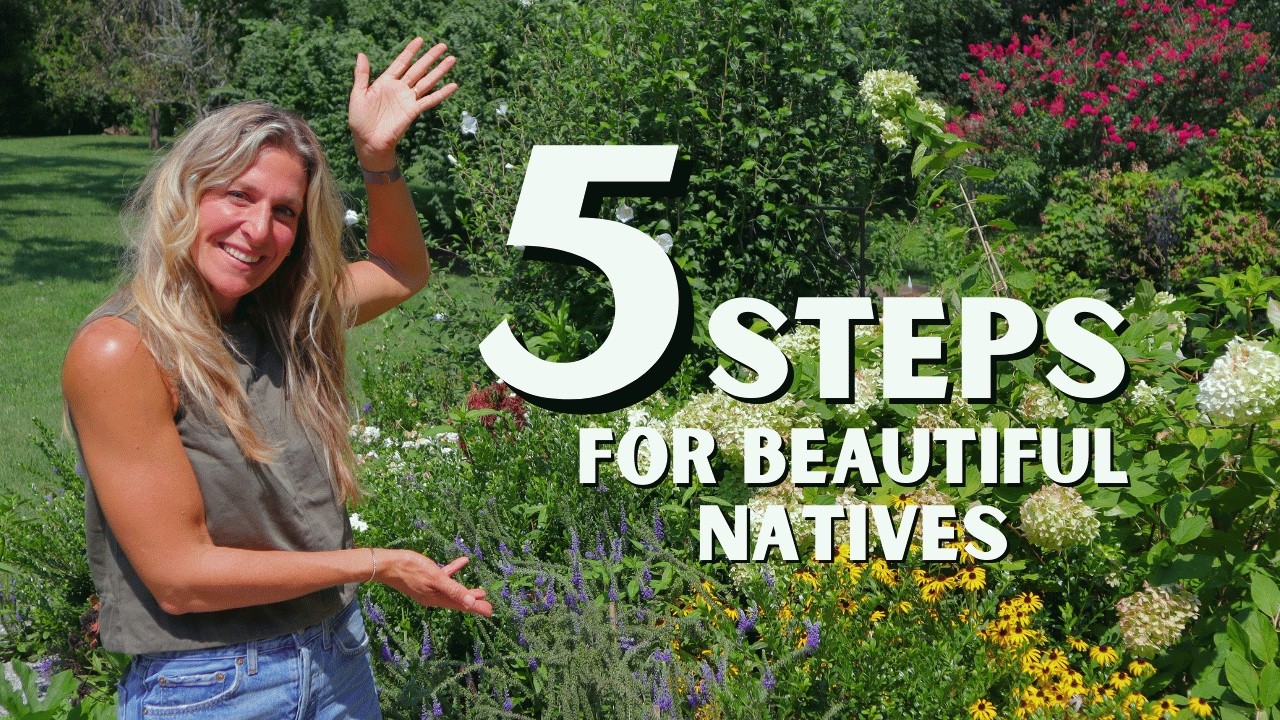
Nicole Johnsey Burke walks through five steps to design a native plant garden: identify what grows in your region, organize plants by size into tiers, mix evergreens and grasses for year-round structure, stagger blooms from spring through fall, and know you can blend native plants with ornamentals. Design is the hard part; after that, maintenance drops.
Chapters
If you know you should set up a native plant garden, but you're afraid it's going to be ugly, then this is a video you've got to watch because in the next few minutes, I'm going to share with you my native plant garden design system so that you know the step-by-step to set up a native plant space that is good for the environment, but also is so beautiful you won't be able to stop staring at it. I'm going to be using this native plant space to teach you all the steps, so let's get into it. You probably already know this, but native plants are one of the best things we can do for the environment. Number one, native plants are literally native to your area. These are plants that would grow in the wild if no one was there to tend them. So native plants will take way less resources to grow and to keep alive. This means you won't have to water them once they're established. You don't have to fertilize them or tend them. You really don't have to do anything for native plants except for get them into the ground in the first place. Next, all the wildlife in your area, they have grown over the hundreds, thousands of years to depend on native plants for Survival. So when you put native plants into your landscape, you are providing a food source for wildlife. You're providing a place for them to take shelter and also a place for them to raise their young. And this is super important as we are increasingly diminishing the wild that is available to our wildlife. You get to give them a place to live in your own backyard. And then finally, native plants actually bring ecological balance to your yard. They actually create an ecosystem. So if you have way too many mosquitoes, way too many pests in any one part of your landscape, it could be because you're missing native plants. Native plants feed pollinators, and they also bring a balance between predators and pests that can balance out a bug problem in your grass but also can keep pests out of your vegetable garden. There's really no reason why all of us shouldn't be growing native plants in our yards, but most of us are afraid that native plants are honestly kind of wild and ugly. So in the next few minutes, I'm going to show you how we can fix that. Before you start designing and doing my step-by-step, you gotta figure out, number one, what are the native plants for your area? And number two, which of those native plants can you actually get your hands on? So we've got a resource right below this video where you can find the native plants for your particular area. You're just gonna get a full list. Then I want you to call up a local nursery or garden center, local to you, not the big box places, and you're gonna get a full plant list from them. Then you're gonna have to do a little bit of homework, and you're gonna match the two. Take the list of the plants that are native to your area and then match them with what your local nursery or garden center has. So first, ask your nursery if they've got that. If they don't, you gotta do the hard work. Now let's get into step number 1. The first step is dividing your native plants into 3 categories, and this is what I call the size category. We're gonna be labeling these plants as small, medium, and large. A lot of times when you walk into a native plant garden or you're just out in the wild and things look all bushy and crazy and messy, it's because they were not planted by size. But you're going to fix that. Large plants are going to be categorized as plants that are going to go from 3 to 5 feet in terms of their horizontal space, and then their height will be at least 3 to 5 feet as well. So we're thinking here shrubs and bushes, things that could even be like small trees. Those are the kind of plants that we want to label as large. Next, we want to have medium-sized plants. These are going to take up 1 to 2 square feet in terms of their horizontal space and then 1 to 2 feet in terms of their height. These are going to be some of your smaller bushes shrubs. They may even be some grasses that kind of spread out to take up about a 2 by 2 space. And then finally, we have our small plants. These are going to be 2 to 3 per square foot, much smaller plants that will spread but take up a very small footprint when planted. So you're going to take your list of native plants that are available in your local area, and you're going to divide them into large, medium, and small, and then you're going to start to make a design plan. So in any space where you want to create your native plant garden, we want to create rows. First of large plants. So you want to give one large plant about 3 to 5 feet of space in your plan. And then for every large plant, you wanna have about 2 medium-sized plants. So these are gonna take up 1 to 2 feet of space in your garden. And then in front of those medium-sized plants, you wanna have 3 to 5 small plants. This is going to create a tiered look in your native plant space, which is immediately gonna give it some order and sophistication, even though you're growing plants that are absolutely wild. Once you've got your design based on the size of the plants, Then we're going to study the structure of the plants, and that's step 2. One thing I want to clarify is that a native plant garden doesn't have to be 100% native in order for it to count. I am not an all-or-nothing gardener. I totally believe in doing something 50, 60, 70%, and it actually counting. So the native plant garden spaces that I put in for clients, they're usually a mix of mostly natives but also some ornamentals that my client just wanted to include. In this case, it's these hydrangeas. So when you set up your native plant garden, don't feel boxed in like it has to be 100% native. 100% native. You can have fun and put in some other plants in there too. I won't tell anybody. So we fixed the mess and wildness by dividing our plants by their size, but what about the winter? So many native plant gardens just look terrible in the middle of winter because everything that looked gorgeous in summer is completely dead, and that's where the structure of your native plants really comes into play. For the first few years, I only planted the blooming plants in my native plant garden, and it just looked awful in the middle of January, and that's when I learned this trick to balance out the structure of my plants so that there was always something beautiful and kind of holding the architecture of the native plant space together throughout the entirety of the year. So as you look at your native plant list, you don't just want to pay attention to the size. You want to pay attention to what type of structure this plant will have. First and most important is we want to have some evergreen plants, plants that literally will be green all 12 months of the year. You want to have evergreen plants as a major part of your native plant system. Then you want to have some grasses. These plants still, their primary production are going to be leaves. They may have some plumes and seed heads that they'll produce as well, but their primary function will be creating leafy greens in your native plant system. You also want to have grasses there. And then finally, you of course want to have some bloomers, so things that you're growing primarily to see the flowers from. Once you've got your plants not just divided by size but by their structure— evergreens, grasses, and flowers— Then you want to be sure that at least a third of your plants in all 3 sizes— large, medium, and small— at least a third of those plants are going to be either evergreens or grasses. This is going to give you that year-round beauty in the garden, even after your flowers are long gone. If setting up a native plant garden sounds like something you're into and you want my help to do this step by step, I actually have an entire course on how I do my native plant gardens, and it's actually on sale right now. So if you're interested, if that's your thing, I'll put a link right below this video. Once you've determined the And the structure of your plants, it's time to pay attention to the sequence. We don't just want evergreens throughout the year; we also want blooms for as much of the year as possible. So all those flowers that you put into your design, you now want to make sure that you have plants that are going to bloom throughout the different seasons of the year. And good news: in almost every area, there are native plants that put on color in the beginning of the spring all the way to the end of the fall. Most of us miss this fact, and we just have a native plant garden filled with coneflower, so we get flowers for 1 or 2 months. Out of the whole season, and the rest of the time it's just green. But not you because you watched this video. So you want to make sure you find enough flowers that bloom in the early spring. We have some wild roses that put out blooms very early in the year. Then as you move to the middle of the summer, this is going to be probably the easiest time to find blooms, so you want to be sure you don't overdo it, that you have some of your best blooms from the beginning of June to the middle of August. And then A bloom time that most of us forget is the fall. You want to be sure that you find some plants that love to put on color and really do their best blooming when the temperatures start to cool down and the daylight hours shrink. This way, you're going to have flowers all the way from March or April till September, October, maybe even November. And a bonus is you can find some grasses that put on color either in the spring or in the late summer, and you can use those grasses to add to the color of your native plant space too. Now, once you've figured out the size, the structure, and the sequence of your native plants, all that's left to do is actually put them into the ground. Native plants are amazing because they take so little care, so the hardest job is something we've just done together, which is design a native plant space that you actually love and want to look at and keep. We did an entire vlog of setting up this whole garden space, from the raised beds, the trellises, to the whole native plant garden space, and you might want to watch it to see the entire process. It's right here.