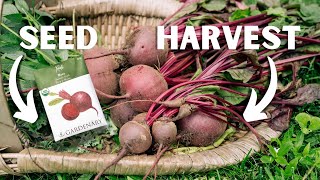
Nicole Johnsey Burke’s YouTube tutorial explains how to grow beets from seed to harvest, covering seed appearance, shallow planting depth, finger-based spacing rules, a staged growth timeline (about 30 days, 60 days, and ~100–120 days to maturity), and care tips (compost, regular watering, season windows). The video emphasizes beets’ nutritional value and offers practical, easy-to-follow steps for home gardeners.
Chapters
How long does it take to go from this to this? Today we got the beat. We're talking about beets and how long it takes to grow beets from seed. Beets are roots that are so good for you. I mean, look at this color. When you eat a root, you can know you're eating one of the most nutritious parts of the plant. Why? Because this is where the plants store their nutrition. When plants are growing and they know they've got to pack in the vitamins, the nutrients, and to grow to the next level, they put all that goodness in the root. So when you eat the roots, you are going to be so healthy, you are going to be so full of good stuff. So let's talk about what it takes to get a seed to turn in to this. Now, beets grow underground, and a lot of times their growth is a little bit mysterious. I like to group beets alongside radishes and carrots when I think about the crops in my garden. In fact, in my second book, Leaves, Roots and Fruit, I talk about this concept that leaves are the easiest thing to grow in the garden. Roots are a little bit more complicated, and then fruits are the most complicated. So you're going to find beets right there in the middle and between radishes, carrots, and beets. Honestly, beets are the ones that take the longest in the garden, and I've found the most complicated to grow, or at least the ones that it's taken me the longest to really fit figure out in the garden. I think a lot of it is due to the spacing and also just how long it takes to turn a seed into this delicious, nutritious root. So let's take a look into my beet bed where I've been planting for a couple of months, and show you what beets look all along the way as they go from this to this. All right, when beets start out, you've got this tiny seed. Beets are in the same plant family as spinach and Swiss chard. And you're going to find that those seeds look very similar to one another. Now, they say that in each of these seeds, it's actually two plants. And you'll start to see this as we go through the garden, that when you plant just one of these beet seeds, two small plants will grow from the one seed. Some gardeners are going to tell you to come back and thin one little seedling off of the other. I generally just leave them and let them be and kind of duke it out as they grow. It so we're going to take these seeds and what you do is plant them just at a little bit of depth in the garden. A key to having success in the garden is not burying your seeds too deeply. Most gardeners I know that have trouble starting from seed, it's because they bury the seeds too deep. And those seeds, just as they're starting to grow and ready to find the sunlight to get some photosynthesis to help them go to the next level, they're still stuck in the dirt and cannot find their way to the surface. And so for these tiny little beet seeds, we only want to bury them two times their size. So in a little space like this, really it's as simple as just getting your finger, getting a little dibber and then just burying it just like that. So really less than one inch deep. So that's going to be at day zero. That is what it's like to plant out these beet seeds. When I think about spacing for my root crops, I generally do two fingers for radish seeds, three fingers for carrots and four fingers for beets. That allows each of these root crops to have as much space as they need to grow. This works. You can see if I take one of these beets, probably one of my most mature beets that I grew in the garden, if I take four fingers, you can see how that almost perfectly covers the width of the beet. So if you plant your beets at a four finger, four finger division, you won't have to do much thinning as they start to grow to the next level. So that's at level one, when you get the seeds started. You want to be starting these seeds when the weather is either starting to warm up at the very beginning of spring or as the weather is just starting to cool down at the end of summer. Beginning of fall, if you're in a really mild temperate area, you can grow these all through the wintertime. Beets do not mind frost, but they do start to stress a little bit in heat. So the beets you're seeing here in my garden have been here for quite some time and we're in the middle of summer, so we've had 90 degree weather for many days on end. So you can see these greens are a little like worse for the wear, but the beets are still hanging on. So we're going to look at a couple of different levels of growth and what beets, what you can expect beets to look at throughout their growing period. So right here, what we have is a beetle that is probably at about 30 days after planting. So this in general is what your little beet is going to look like. They're going to take quite a long time, one to two weeks to turn into a seedling and then it's going to take up to a month for you to get this growth at this level. Next up we have one that is about at 60 days. So you can see this has almost doubled the size of this first one here at 30 and, and you're going to get more greens, more bulb size, more root size. And this is when it's starting to get to its place where it's going to go all the way to full maturity. So this is 30 days, 60 days. This is when you really want to be sure that you've got nice nutrients around your plants. I love to add a little bit of mushroom compost right around the base of all my beets right at this point. And then this is also when you be sure that there's plenty of, plenty of water on your crops, because water is what's going to kind of energize this plant to grow to the next level and to really expand its root size so that it's harvestable. This here is one that has definitely reached full maturity and has been in the garden about a hundred days. So you can see how it took this root size here and then has really like 3x4x days it. So we're probably at, we're even past 100 days, if I do the math, probably at more like 110, 120 days from the moment that I planted it from seed. So we've got 30 days in, 60 days in, and at about 110 days in. So you can see how long it takes to go from this tiny little seed all the way to this delicious mature beet. So depending on when you're watching this video, it is probably time for you to be thinking about growing beets yourself. If it's in the cold winter, it's time to order those seeds and get ready to plant as soon as the soil is workable. If it's in the middle of spring, it's time to plant some more beets to push you all the way through the summer. And then even if it's in the summer, it's time to get some beet seeds so that you can enjoy beets all throughout the fall season. There really is no time of the year that we shouldn't be thinking about beets either. Ordering the seeds plus planting the seeds, adding a little bit of compost and water to our plants or harvesting these things so we can enjoy them in the kitchen. Beets are a true superfood. You can see all these dark colors in the leaves and in the root. You get so much nutrition when you eat these, and you especially get this nutrition when you eat the ones that you grew yourself. When you pull these right from the soil that you know you've grown in organic method, bring it into your kitchen and cook it up. The goodness you do for your body is literally impossible to get from any other source. So are you going to have the beet too? I hope so. It's only going to take like 120 days. I mean, you can do this. So tell me if you've got any questions about growing beets right below this video you can find out how to get our gardenary seeds so that you can grow your own beets from seed the gardenary way right below this video as well. Thanks so much for watching. Don't forget to subscribe to the gardenary channel so you can see when I harvest some more delicious things like this beet and I'll see you next time.