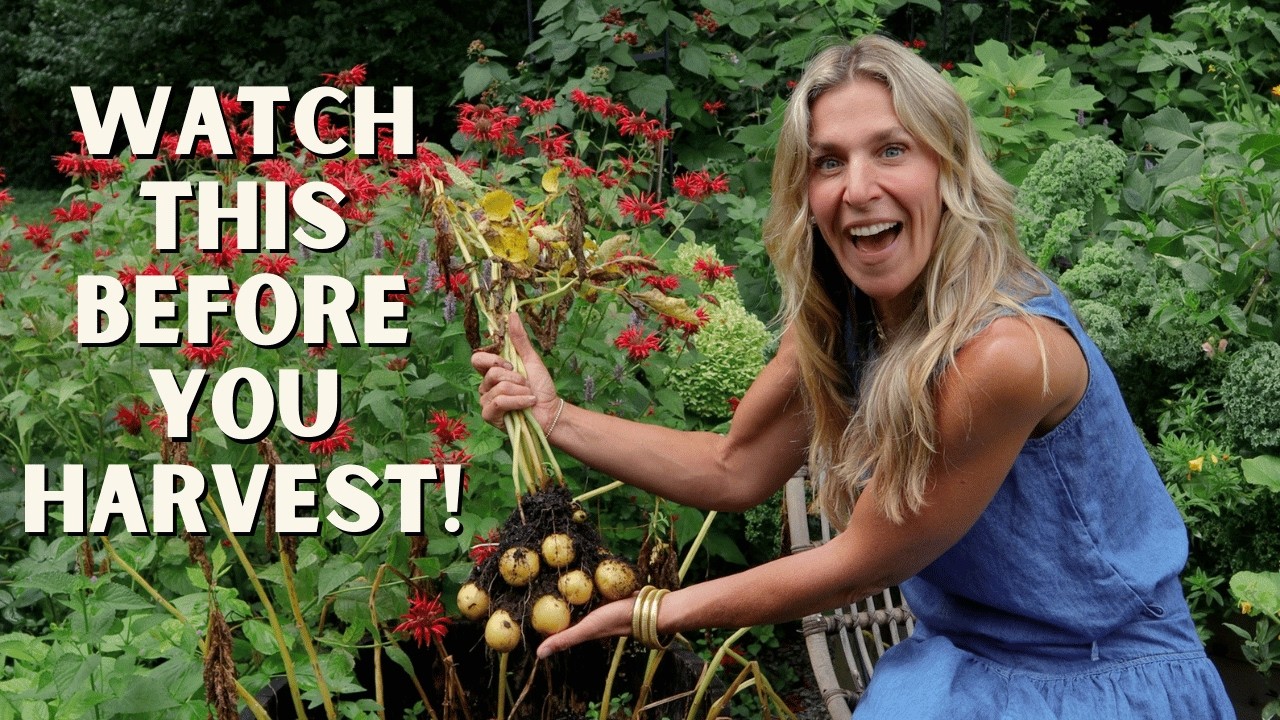
Nicole Johnsey Burke shows when to harvest potatoes by watching the leaves: yellowing signals baby potatoes, brown stems mean a full harvest. Expect 30 to 40 potatoes per barrel. Dig 5 to 6 inches around the plant with a spade, support the stem, and pull gently to avoid bruising the tubers.
Chapters
Potatoes are one of the most exciting things to grow in the garden, but how do you know when they're ready to harvest? A few months ago, I planted loads of potatoes in 4 whiskey barrels in my garden, and today they all basically look like they're dead. But in this video, I'm going to show you why that's actually a good sign so that you know exactly when to harvest your own potatoes. I'm also going to throw in a few mistakes that you should avoid so that you get the biggest and the best harvest possible. Potatoes are in the Solanaceae family, the same plant family as tomatoes, peppers, eggplants. You'll notice this with the leaves. The leaves look very similar to tomato leaves, but potatoes grow totally differently than those other plants. The first way is in the planting. You're going to take a tuber like this and literally stick it underground. I did this in these whiskey barrels. You could also do it just directly in the ground in your garden. I don't recommend planting potatoes in your raised bed. I made a whole video about that. I'll link it right below this video. So you're going to put the tuber right underneath the soil, and then you're going to start to see these leaves pop up above the soil, and what's happening is the more these leaves grow, the more your potatoes form underground. So you want to let the leafy greens above the plant grow as long and as big as possible. The more leafy green growth, the more potatoes underground. You just have to trust the process. But once these plants have been in the ground for about 2, almost 3 months, you're going to start to see some decay in the plants. The first sign is the yellowing leaves, and if you've never grown potatoes before, you're going to think, "Oh my gosh, my plant's dying, and I didn't even get one potato!" But this is actually a sign that you're on your way to a great harvest. So as these leaves start to yellow, this is your sign that you could actually do your very first potato harvest. You wouldn't want to dig the entire plant at this point because it's not fully finished, but if you're just feeling the urge to have a homegrown potato, this is your moment to dig in and get a few. So what you'll do at this point is just dig little baby potatoes right off the surface of the plant. You don't want to take too many, but it is a great opportunity to just get a little bit of reward for that hard work that you've done, but leave the plant because then we're going to move to the next stage, which gets you even more potatoes in just a few weeks. A week or two after those first leaves yellow, you're going to start to notice that the main stem of your potato plants start to bend over a little bit, and there's even more yellowing on the leaves. Now, I planted just about the same amount of potatoes in this barrel as the other one, and you can see how much further along these leaves are in terms of decomposing. So This is a sign that you're going to have even more potatoes underneath your plant. They're not completely finished yet, but they are really close. So at this stage, let's say you're having a party or you want to make a lot of homemade French fries, this would be a time where you could actually pull up an entire plant. You're not going to get as many potatoes as you would if you wait a little bit longer, but you're also probably going to get a pretty good harvest. So in order to do your first harvest, you want to take a spade or a garden fork, and you want to go about 5 to 6 inches around potato plant and just start to dig down. I either use a spade or I'll use a garden fork and push around and then try to pull the entire plant up at once so that I can get all the tubers attached to the main stem. Now the further along these are in terms of decomposing, there may be a little bit of breakage, so you just want to support it as you pull it up. This one is ready to test. I'm probably going to leave these other plants that still have a good bit of kind of lime green leaf on here. I'm going to let this stay in the garden for a little bit longer, and I'll show you that next stage stage after this one. So I found that the fancier you dress when harvesting potatoes, the more potatoes you get.
Years ago, I was photographing for my book Kitchen Garden Revival, and I was dressed pretty fancy, and I got some awesome potatoes in that harvest. So ever since then, I always get dressed up. So just, you know, that's a tip in case you're wondering why I'm wearing a skirt. All right, so we've kind of circled this plant, And now we're ready to see what we got. So this is a purple potato. It's looking pretty beautiful. This is the original part of the plant here. Here's another potato from it, and you can see these potatoes are larger, closer to being full size. I'm going to dig around just a little bit more, see if there's anything else in here. There's 2, 3. So I like to say a good harvest from a potato plant is going to have at least 5 potatoes for the 1 potato that I planted, and this one's turning out to be pretty on par with that. I think I've got 7 potatoes here from that 1 potato, and you can see you have to kind of dig because they do spread themselves out in the soil. They're all reaching for nutrients and space. All right, so one potato plant, and then 1, 2, 3, 4— I got 8 purple potatoes from that one.
So this means in this whole whiskey barrel, I'm probably going to have about 30 to 40 potatoes from about 5 plants. This plant is at the final stage where you can see there is no leaf growth, there is no green on these leaves, and they are almost completely brown from the stem up. This is a sign that the plant is done producing. No more new tubers are going to be growing under underground at this point. So here you have two choices. One, you could go ahead and pull the plant. The second is to wait another 1 to 2 weeks, and what this allows the potatoes to do is harden up and harden the skin. This will mean that you get to keep the potatoes longer because they've kind of built in their own storage protection underground before you dig them up. I think these have been dead for at least a week, so I'm going to go ahead and pull these up from the ground to show you what each plant produced. I did have a little competition going in this planter. I had a couple of herbs come up volunteer, so we'll see what actually happened and how many potatoes I get. But I think I had 1, 2, 3, 4, 5, 6, and then one in the middle, so I think I had 7 potato plants total. So I'm gonna hope that since I'm promising you guys that you'll get a big harvest, that I actually get one too.
So let's check this out. Wow, that is pretty great, right? Just from this one plant, we've got 1, 2, 3, 4, 5, 6, 7— there's like 10 potatoes on this one plant. It looks really beautiful. Wow! And I love this kind of potato. I think this is like my German or my Yukon Gold kind of potato. Trying not to get too much dirt in my basket.
All right, I'm going to put these in the basket.
That's just from one plant. Feeling pretty good. All right, I'm feeling pretty lucky, pretty excited now. So that was plant number 1, got some small, medium, and large potatoes off of that one. Let's see what we got here. Again, I like to loosen the soil right around the plant, and this one did pretty well too. You can see how this one's green. I let that get a little sun on it. You don't want that for your potatoes. I was so lazy with these potatoes. I've had an extremely busy spring, And so I did not mulch these or add compost or anything of the sort. So that one's still pretty good. Let's try this middle one. This was where it was competing with an herb. The anise hyssop grew up in here. I had to pull it. If you have kids, this is one of the most rewarding things to do with your kids.
This is what I've gotten from just 3 plants, and you can see the quantity difference here because I let these completely die in the garden before I dug a single tuber. The cool thing about potatoes is that for a lot of us, we can actually grow potatoes twice a year within the gardening season. So depending on when you're watching this, you might be able to still sneak in a huge potato harvest before the end of the gardening year. So I made a whole video showing you the step-by-step of how I grow my own potatoes at home, and you can watch the entire thing right here.