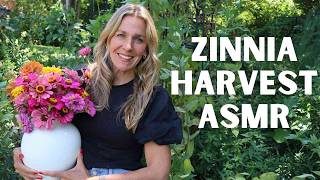
Nicole Johnsey Burke demonstrates how to harvest zinnia seeds from spent blooms, save and store them for next season, and use pruning to increase cut-flower yields. She highlights zinnias’ benefits for pollinators and vegetable gardens, shows a homemade treatment for powdery mildew (baking soda + castile soap), and notes planting-to-flower timing and seed counts relevant to gardeners.
Questions this video answers
At least 100 seeds per pack.
1 gallon water : 1 tablespoon baking soda : 1 teaspoon Dr. Bronner's Castile soap.
Approximately 65 days until flowers.
Each time you cut a bloom, two more blooms grow in its place.
Chapters
Hey there. It's Nicole Burke. I've got my pruners, my zinnias are blooming. So let's work together and make a beautiful cut flower centerpiece for the kitchen table. Did you know that you can grow hundreds of flowers every single year for the rest of your life from just one pack of seed? Zinnia seeds are the easiest cut flower to grow, and they're part of our easy garden kit. When you open up this pack, you're going to see that there are at least 100 zinnia seeds in this one pack of seed. So these 100. Each of these seeds, when planted, will grow and create one zinnia plant. If you prune your zinnias the way I teach you, then you're going to get multiple blooms from each and every plant. We're talking 10, 20, 30 blooms from one plant, because each time you cut a bloom, two more blooms grow in its place. Now, every single time you cut the bloom, even when it fades in the vase, you don't want to throw it out. And here's why. So here's a bloom that's starting to fade away. You can see the petals are starting to wilt a little bit. And the magic of growing zinnias for the rest of your life from just this one pack of seed. I'm about to show you how this works. So at the edge of every petal, inside what's growing, is a seed. You see that? And look at how many petals are on this flower. So the more petals, the more seeds. You let this dry out, and then you simply pluck each petal, and you find a seed at the end of it. This means that from this one bloom, from this one pack of seed, which could produce, say, 300, no, 3,000 blooms just from that one package. From this one bloom, I am going to be able to collect at least 100 more seeds just from this one bloom, because look at how many petals are on this thing. There's 100 petals here. And at the end of every petal is a seed. So what I like to do at the end of the season, because I want to remember the colors that I've had the year before when I'm planting my seeds for next year year. So I take these petals, I let them dry out completely, and then I store them in a cool, dry place with the petals included. I don't separate the seeds just yet. So I let these sit throughout the winter, and then when it comes spring, I start to pull out the seeds, but I know which ones are which color? Because I can still see a little hint of the color on the bloom as it's. They're dried out over winter. Then I just pull off the petals. And the coolest thing about nature is these petals are actually meant to help spread the seed. So you don't even have to separate the petals off the seed. You can literally just spread the seeds as they are with the petals attached. So you can see some of these still need to dry. Let me show you these white ones. I'm harvesting them to. It's premature. I need to let them dry out some more. But these that are gray color, that's what you want it to be like. Just like that. You can see I'm not even done yet, not even finished. And these are all the seeds I already have just from this one flower. That's it. That's it. That's how you do it. So I'm going to take these, save them, make sure I know what color they are. And then next spring, from just one bloom, I have the equivalent of what was inside this pack. And this is just the start of what's still growing. I'm not done yet. I've got probably a month and a half or two more months to these zinnias to grow. Zinnias grow the entirety of the growing season when there's no frost. So for me, that's April all the way till November. Okay, long time. So I get flowers all the way through that season, and then every single bloom can create 30, 50, 100 seeds for the next season. The best thing about zinnias, too, is they're not just pretty, they. They are so good for the garden. These flowers are continuously covered over with swallowtail butterflies, monarch butterflies, bees, all kinds of beneficial insects. You can see them flying here even while I'm talking. And you plant these right by your vegetable garden. They increase production and they cut down on pest pressure. So zinnias are not just another pretty face in the garden. They are a major helper. One of the biggest challenges when it comes to growing zinnias is getting powdery mildew on the leaves just like this. The good news is powdery mildew will not affect your flowers, but it's just kind of unsightly. And none of us like seeing mildew in our garden. So here is a simple fix that you can make right away with ingredients that you've got in your pantry. We're just going to be using water and some baking soda and some Dr. Bronner's Castile soap. So the ratio to make this mix is 1 gallon of water, 1 tablespoon of baking soda, and 1 teaspoon of castile soap. Now, I don't have measuring cup out here, so I'm just kind of winging this. And I'm not going to be doing a gallon of water. I'm just doing a small little container here. So I'm going to do less than a third of what the recipe calls for. So just a little bit of baking soda, a little bit of soap, and then we fill the rest with water. Now, some recipes will call for neem oil, but I try to stay away from neem oil in the garden because some studies have shown that it can be harmful to beneficial insects like butterflies and bees. So we're going to give this a nice shake. You don't want to spray it on your leaves when it's sunny because it can can burn your leaves. So you want to spray it at a time like this right before, at the early of the morning or in the late of the evening. And this is something you want to put right on the leaves just like this. This is a simple homemade spray that pretty much any of us can make to cut down on powdery mildew and enjoy more blooms from our zinnias. All right, it looks like she is ready for the kitchen table. We're going to have some fun meals around all these flowers this week. Zinnias are the easiest cut flower to grow. You plant the seed in the soil, you get flowers within 65 days. And zinnias are part of our Easy Garden kit. You can check it out right below this video.