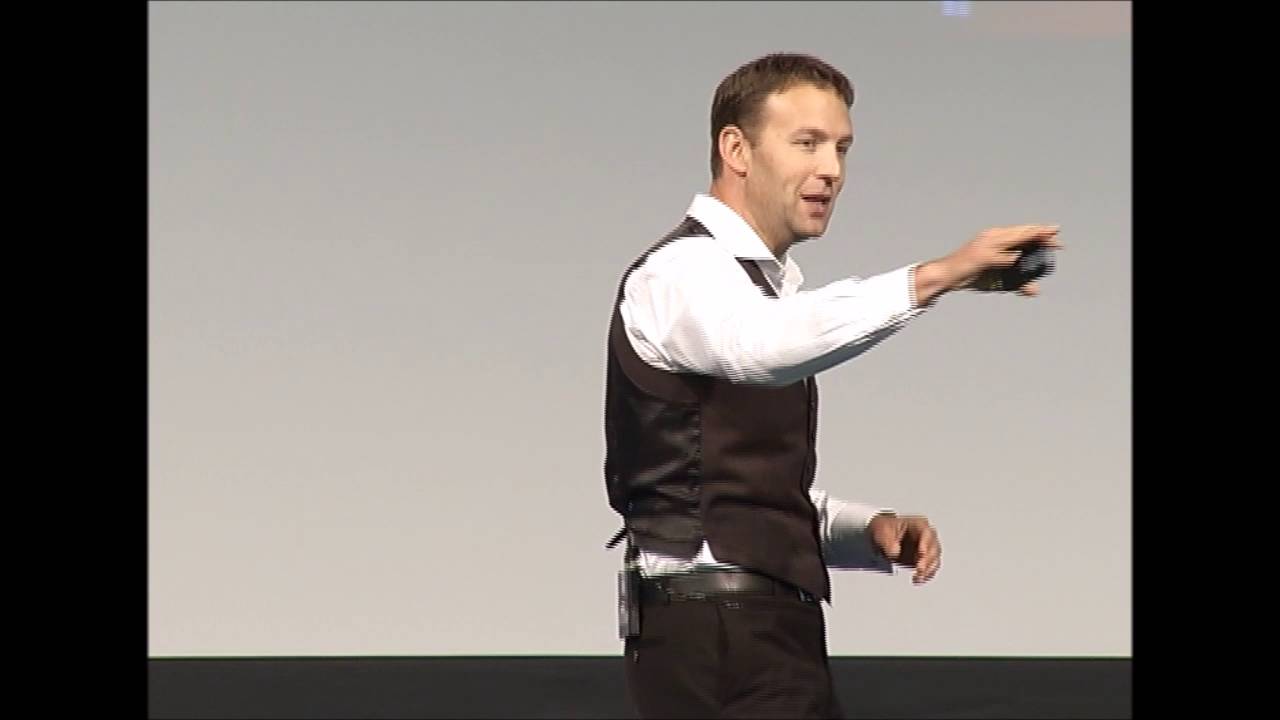
Gavin Freeman argues that traditional motivation fails and leaders should instead create environments where people motivate themselves. Drawing on psychology, business, and Olympic athlete principles, Freeman discusses the leadership shadow, discretionary effort, and why listening tours matter more than direct motivation.
Chapters
Welcome back. A new book by Gavin Freeman is entitled Just Stop Motivating Me. So let's find out why Gavin is not in the motivation game. What's the matter with you, mate? Motivation's a good thing. Why are you against motivation?
Well, it's not that I'm against motivation, I'm just—
Your book sounds like it. The title is Just Stop Motivating Me. Just stop motivating me, okay?
And the principles behind it are that I need you to stop motivating me and let me be motivated myself.
Very good.
All right, so what we find is—
I'm big on self-leadership. That's what you're talking about?
Absolutely. So leaders need to stop trying to motivate people because all they're ever going to do is push them the way that they want to be pushed. And ultimately, individuals might get motivated to do small little things, but as soon as those leaders disappear, that motivation is going to go with them, and they're not going to continue that behavior moving forward. Okay.
Explain to me the structure of the book. Is this you just whinging about leaders, or—
No, absolutely not. What I did was I had a look at the theory of motivation. You know, we think about positive and negative reinforcement, right? We think about if I do something— if you do something really well and I pat you on the back, you're going to keep doing it? Maybe, maybe not. What if you do something poorly? If I, you know, get the stick out and give you a bit of a whip, will you stop? Some will, some won't.
I guess it varies person to person. Some people react to positive stimulation, some people need negative.
What we found though when we did the research behind it is that in fact I like to think of motivation as a continuum, from being motivated to succeed to being motivated to avoid failure. And it's just the context that changes and drives our motivation in a different way. Good example, right? You love sitting here in front of the TV talking to the cameras.
How do you know that?
Well, you've got a big smile on your face.
Okay.
But a lot of people would be absolutely scared, petrified to do this. And they might be scared to publicly speak. Their motivation is more motivated to avoid failure. They don't want to stuff up. And so the behaviors we would see is they would choose not to come on your show. Or if they did, they'd be very reserved and scared that they would—
Are you arguing to say I don't mind failure?
I would argue that you don't, and in fact I would argue you're much more motivated to succeed, and therefore failure is simply a stepping stone to future success. So you'd look back, think about what you did poorly, and then plan to improve on it as we go forward. Now that's a challenge for leaders. How do they create that form of an environment to enable their people to be motivated to succeed?
Okay, now, MPsych MBA, what's that mean?
Psychology, so I'm a psychologist by nature, and I did the MBA only because my dad was an accountant and I figured I had to merge the two together at some point in time. But I look at the human behavior, you know, why do we do what we do, not what do we do.
And also, the name of your business intrigued me. It's Business Olympian Group, and I asked you before we came on, have you been bounced by the IOC for using Olympian? So tell us the story there.
Well, no, not at all. The word Olympian is actually not copyrighted, and it's not covered. It's in fact in the Act you're allowed to use the word.
Yeah, I guess any Olympian should be entitled to say, I was an Olympian.
Where it all started was I was actually a part of 2 Olympic campaigns, both the Sydney campaign and the Winter Olympics in 2006 in Torino. And I remember sitting down and I worked with an individual who won a gold medal.
You were motivating, were you?
I was working with him. And I remember that moment and I looked at it and I thought, how do we capture that moment of his ability to perform consistently under pressure? And I thought, well, what do businesses do every day of the week? They have to perform. So can we bring those skills from what elite athletes can do? You know, work for 4 years, you get one shot. One shot at it. Imagine that moment, and you've got to be able to perform consistently under pressure. Businesses, you get a couple of shots in it, but ultimately you've got to perform on the day, and that's what we do. So I brought that thinking into it.
And if someone fails in front of a customer, that customer can be lost forever. So it's just a progressive thing.
Absolutely.
So you interviewed a whole lot of leaders. You found them using the word motivation.
Yeah, and this is what was interesting. So we had a whole number of CEOs and CFOs. We even had Nelson Mandela's personal bodyguard as part of the book. And they often used the word motivation. motivation, but they don't use it in a motivating way because they realize that they've got— in some cases, one particular CEO has nearly 100,000 employees. There is no way he can directly influence 100,000 people. So we use the word motivation, but in an inspiring way. How do I inspire my people to be able to achieve what they're trying to achieve? So if you've got control over your destiny, you're going to be— you're going to put that discretionary effort in and you're going to work that much harder and be self-motivated. So these leaders all used the word motivation, but what they were more talking about was their leadership shadow.
Who was the best? Who were you most impressed with in being able to take obviously what he or she wanted to do, get their staff to outperform? Who do you think was the best and why?
Oh, look—
And don't run away from it. If people ask me who's the best CEO in the country, I can give an answer.
I'll give you 2 then. And they're very different areas. OK. One was a guy by the name of Guillaume Swiggers, who used to be the CEO of Deloitte and has now moved over to Auricon.
Yeah, I know Guillaume.
Fascinating man in the way that he conceptualises his people and the way that he recognises how he can impact on his people, realising that he can't do the work of everybody. The other guy that completely blew me away was a guy by the name of Carlos Scheinkessler, and he is the head of the ICU at the Alfred Hospital. Down in Melbourne. He has, you know, he has 2 fascinating things. Most of his patients are unconscious, they're in an ICU. Second thing is he has a group of doctors who are all the top of their game, and his job is how does he pull this high-performing team together.
And doctors can be very individualistic.
Absolutely. And he's got an environment which you have to read more about it, but it's fascinating where he's got all of his doctors working in a private practice. Not one of them draw the salary from that private practice. They contribute it all back to the group, and then they use that to buy their toys, as he says, you know, all the equipment equipment that they need to do their jobs. So it was a fascinating insight.
I interviewed a lady, American lady, Liz Wiseman, who I think was Vice President of Oracle at one stage, and she wrote a book called Multipliers, and she said that the great leaders, rather than lead from the front, they actually encourage people to take responsibility, and by taking that responsibility, they are actually able to Make decisions rather than being told what to do.
Absolutely. People have to be— have to display this discretionary effort. What we don't want is people to be supportive of an idea. Because supportive of an idea is, I think it's a great idea, I'll sit back and be very supportive.
The boss comes in, we're going to do this. Yeah, we're going to do this.
What we've got to be careful of is that we don't end up with the someone phenomenon. You know that theory that says, you know, we've got a great idea. someone should do it. And then what happens is nobody does it because nobody wants to take that accountability. They don't want to put their foot forward to have a go because they might be fearful of the outcomes if they were to fail. So we've got to learn how to fail fast, fail quickly, fail cheaply. We've got to play Angry Birds at work.
Angry Birds.
Yeah, absolutely.
Tell me this, Gavin. I'm sure there are a lot of business owners, but even some parents who might be listening here as well. The same, the same kind of Encouragement/motivation, does it have to differ person to person?
That is the key to all of this. The first thing is find out about what drives you, because if you know what drives you, you can at least understand the concept of motivation. Then it's about actually going to ask your people and talk to them and find out what it is that motivates them. You know, there's a, you know, one of the particular CEOs who works in an Asian culture, one of the tasks that he looks at doing every year is meeting 50 people in the business, but none of those report anywhere near directly to him. You know, Rod Lever, who's up at Lendlease, he gets out every year on year and meets everybody down in the business to understand the different levers that are being pulled around his business.
I think Michael Eisner at Disney used to do that as well. He used to get— he wanted people who were actually at the coalface selling tickets on rides because he believed that He knows what the marketing guys are thinking, but the marketing guys might not know what the customers are thinking.
But the other thing you want to really make sure of is you don't end up being a stereo leader. You want to be a 7.2 or a 9.2 amplifier. So you've got different people out there selling different messages, because somebody's going to hear that sound coming out of the back corner, somebody's going to hear it coming out of the front. You don't want the message just to be coming out in stereo.
Okay.
Same old, same old. Okay.
Maybe you have to be a hi-fi person to get that analogy, but I think I got it. Now, Just Stop Motivating Me in all good and bad bookstores, I presume.
Do you know what? I even found it online in Estonia.
Love the sound of that. Yeah. All right. Nice to meet you.
Take care.
So once again, the book is Just Stop Motivating Me by Gavin Freeman. Thanks for coming on the show.
Thanks, Peter.
Okay. After the break, we'll try and work out why governments are not supporting not-for-profits, but Before then, we go to Melbourne to talk to a gentleman from Manpower. They have a survey, an employment survey, and Richard Fisher should be in our Melbourne studio. Richard?
I'm not here.
Ah, Richard's not there. We've got a technical problem. We'll come back to that in a second. We'll go to a break right now.