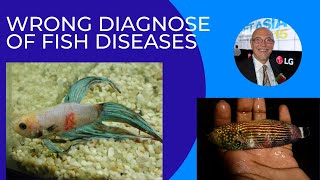
Gerald Bassleer shows aquarists how they misdiagnose fish diseases. White spots that look like ich might be lymphocystis or oodinium. Red ulcers could be bacterial or the protozoan Tetrahymena. What looks like fungus is often stalked ciliates. Use a microscope and reference books before treating.
Chapters
Hello, dear Aquarist, Today I have a special video for you about things that can happen when you deal with fish diseases. It's the errors that people make when they do a wrong diagnosis of fish diseases. And yes, we make errors and particularly if we don't use the good methods of diagnosis. So I will show you my screen and that I try to tell you what is happening when you do a big error and accuracy do make big errors, particularly on social media, just posting a fish and it looks like this disease and everybody has a decision made what kind of medication to use. So there's a lot of wrong diagnosis made for sick fish. Maybe your language is available in the subtitles. It's like the lady looking for her dog looking in the wrong direction, not using the good examination methods. So always ask yourself, did I make a good examination and wrong diagnosis of fish diseases? I will give you today some examples. Ick. It can be something else. It can be other parasites. Red wounds can be bacteria, but can also be a parasite like tetrahymena or uronema. Fungus. Is it always fungus? It can be parasites like forticella, the neon disease. Or is it white necrotic lesions caused by bacteria. And certainly there are many more. But let's talk to you today about these most important diseases which we are familiar with and quite common in our hobby, like white spot disease or ich here on this clown loach and here on the black ember, emperor tetra. But sometimes people diagnose it as ache. And this is like a false ache. It's lymphocystis. It's a virus. It starts with a few white lumps like here on the fin and on the tail of this rabirezi. But look how massive it here looks on this gourami. And people try to treat with ICA treatments without success. Yes, because this cannot be cured by a egg treatment. Or here, false egg. This is oodinium. Why do I know that? Because I used a microscope. Look how white clumpies of parasites are sitting there. And people try to treat for egg. Wrong diagnosis. Or here, the spongas pseudo white spots. Those are sporozoa parasites. Or here, the liporinus is dorsal fin encapsulated worm larvae. You will see when you try to treat, it doesn't go away. It might be something else than egg. So think about it. If you're sure if it's egg or not, be cautious. You make a decision. And the same for red wounds or ulcers caused by a bacterial infection. Here on this long nose Organatonymus petraci. See the red wounds. This was clearly diagnosed with a microscope, that it was bacteria. But here, this guppy on the left and this colissa on the right with big wounds caused by a parasite Tetrahymena. And an antibiotic will not only treat it, maybe helps a little bit, but doesn't kill the parasite. The same for those red wounds in marine fish caused by the parasites Uronema. Big wounds. And how do we know? Because we take a skin scraping and we use a microscope. Fungus. Well, everybody knows this picture for fungus. Very clear picture of fungus. Yes, but look at the video at the uru. Look at the dorsal fin, little whitey clumps. And everybody diagnoses this as oh yes, that's fungus. But when we use the medicine it doesn't work well, it's a bad medicine. No, it's a bad diagnosis because this is a stalked parasite similar to Epistylis or Vorticella. The same here on this Ramirezi. Look at the dorsal fin with those white lumps. Those are not fungus. Or those were parasites because we diagnosed them with the microscope. So be aware, when you cannot cure it with a medication against fungus, then it might be something else. The neon disease, like on this neon tetra caused by a sporozora, which is incurable. But there are some neon diseases which are curable. And people say, yes, I cured a neon disease. No, you cured a false neon disease which is caused by a bacterial infection. Look at this white is band here. Or this neon tetras the same kind of appearance of the white. Why? This discoloration of the fish is caused by a bacteria. In most cases columnaris and an antibiotic can help and save the fish. It's false neon disease. So that's some examples. So use a good diagnosis and the best way is using a microscope, using a book like my books I have available in different languages. The link is here below where you can purchase the books. So you see all the different lookalikes of egg or fungus. So always ask yourself, did I make a good examination? I may be wrong, but that's very unlikely. So subscribe to see more videos on diseases of aquarium fish with correct diagnosis and suggestions for treatment. I may be wrong, but it's highly unlikely because I use a microscope. Thank you for watching.