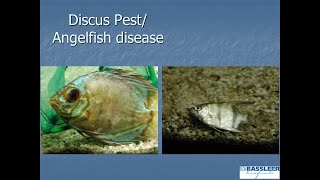
Gerald Bassleer explains discus pest, a 25-30 year old aquarium disease marked by darkening, excess slime, and lethargy. Gill flukes and Spironucleus hexameta often appear, but no single cause exists. Prevention relies on keeping fish from different sources separate and boosting immunity; treatment starts with large water changes and raising temperature to 32°C.
Chapters
Hello. Today I will discuss for you the fish disease, case number five. About the famous discus pest or the angelfish disease, which has been a problem already for 25 years in our aquarium fish hobby and our industry. We notice that the discus fish suddenly change color, change behavior, showing a slimy coating, having a difficult respiration. Like here showing in the aquarium. The fish become listless, they become nervous. And you see the fish are suffering very badly. So this is not normal. And it goes overnight, it starts very quickly. Here you see this discus with a very slimy coating, whitish coating. He's getting very nervous. Respiratory behavior becomes very erratic and the fish are starting to hang in the corner. And the same happens with the angelfish. We call that also the angelfish disease or the pest. Hanging at the surface, hanging in the corner. And here, with this golden severum, the same problem. These two records are made in a pet shop. So the fish were suffering badly. So what is this all about? The discus pest, the angelfish disease that started about 25, 30 years ago, had the fish become very slimy, having excessive mucus hanging on the body, becoming whitish, laying on the bottom, and eventually also die. The discus pest. We can define the typical behavior and the symptoms. We see. It's the darkening of the color, the extra slime and the mucus, the grouping, the laying on the bottom or at the surface. And after some days they become very listless and they start to die. Usually it happens when one new fish from different source added to the aquarium. For example, adding a German discus to an Asian discus, or an Asian discus adding to a German fish tank, or a wild discus adding to tank raised discus. So introducing different origins. It also can happen with the change of season. And mostly when there is a foggy weather, usually during spring or in the fall, when we see there is a change in the season, particularly with low air pressure. Usually it happens overnight. It goes very quickly. When we see the Discus pesti, we examine the fish. Well, what first thing we notice that the fish lack a kind of immunity, a kind of resistance, and is showing allergic reactions. See here the photo of the gills covered with excessive mucous slime coating, giving a difficulty for the fish to do a good respiration. So it's causing respiratory problems. We find quite often parasitic infections. At the same time, gill flukes or Spironucleus hexameta parasites. Sometimes viral infections have been found, like iridovirus. Also secondary bacterial infections are found. So the conclusion for the discus pest or the angelfish disease, that there is not one clear factor we can determine and still up until today there is no good scientific study done so far. So what can you do when you deal with this problem? Well, the first thing you should think about is try to prevent. Try to avoid mixing fish from different origins, from different breeders even try to keep it separate. Avoid the contact of the different accorda, even the nets and the water and the hoses try to keep it separate. So word buy secure. If you need more questions about how to work biosecure, please ask me. Improve the resistance of the fish. Help the immunity of the fish by giving immunostimulants in the fish food. Try your Dr. Besler biofish food forte or the professional care or new Lapacho. And when the problem starts with the discus pest or the angelfish disease, do first of all a big water change and sometimes many days after each other. This already can help some people raise the temperature above 32 degrees Celsius and do a proper examination. Use a microscope because sometimes with the microscopic examination you find certain diseases and you can add a specific medication and sometimes just treating by that specific patagon you can treat your fish. So this was about this case and I hope more cases to come to explain to you about the skinny cardinals that are dying. Goldfish are suffering and getting skinny, another interesting case and also betta fish which can easily be attacked by oodenium parasites and many more. Meanwhile, you can learn more about our fish diseases in my books the new Illustrated Guide to Fish Diseases or also on marine fish in our newest edition. I thank you for the attention.