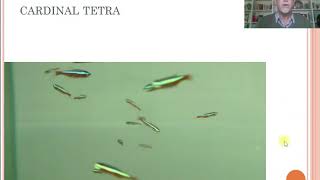
Gerald Bassleer examines emaciated Cardinal tetras with destroyed gills and bacterial granulomas in their organs. He treated them with probiotics, prebiotics, and oxytetracycline, seeing improvement within days using biofish food alongside antibiotics guided by antibiogram testing.
Chapters
Now we will talk about fish disease. Case number six. I hope your interest was already raised in the previous five cases. But now I will show you a common problem with Cardinal tetra or the Paracharidon axorrodi which are skinny and are dying. Which is a problem that we see quite often with our tropical fish. The skinny Cardinal tetra we found in the tanks and in many tanks for many importers. That many getting very skinny. You can see the skinny ones between. And some are fat and full grown, but some are very skinny. Look at the back. And they seem to suffer. After a couple days they start to die and it's not much we can see. Unless, look, look at this one here. Unless there's that frame, very skinny look. And it looks like the fish are wasting away. That is the problem which I encountered and was offered to me to do research on. Well, when we did an examination of these small fish we found particularly serious problems in the gills. Here we see a partially healthy gill. But here we see a gill which is completely demolished, eaten away by bacteria. There are millions of bacteria, small white and blackish dots here also here there is no guilt tissue left anymore, no lamellae anymore. A serious bacterial infection which was causing a serious problem on this fish. Also internally we found in the organs granulomas and granulomas could be encountered or caused by bacterial infection. And in most cases it is bacterial infection. And we found also massively around the organs a lot of rod shaped bacteria. So this was a massive bacterial infection on the gills and also internally in the organs. So the fish were not eating anymore and getting weaker. So to give you an explanation that we could conclude that we found a bacterial infection and that badly damaged the fish, particularly in the gills. Also internally in the organs we found tubercles. So we propose at that moment a treatment with pro and prebiotics in the food. By this the fish can restore its immunity and the self defense which is important to overcome the disease. We also recommended the use of our Dr. Basler Bivoufoot Fico. Fico Idone is a big help against bacterial infection internally and externally. And also antibiotics can be a good choice here. But usually you know, after a good antibiogram which antibiotic to use. But usually it takes a few days. Here we experimented with oxytocitracycline and this was a good choice. And the fish repaired within a few days together with our Dr. Beslin biofish food Fukuya. So if you want to read more about on YouTube I have a specific video on bacterial infections which are common in our tropical fish. And you can find this on my YouTube channel. And this explains you what you can do or what you can find in bacterial infections causing serious problems in our tropical fish. So more cases will come soon. I hope you stay tuned. Thank you.