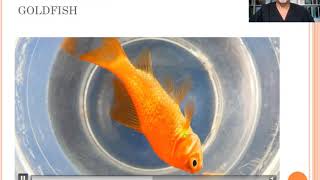
Gerald Bassleer documents a bacterial outbreak in farmed goldfish causing wasting and gill rot. Lab work identified mycobacteria forming granulomas in organs, making treatment nearly impossible in advanced cases. Kanamycin or rifampicin worked only on early-stage fish; contaminated feed or infected broodstock likely started it.
Questions this video answers
Carassius aratus (goldfish) -- as stated in the video.
Mycobacteria (most of the bacteria found in granulomas).
Kanamycin or rifampicina.
Chapters
Hello. Today we discuss fish disease. Case number seven, about goldfish, Carassius aratus, who were skinny and were dying. This is a problem we found at a big fish farm, which I was invited to find solutions for this kind of problem. You see the many skinny fish at the bottom, some dead ones of this big pond. The importer and wholesaler was having some losses. So we were trying to find out what is the problem on these skinny goldfish. So we examined the fish as good as we can. What is typical was a design that the fish were having very heavy respiration problems. The gills were open. So he has a problem in the gills. And you see this skinny body here. The fists were getting emaciated, so not eating, suffering. The first thing we found when doing a skin scraping, we found that the scales were badly damaged. Look, eroded and eroded, damaged scales. This is usually due to internal bacterial infections. So. So this is the first signal or symptom to tell us what's going on. When we checked the gills, we found that bacterial infections did damage. The gills and other gills were very badly advanced, rotten away. So the fish were suffering from gill rot internally. We found granulomas in the intestine and the organs. Here is the intestine, and here are the gorgons, the spleen and the liver. You see the granulomas. You see this granuloma here, encapsulated by the organs. Also, the kidneys were very badly functioning because they had many granulomas inside. And this is causing a risk that the gills had to do much extra work, because if the gills cannot. If the kidneys cannot do the job to secrete the ammonia or excrete the ammonia, then the gills have to do it. So the gills are overloaded with stress to do that extra work. And that can have an impact on the quality of the fish. So our conclusion was that the badly damaged fish had poor working or failing organs, gills and kidneys, due to a bacterial infection with granulomas. So the fish starts to weaken, not eating and dying. The treatment. Well, the lab examination found that the granulomas had different kind of bacteria. And most of it we found were mycobacteria, which are difficult to treat because the granulomas are encapsulated. So no medicine can reach. And that means a good percentage will die. So the problem came from the fish farm only at the beginning stage, the fish could be treated, or the fish, which were still having a good body shape and a good condition. So the antibiogram could show that we could use kanamycin or rifampicina as treatment. So the origin of the problem could have been the food at this pollutative mycobacterium and the mother fish that pass on the mycobacterium via the gonadge to the eggs and that I explained in my training on fish disease part one. So this is the kind of solution we could give for this problem. If you need more information, stay in contact with my playlist on YouTube. Subscribe and you can learn more in the future about fish disease. I thank you for your attention to become a good acur.