This content was created by Gerald Bassleer. This content was uploaded by Gerald Bassleer. This is a YouTube video titled "Fish disease Case 9: Ancistrus gold with false fungal infection" created on October 11, 2021, by Gerald Bassleer. It discusses a case study on fish diseases, specifically focusing on Ancistrus gold variety affected by bacterial infections and ciliated parasites, and provides treatment recommendations.
Chapters
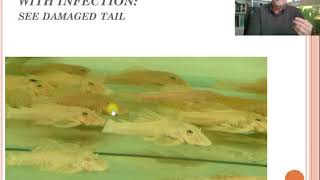
Hello. Now you're back again to my next case. We are already now at our fish disease case number nine. It will be about the ancestorous gold variety. We will explain what we found here with bacterial infections and stolact ciliated parasites on this ancestor species. Here we see the picture of the fish in the tank. There are many different sizes or species I can say in the tank. But you can see this one here had a badly damaged tail. Other ones seem not so badly affected or might be starting to show some little legions. But it all started with a damaged tail and that we can see here on the video that this fish is already seriously damaged while the others might start to suffer from the same problem or the same disease. So that's why it's important you take out that fish and you examine the tail. Or you take a scraping from the tail you see here, the white is a crusty appearance. If you would go look detail and might be look a little bit like fungus. Well, if you take a scraping or you cut off the part of the tail you see here, the damaged tail you see here, bacterial colonies in between. And what we also find here are some stalked organisms. These are stalked ciliated person here is here or there and they're setting down, settle down on the tissue, on the damaged tissue of the fish. And they are ciliated parasites. Which pieces exactly it is. It could be Epistylis, I don't know. That is more for laboratory specific parasitologists. And I would lose time and I would lose money if I send it to them. So for me it's already to know if it's the stalact ciliate parasite. I know what treatment I can do or perform and what the reasons could be of the problem. Here we see it on the video, the stalag parasite. You can see here they're moving a little bit. They have ciliates here which is moving the water here is one. They're retracting when they're getting scared or they're expanding what they want to feed. So it's the movement. I'll show you more in detail on this video. Here we see the ciliated parasites and they're sitting inside the tissue of the tail of that fish and making more lesions, more wounds possible. Here we see the feeding action and here you see the ciliates on top of those taloparidid and they're sitting clustered together. And that's why maybe they look a little bit like fluffy puffed fungus on the outside of the fish. And here we see all bacteria bacterial colonies. I can show you in the video again you might see here, look in detail, you might see some movement here of the millions of bacteria which at the same time invading the fish. So we're talking here about a co infection of bacteria and the parasites. So we will have to look at a combination treatment. This is usually happening in certain conditions and I explain how you treat, what you can do about it. But it's important to understand when you have a parasitic infection that's usually very often combined with a bacterial infection. And this has to do with environmental factors which can be playing a role. It's like too high temperature or a bad ph. It can be that there are bacteria in the water and fungus and parasites, other parasites and then there are the parasites. And there are some studies done on that. It's easily a disease outbreak with the availability of pathogens and environmental factors and the host the fish. And that combined gives a risk of a disease outbreak. And in this case a combination of a disease. Several scientific studies are done about it. So for the treatment of this case of this co infection on the ancestral gold, it's very important you have a good water quality. So the first thing you can do is give a good water change. Do a proper filter cleaning because it's important that the filter is working properly. Avoid less crowded conditions because usually this infection appears when fish are kept to large volume masses together or to highly crowded conditions. Apply an antibacterial medication because we've seen the bacteria, we've seen the fin rot and apply formalin malachite green combination or lac FMC that I explained in my books. That is the combination you can treat the parasite with. Also sea Salt might help 3 to 5 grams per liter, but you have to be careful. Some fish like the Ancytus can be having toxic reactions when dealing with salt and formalite green and antibiotic. So be careful. Feed the fish river pro and phytobiotics so you can help the defense system of the fish and the repair of the tissue. I recommend therefore the basilar biofish food alloy vera. Avoid the spreading work bio secured so be careful when you handle the fish with nets that you don't use that net for other fish tanks because it can spread to other fish tanks. So this was this case and I will show you more in the coming weeks. Next time it will be about the marine fish shit on topless. So stay tuned. More cages to come. Thank you.