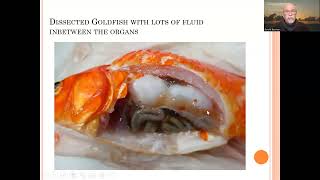
A short video case (case #104) by Gerald Bassleer documenting a large goldfish (Carassius auratus) with severe dropsy/ascites and multiple organ tubercles. The presenter shows external signs (raised scales, distended belly), dissection and microscopic images (fluid-filled body cavity; liver, spleen, kidney with dark patches/tubercles), suggests mycobacterium (fish tuberculosis) as a likely cause, and gives treatment/prevention advice for keepers and suppliers.
Chapters
Dear fish keeper, keeping fish alive is our goal, is our responsibility. When you have a live animal, you should be responsible. And also when you have a goldfish. A goldfish is a very simple creature and sometimes sold for people which are unaware that this fish have to be taken care of. And today I have a goldfish which was already growing up and had suffering, suffering from a severe problem. But even people keeping goldfish in a small place, well, should be taken care of as a responsible fish keeper, as a responsible person, because it's an animal life. And that's why I also take some time to try to work with goldfish and to try to learn what we can teach our people how to take care of it. And here it's our case, 104. About a big goldfish which had a large belly, had dropsy and was dying. And here the video shows the fish which I received. You see here, the big belly, you see already some raised scales on the side. So this is a kind of dropsy, we call it ascites is another name. And this fish was dying. Here we see again a close observation of the scales popping up, raising up. And that's because there is an internal problem. That's why the scales are raising up, because the body is very heavy, loaded with fluids, which I'll show you later on in the dissection. Like here we show here. See, it's a lot of water fluid. And that fluid is making the belly growing up. And the organs are in bad shape. And that's why we use a microscope to examine what we find. The liver with a lot of dark patches. You can see it here. All Milanum macrofar centers. That means there is a kind of inflammation, infection going on. And macrophages are trying to defend the organ, but at the same time making holes. Those kind of holes is damage of the tissue. Also here, the spleen. You see already some tubercles developing here. And here's another tubercle. You see the dark patches, which is not normal, healthy, not normal tissue. Also here in the kidney, we see tubercles here and here. And here in the darker areas, which is not normal. Here we see a closer observation of the tubercles in the organs and here of the kidney of this goldfish. Well, the treatment we can judge justice. First to analyze what did our findings that this kind of symptom and the fish had this kind of raised scales and such a heavy load of fluids in the belly. Well, it might be too late to treat. This fish will not eat well, will not respond well to any treatment. But still the other fish in the pond or in the aquarium might have less symptoms and should be taken care of because they might develop these kind of dropsy symptoms in the coming days or weeks. So try to treat as soon as possible and put a very sick fish asleep. You can use Narcomore from Aquarium Unster for example. We suspect here with all the tubercles we've seen that it is mycobacterium or fish tuberculosis and that's usually caused by the breeder. So you should check with your supplier. Some fish manager had some success with antibiotics, but that's not a guarantee. Ask your fish doctor what you can do about it. You can help with a fish food to fish to build up his immunity and to strengthen the fish and we recommend for that or Dr. Basley or buy fish food Fuko or the herbal or the professional treat. Those are all different feeds that help the fish in this kind of instance and feed at least for 20 to 30 days this kind of food and no other food. Try to read my books to learn more about fish diseases. I have two books and I have in freshwater also have one marine book in many different languages available on our website like indicated here above. Well, thank you for watching and try to get more training. Follow my Patreon and you might become an expert and a more professional in keeping your fish in the best condition, particularly the fish managers in the shops and at the wholesale facilities. Soon learn more and you will be more happy than to take care with the best of your fish. Thank you for watching.