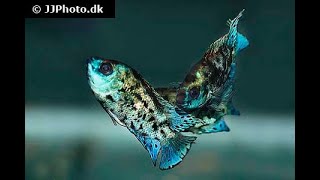
Gerald Bassleer examines Jack Dempsey cichlids with wasting, gill lesions, and internal tubercles suggesting mycobacterial infection. Necropsy reveals tubercles in the intestine, liver, and spleen. He recommends euthanasia for severely affected fish and notes that antimycobacterial treatment typically has poor outcomes.
Chapters
Dear fish keeper. Dear Aquarius. Today, something for the cichlid lovers. It's about the Jack Dempsey. The Jack Dempsey is particularly popular in Asia and in America, not so much in Europe, but still, it's a very beautiful fish, very active and giving a lot of pleasure to a lot of Chiclet lovers. So here I showed in my case 100 elf with a rotio octofiatis, which is the scientific name of this electric blue Jack Dempsey, which had a fish tuberculosis, a mycobacterium infection, most likely. We see a few are getting very skinny. You see here at the bottom, getting skinny dark. Here is another one. They're not growing well. They're slowly wasting away. While others look very healthy, moving very well. Here we see more in the corner. And you see that the small weak ones are picked on by the more healthy ones. And it's the skinny ones, like this one here. See, it's getting darker in color, getting skinny, which is will die in coming days and weeks. Hard to say, but that's what you encounter when you have a fish showing this kind of disease pattern. When we examined the gills, we saw some lesions in the gills, some gill rot, some bacterial infection, most likely that is causing the gill lamellae to be damaged. And we found the internal in the organs, a lot of tubercles in all the different parts of the organs. And I will show you with a video how that looks like a meta germination. And here you see the intestine. You see here and here and here, all tubercles on the side, on the cell wall, on the wall. And here inside the intestinal wall, many, many tubercles, which is unusual to see that many. And a fish. Well, in this case, it was unique for me as a. As a fish doctor to find it. Also here, see it in the organs. Many, many turbines. Of course, I took the most sick fish out of the corner, which was dying anyway. So I used this fish for identifying the problem, to help to save for the other fish which are still active in the aquarium. Here you see the liver full of tubercles. There's some healthy tissue left, but some tissue is really taken away. Here you see the spleen in bad condition. See here tubercles. Big part is gone of the spleen. Well, this is of course, badly damaged organs. This is a bad fish production. The supplier gets this fish from a breeder which is taking poor care of the fish as a poor brood stock. It's usually the parents who are carrying the disease and passing it on to the offspring. Remove and put to sleep the suffering fish use Narcomor plus for my Gorilla Muenster. Maybe some of the fish are less affected and could survive for a long time. Ask your fish doctor for an appropriate antibacterial mycobacterium medication. Some people did some trials, although in general the results are very poor. Poor or usually poor, particularly for those who are badly infected. Maybe it helps those which are little infected. I recommend feeding with a functional food like our Dr. Basil Biofoot Fuko for several months and no other food which helps the fish to become stronger and defend themselves against bacterial infections with the help of Fucoidan that helps control bacterial infections. Read my books on fish diseases so you learn more how to encounter these problems and to face it and to deal with it and to use proper actions and learn more at my Patreon to become an expert worthwhile to become an expert when you deal with fish and you keep fish in large quantities. So I thank you for watching this video and I hope it brings you the joy to become an expert that you can control the problems and know what the problems are and how to face them. Thank you for watching.