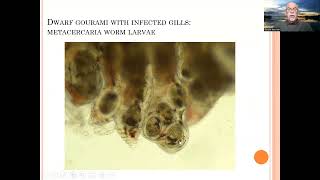
Gerald Bassleer examines dwarf gouramis with parasitic worm larvae embedded in their gills. The encapsulated metacercaria destroy gill tissue and cannot be reached by medication. Bassleer traces the infection to biosecurity failures at Asian breeders and recommends supportive care or euthanasia for severely affected fish.
Questions this video answers
Case 114.
Trichopodus lalius (dwarf gourami), red variety.
Encapsulated metacercaria (referred to in the video as 'Metasarcaria' worm larvae).
Narcomore plus (tranquilizer mentioned by name).
Dr. Basler biofish food professional care.
Chapters
Dear Aquarest, good day. I'm happy you are back again to follow my cases on fish diseases, because that's the way to learn how to diagnose, how to prevent and how to control your fish diseases or help your fish to survive in the aquarium. And I show you today my case on fish diseases, which is a case about a gourami. It used to be called a Colissa, but these days it is a Trichopodus, a Lalia, red variety. And here in this case, they were very skinny, some were dying, and we found parasitic infections in the gills. This is the case 114. You see here the bunch of dwarf gouramis that were received. And you see a few like this one here, looks very skinny, nearly deformed, and they die within a couple days, couple weeks. See over here another view of that bunch of group of dwarf gouramis that came from a breeder from Asia. And it's a problem from the breeder, which I explained in this video. Watch and you will see what we found in the gills because this was nasty, a nasty parasitic infection. Look here at the gills, what is left of healthy tissue, Hardly anything. It's all worms here, all those capsules here, all those black things here, those are Metasarcaria worm larvae encapsulated and taken away healthy tissue here. Big parts of the guilt tissue are gum. These are all individual worm larvae here, one that is alive. And most of them were alive and active, moving around because they are larvae and they are waiting to become adult when the fish has been eaten by by another predator fish or by a bird. And this capsule, that's the thing, this capsule is very important so that the swarm larvae is well protected for any medication in the water. You cannot reach with medication. So that makes it so difficult when we want to treat these kind of diseases and to explain you the cycle of this parasite. Here we see it in a garage. Fish are Florida garfish, but we can see it also in this dwarf gourami that here, this encapsulated worm larvae is in the gills or in the tissue of this fish. And then the heron bird or another fish eats the larvae and then it becomes a big worm inside this bird or fish. And then this fish expels or excretes the worm. Little assist, little worm, like we go into a snail from the snail, it goes as a larvae into the fish and then the cycle is completed again. So snails are a risk and the birds. So this farm, who had this problem breeding this fish, he had birds and snails, probably most Likely around the pond. So not taking good care of biosecurity. And I give different lessons about that on my classes on fish diseases. You can follow that on my Patreon where you can learn how to prevent that. This problem occurs in the ponds. So to treat this, well, you can imagine to treat encapsulated worms, well, those fish that suffer very badly, they will die. You better put them asleep with a product like Narcomore plus, which is a tranquilizer from Accordion Muenster. No medication will kill those parasites. Some fish might have little infection, only very few of those metacercaria and so there is little damage and they can survive much longer or they will survive forever. That's hard to say unless you examine the fish, but at least you know that the very badly damaged ones will die. So what you can do and continue to give is the best care you can. And we recommend that you feed the fish with your Dr. Basler biofish food professional care for several weeks and no other food. Because this will help the fish to develop a good resistance, a good immune system to become stronger. The problem, like I explained, is that the breeder and the infection cannot spread to the other fish in the aquarium. Except when there is a fish eating another fish or a bird sitting on the top of the aquarium. So I don't know if you have a bird flying around your room and likes to eat fish, but that's usually a problem at the pond. So get more knowledge and experience and information from my books on fish diseases which are available those books on my website and available in different languages. Spanish, French, German, Portuguese, etc. You want to learn more about fish disease to become more professional? Well, go to my Patreon there I have specific training for you available. So I hope this video helps you to understand this specific case of fish diseases. And stay tuned to learn more. Thank you for watching.