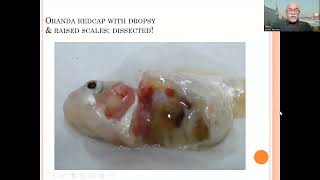
Gerald Bassleer examines an Oranda goldfish with advanced dropsy, showing raised scales, gill flukes, and bacterial infection in the kidneys and spleen. He recommends immediate antibiotics plus anti-parasitic treatment, lab testing to identify the bacteria, and euthanasia if the fish is too far gone.
Questions this video answers
Case no. 115
June 29, 2023
Chapters
Dear Aquarist, today I'm bringing my presentation on fish diseases from my home. Well, it's not here in an icy place in Moscow that looks in the back. I used to visit that beautiful town because I have friends and family over there. And today it's from my home office. But it's winter and it's cold. So I have time to make videos and cases on fish diseases which I studied during my work. And to do it today. It's about a lionhead or under lion head, which is a. Was a beautiful goldfish, which I show Here in my case115, the Carassios auratus red cap. Yes, the beautiful red caps is a beautiful fish. But anyway, this one had raised scales, dropsy, suffering from a parasitic and a bacterial infection, like I show here. Here in the picture. Look at raised scales. Look at pineapple fish. Well, if you see this advanced case, well, you might be sure that this fish is in very bad condition. And maybe the other ones in the aquarium can have the same kind of problem later on. So you have to take care as soon as possible. And here I show you in the video, a few more will catch a disease later on. That's why we collected it. The other ones look pretty well. Okay, that if you were showing this kind of race scale problem. And most of them were happy and healthy. But it's time to act. It's time to understand what is the problem of this disease. So you can take appropriate actions before most of the fish get sick and it's too late to treat. So take time to watch and examine fish. And that's what I show you here in my presentation. The damage in the gills. Yes, the gills are affected. You can see the lesus here, the bleeding here, bacterial infections here. Also parts which are gone, necrotic tissue here, gill amelli which are damaged by bacteria. And at the same time we found gill flukes. See the gill flukes here moving at the side, the carrying pulse lesion that can cause damage. And those damaged areas are a risky area that bacteria infectious can or bacteria can penetrate, induce wounds in the gills and cause bacterial infections and lesions and damage. So then we opened up the fish and we saw a watery fluid mess inside. Blowing up organs which are all very big and large, which is not normal. Didn't look healthy, particularly the watery content. This is typical for that fish with dropsy and raised scales. Because the kidneys do not work anymore. There's a lot of fluid collected in the belly, which blows up the fish because the kidney cannot take away the fluid. And we can see the kidneys here, which I show here, which are enlarged. So there is a problem with the kidneys which you can examine with the microscope. So I can explain you. Here we took some of the organs on a plate. We squeezed it. We squeezed it with two glass plates. Here at the right is the liver. In the middle is the spleen. And here are the kidneys, the enlarged kidneys on the left. And that is what we see in the microscope, the kidneys with tubercles. Here's some larger ones. Here's some smaller ones, smaller ones here. Smear here. So that is taking away healthy kidney tissue. Here you see many of the small tubercles in other parts of the kidney tissue. Those are bacterial infections encapsulated by a reaction of the organ to defend itself. And also in the spleen we found some tubercles. And the liver looks very weak, poor, I can say with whitish areas. So what can we suggest for this Oranda lionhead red cap? Well, the fish which have heavily dropsy, you should put them gently asleep. And you can use a tranquilizer like Narcomore plus from aquarium Unster. If you act quickly here, with appropriate action and medications, you might save many fish. You should apply an antibiotic and an anti gill fluke treatment at the same time as soon as possible. Particularly the antibiotic must be applied as soon as possible, maybe in the food. And then it's taken up by the fish who are still eating or in the aquarium water. Ask your fish doctor, he is the expert. Should tell you what antibiotic you can use. Because that can depend on the kind of bacteria. You can send it to the laboratory and within 48, 60 hours, you know, maybe that that kind of bacteria. What kind of appropriate antibiotics should be used? Ask your fish doctor to help the fish. You can also use it with food like our doctor Bio fish food garlic. Use it for several weeks. It helps to control the gills and the gill flukes. Later you can vote with Dr. Basler buys food free coat to help the control of the health of the fish. Those are things through fish food. Learn more. Well, study my books on fish diseases which I have available in different languages. You want to become more aware about phage disease and how to diagnose. Follow my Patreon chiropractor. Then you can become an expert and a good fish keeper. So thank you for watching and I hope this video helps you to become more specialist. Thank you.