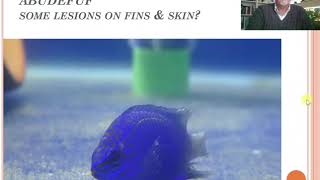
Gerald Bassleer presents Fish Disease Case Nr.13: a blue damsel suffering a mixed infection. Externally the fish shows fin/tail rot, lesions, and lethargy/respiratory distress from damaged gills. Microscopy revealed bacterial colonies on the tail (suspected Columnaris), visible parasites including Cryptocaryon (with cilia) and Uronema-type ciliates that invade wounds; internal findings included splenic melanomacrophage centers and haemorrhagic-looking liver blotches. Bassleer diagnoses a combined bacterial and parasitic infection and recommends killing parasites (mentions FMC: formalin + malachite green + methylene blue), freshwater baths if wounds are limited (pH>7.5), antibacterial treatment ("ferltadone" at 2.5 g per 100 L for 24–48 h), and probiotic/medicated feed (product named in the video) alongside general prevention advice (reduce stress, transport, aggression, and food problems).
Chapters
Fish disease case number 13 today it's about the blue damsel, Abe Duf, a fish that is wasting away weak, laying on the bottom, having damaged fins, dying. Not much we can see as a pathogenoo with the naked eye. This is what we see on the picture. You see some damaged tail, a fin, some lesions, not much to see. Let's see on the video. Well, you can see some fin rot here at the pectoral fin and at the tail. And the fish is suffering from respiration problem laying on the bottom. So you see the fish is suffering. So you want to know what is wrong with this fish? When we look at the tail, we found here a bunch of bacteria which is a group, a colony of millions of bacteria grouped together on the t tail. Here you see the tail rod and also we seen some parasites here we also seen some looks like Columnaris infection. It was not obvious to see here, but this seems to be all son of Columnaris. It was not so clear to see in our microscopic observation, but we supposed to have a mixed infection found with Columnaris bacteria grouped here together here grouped together like tube effects. But when we looked more closely, we saw parasites moving around. Here we see a parasite and here we see a parasite. So it's not only the bacteria which we noticed, but also some parasites. So we had to look more further in other parts of the skin tissue that we could found. So we went more in detail. We found here a Cryptocaryan. This is a small Cryptocaryan pericide. And here is another bugger moving around which we will see later on. But this was a Cryptocaryan. Now we go in detail. Here we see a beautiful view of the mini cilia of the Cryptocarya moving around. That's how the little parasite is feeding and moving. So Cryptocarya was starting to become an infection already part of the infection on this blue damsel. And when we look further on the tissue of the skin and the tail, we found Urinema perticites, which is a ciliated parasite, a parasite that causes serious damage and lesions. It reproduces very fast. You can find more in my videos on YouTube and in my books on this subject. Because this parasite is a nasty thing and moves into wounds and makes the wounds larger and bigger and more difficult to cure. So you have to treat from the beginning. This is the parasites again at a smaller magnification. You see how many are moving around and they are damaging the scales and the fish's fin. So this is a combination of bacteria and parasites and at the same time we saw damaged gills. You see here the gills rotting away. That's why the fish had also here had some respiratory problems causing it. We looked internally. We also saw that the spleen had some melanomicrofarx centers, possibly due to bacterial infection. And we also found that in the liver, some reddy bleeding blotches in the liver tissue looking very unhealthy. So we found that as a mix of problems, most likely due to bacterial infection and a combination with parasitic infections. So the thing you have to do is killing the parasites, which can be very nasty, particularly urine parasites. You can try to use Farnamore or fmc. FMC is my combination of formalin, malachite green and methylene blue, which is a perfect killer for parasites. Unfortunately, you cannot use that. In retrospect, reef tanks, freshwater baths can help, but only when the fish has no large wounds. In this case it might be questioning, but it would be possible because the fish has only some fin and tail rod. So a freshwater bath in a water that has a ph more than 7.5 would be a way to clean the fish from the parasites. Also apply an antibacterial medication like ferltadone, 2.5 grams in 100 liters for at least 24 to 48 hours. Feed the fish with pro and phytobiotics to help the defense system. We recommend therefore our Basilier Baijafood Metrine that helps the fish to protect from the parasites and at the same time repairing the fish and repairing the microbiome and the skin flora and the mucus. So this is a mix of problems. Also think always why did my fish get sick? Why did the fish get an infection? Usually it is stress or transport or aggression or a food problem. But see, this fish had a mix of problems, bacteria and parasites. So the next time we will talk about the Moraletti loach with red patches on the skin. Some interesting case we found also in our hobby. Thank you for your attention.