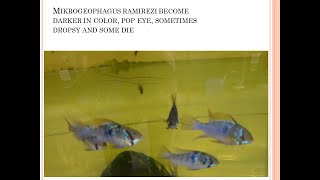
A short veterinary case presentation (YouTube) by Gerald Bassleer covering case #145: Mikrogeophagus ramirezi (Ramirezi dwarf cichlid) exhibiting darkening, exophthalmia (Popeye), lethargy, loss of appetite, dropsy and raised scales; necropsy revealed organs with black specks/tubercles consistent with a bacterial infection, most likely Mycobacterium. The speaker recommends euthanasia for severely affected fish, supportive care (good water, low stress, good nutrition) for mildly infected fish, and notes laboratory confirmation is possible but costly (~€150). He mentions some antibiotics have been tried (aminocycline, kanamycin) but treatment is difficult; he promotes his books and resources for more details.
Chapters
Hello, dear Akarist. Welcome to my case number 145. Today we will talk talk about a common dwarf cichlid, the Ramirezi Micro Geophages ramirezi, which is a beautiful colored dwarf cichlid, very common in our aquarium hobby. You can keep it in a community tank. And this fish is mostly available as a tank raised fish coming from Asia, from Europe or from America farms where you can obtain it in pairs and in beautiful condition. But as any live specimen, we can get diseases. And today we will talk about a specific disease that is common in this kind of fish. So watch my presentation on this specific case which might help you to understand fish diseases in this kind of kind of fish. Fish disease case number 145, the Microgliaphagus ramirez with tubercles in organs which are most likely mycobacterium, a bacterial infection. Here we see the Ramirezi becoming dark. Some Popeye. You see also the Popeye or exophthalmia. They're getting listless. Sometimes they get dropsy, big body, raised scales, and they eventually die. I just show you this one here, somewhere in the back here. See also separating from the group, not hungry anymore, not eating. And they will die in the coming days. And that's the fish you should take out and examine. See, some are very beautiful, still colored and not so badly infected, we can say. So when we opened up the fish, we saw that the internal organs look bad result discoloration of organs and general bad view of the organs. I explain that in my books, when you study my books on fish diseases. And when we took out the organs here, we took out the organ. We see here the spleen and you see all the black spots already inside the red tissue, which should be normally nice color, red colored. But here we see all the black specks and that means something is not normal in that organ. And that we can then see here the black spots in the tissue which is causing caused by a bacterial infection and causing bad functioning of the organs. And the fish will get sick and waste away. So the fish that are wasting away with prefer to recommend that you put them gentle asleep with an euthanize or euthanize them with an appropriate product like clove oil or quinoline sulfate or narcomore plus or other products which are available through your aquarium shop or through your veterinarian. Because some fish cannot be saved, like this one, which I dissected. And you better put it to sleep, because the fish is suffering and the fish that are dying can be eaten by other fish. Because usually fish well they are like carnivores. And fish is dying to start to pick on it and eat on it. And that's easy then to get infected with the mycobacterium, which the fish was suffering from. And if it's Mycobacterium, well, we didn't send it to the laboratory because it's always time consuming and money consuming because that kind of research can cost up to €150. And the lab can confirm it. And in my case, well, the person who supplied me that fish didn't want me to do that. Because we find out that these kind of cases of infection is most likely. Many studies scientific show it it's 80 to 90% those cases are Mycobacterium and that we know that we have a difficulty in treating it. Some antibiotics are tried by people. Some people have, for instance, think they are good luck with certain products like aminocycline or kanamycin. But ask your fish doctor or read my books, I explain some possibilities. But when the fish is so badly gone, like the one I showed here in the video, well, it's too late to treat, will not be successful. We recommend good care for the fish, good water, no stress, good food that helps the immune system of the fish. Again, like I explained in the previous case, a good immune system and a good care of the fish might be able that the fish survives it, particularly those that are not heavily infected. And they can live a long time with this infection as long as the fish is kept in good condition with a good feeding program. And in this case we recommend or Dr. Basger Baish Food Fuko to feed at least for 20 to 30 days and no other food. And that helps in the control and the repair of this kind of infection. So many fish might survive when they have only a little or a slight infection. Here are my books which you can get through our website. You can get more training through my Patreon or get my books on my channel or my website, Basler.com so I thank you for watching this case. Hopefully it helped you to understand that sometimes the dwarf cichlids like a. Ramirezi can suffer from this kind of infection. It's. It's rather common to find when Ramirezi is sick to find this kind of infection because they're raised in very warm water usually. Sometimes they are fed with mosquito larvae which can bring in the mycobacteria or the parents of the Ramirezia already had mycobacterium. So it's common in the fish farming of dwarf cichlids. To find this kind of problem, so be aware that you know how to handle it and to control it. Thank you for watching and wishing you the best in keeping your fish alive.