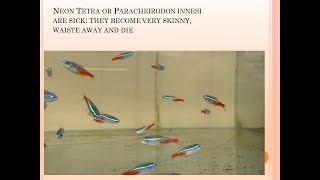
Gerald Bassleer presents fish disease case #150 focusing on neon tetras (Paracheirodon innesi) that show wasting, isolation, and abnormal swimming. Necropsy and microscopy of selected emaciated fish revealed heavy loads of rod-shaped bacteria in abdominal fluid, tubercles in internal organs suggestive of mycobacterial infection, and motile Spironucleus ("spiral nucleus") parasites in the intestine. He recommends treating the intestinal parasite first (metronidazole and his lapacho product) to restore gut function and suggests antibiotic options and laboratory confirmation for suspected Mycobacterium; he also points viewers to his books and Patreon for more information.
Chapters
Hello, dear Aquarist, I'm happy you joined me for my fish disease case number 150. Yes, you selected this video to watch me to present a case of fish disease about the neon tetra. Neon tetras are very popular in our hobby. And yes, as any animal, they can get a disease. And this time it's an interesting disease. I want to share with you and I'll show you my findings during my examination of this fish using the microscope, dissecting the fish and examining what we found in the tissues and the organs of this small neon tetra. And we found parasites, spiral nucleus which used to be called hexameter. And we also found tubercles in the organs. So let me share you my findings, which are in many cases already published in my books on fish diseases, which you can get on my website. And the books are available in different languages. So a time for you to learn more is try to get my books. The neon tetra or the parachydrodone Ilse becoming very skinny. You see this one here? They waste away and they die. You see someone in the back getting separated. Here is one in the back. They're not swimming nice in the group anymore. They separate. They're hanging at the bottom or they hang at the surface. They hang at the back. They're not in the group anymore like they should be. They're not coming to eat so often as the other fish, so they waste away. And that's here. Let me show you again. So both of them look pretty well, but every day there is one out of a few hundred that dies, that wastes away. It gets skinny, that separates from the group. And that's something you have to learn when you watch a group like these neon tetras. If it starts with one, it means maybe five or six already getting sick also. So that's that one fish shows you well, something is going on with us. Please save my friends and family and try to get the medication as soon as possible. And how do we know what to medicate? Well, that's why we examine the fish to find out what problems can occur. And then we select these kind of neon tetra. Look at this. Very tinny one, skinny, one very thin. This one is also getting a little bit skinny, but not so bad as this one because this one is to die today, in the next hours, and this is maybe to die the coming days. So that's the ones we pull out to examine and we found internally. When we examined the abdomen, the fluid, we found a lot of bacteria, the little spots Black spots, the little white spots, but also the little rods here, those are all bacteria. And there's such a large amount available here in this photograph that we know it's a bacterial infection because rots are not commonly found in this quantity in the abdomen and the fluid of the fish. And now we checked also the organs. And we saw here in the organs we saw tubercles. But here we saw the liver, the black markings in there, that is an unhealthy tissue. And then we saw here some tubercles. Here are the bottoms of tubercles. Let me enlarge here with the video. Here we see tubercles in the intestine. Here are tubercles on the side altubercles. Here are tubercles also. So that has an impact on the health of that organ. Here's more tubercles here, more. And that means there is something going on that might be Mycobacterium because most of the cases in our ornamental fish, but we check the scientific reports in 80 to 90% it's mycobacterium causing this kind of tubercles in the internal organs of the fish. A laboratory can confirm that for you. And also we checked the intestine, other parts. And we found here those tiny bugs here moving around outside the intestine because we squeezed the organ and all the organs opened up. And look at the spiral nucleus parasites. They're irritating, they're causing a lot of damage in the intestine and, and causing the fish to become weak. So other infectious can appear or the mycobacterium can become very serious and a serious bad infection causing the loss of the fish. So to tell you that we found spiral nucleus, well this was very helpful. But at the same time we found bacteria with many of our rot type bacteria and tuberculosis in your organs. So what can we do as a treatment? Well, the first one we should try to control is the, are the parasites because they're very seriously damaging the fish, damaging the intestine, the gut. And when the intestine, the gut is damaged, well, the fish will very quickly get sick, weak. He will not take up all the nutrients because the tegamen of the cell wall of the, of the dar of the gut will be not so working properly anymore that he will take, can take up the nutrients. So the fish will have serious problems to stay healthy. And at the same time the fish will weaken. At the same time the fish can get more other infectious like bacterial infections. You can try to treat with metronidazole or a similar medication that you can get from the aquarium shop. You can improve the fish health by using our Dr. Basley Biff's foot lapacho, which is designed to help the fish during this kind of spiral nucleus. And this helps the fish during the infection and fastest recovery. The mycobacterium, you know, we cannot treat, we might maybe treat with an antibiotic. When you see more damage on the fish appearing, more losses, you can combine that with the metronidazole. Some people use oxytracyclon or ferazolidone or nitrofuron medications. But you ask your fish doctor, he can help you with that. So that is depending on the actions you've taken. If you treat it with the metronidazole and with feeding the lapacho, that might already have resolved the problem. And a few tubercles might not be as serious a damage to the fish. So we we don't know because some other fish might have serious damage and some other ones might have very little and some might alive a lot. So it's hard to say in a group of fish like that. But take some proper access like I recommend you. So you will save a lot of your fish and learn from my books on fish diseases to to get the adequate info, how to see diseases and how to treat. Get maybe a specialized training at my Patreon channel and you can get my books out via our website, Basler.com so I hope this video helps you to understand this particular disease in the neon tetra. And stay tuned. I have more interesting videos still coming up about different fish pieces and they might help you to stay and or to become a good aquarist. Thank you for watching.