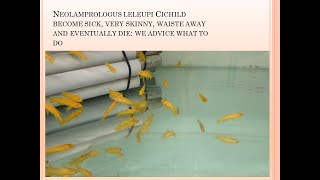
Gerald Bassleer diagnoses an internal bacterial infection in a Neolamprologus leleupi cichlid through microscopic examination of the liver, spleen, and abdominal fluid. Multiple bacterial morphotypes appear in the abdomen. Treatment requires antibiotics from a veterinarian, plus functional foods and early removal of sick fish to prevent spread.
Questions this video answers
151
Tanganyika cichlid Neolamprologus leleupi
Basleer.com
Chapters
Hello dear aquarist, welcome again to my case number 151. Yes, so many cases already I have presented on my YouTube channel and I hope you've seen some of them already because some are interesting for you, particularly for those that love their aquarium fish. I want to keep them in the best condition and I want to use a microscope and try to detect with microscopic examinations the pathological patterns that occur when we examine the gills or the organs or the intestine, you call it, of the fish. And these are made for you to make you acquainted with the issues we are dealing with when we keeping fish. That means fish diseases. And they show us so many patterns, so many signs, so many symptoms which you cannot all describe in a book on fish diseases with some photographs and text. And that's why I'm doing these videos here, so you can see more for yourself. Well, this is a case of fish disease that might interest me to learn more. And so you become a practitioner and understanding the fish disease by getting yourself in the training of a microscope. But even for you as a hobbyist who is not using a microscope, it's interesting to understand, to see what is it all about fish diseases, what does it cause and what are the problems that can occur in the fish, why are the fish dying and what can we do as a treatment. So this might also interest you even if you're not using a microscope. So let's dig in in this case, case 151 about a Tanganyika cichlid, Neolamprologis liloipi, the nice yellow colored cichlids, which is a very popular shicklet kept by the Tanganyika fish lovers. And here we found in this fish like, which is very common in many of our ornamental aquarium fish, particularly the tropical ones, is internal bacterial infection. So I show you here what I sometimes explain in my books as a common feature bacterial infections also in cichlids. I have a lot to talk about, particularly in the new illustrated guide. The book is especially made to see the abundance of problems that occur in cichlids, Tanganyika, Malawi, in all the different groups of fish. The practical guide is a smaller book and has the most important details on fish diseases, not so much all about all the different species because I categorized in your new illustrated guide the fish pieces with the most important related diseases. So that's why this book is so big and a little bit more expensive. You can get them through our website, Basler.com so today we talk about the Neolamprologus, the Loipe cichlid which become skinny. Here you see one in the back, they become skinny, here is another one and they waste away and they die. And that's the fish you take out to examine. And that's the fish you hopefully will use to get yourself trained in the diagnosing of fish diseases and to understand what is disease and what kind of treatments you can implement. And here we found the liver, which was in poor condition. This is a badly formed liver. It was falling apart. It has not a nice orange brown color. Also the spleen, the spleen was getting whitish. You can see it was not a good tissue. This part is a little bit normal, but look at these parts here, which is an unhealthy tissue. And we found in the abdomen, in the abdominal fluid, a lot of bacteria with some rot type bacteria. You see here the little rod types, but a lot of black spotted and white spotted bacteria, probably three to four different kinds of bacteria. And these are can cause those kind of diseases of the fish, that the organs become bad and the fish becomes weak and the fish will die. So here we found a bacterial infection. And then we suggest for treatment to try to get an antibiotic and that you should get from your fish doctor or from your veterinarian or the people you're dealing with. Maybe your aquarium shop is specialized in helping you with that good advice. We also recommend to apply a good fish food like our Dr. Basleer Bai fish food. The grapefruit seed extract with moringa or tefuko, the ficoidan extract or the professional treat. Those are three different feed fish food or functional fish food that helps the fish during the infection and fastens the recovery for the fish. The sooner you start taking actions, the better your results will be. So that is up to you. If you see one fish getting skinny and getting weak, well, take a look at it and you might avoid that. All the whole bunch of cichlids will die in the coming weeks after. So the sooner you start watching your fish and taking out that one for examination, the better your results will be. So my books help you to understand fish diseases. That's why I publish them in different languages for you. Or you can become a member of my Patreon Channel where you can get the training on fish diseases. And my books, of course, you can get Eliza explained. So I hope this video helped you, not only for you as a shiglet lover, but for everyone who deals with fish to understand fish diseases, understand examination and to take proper actions. Thank you for watching.