Gerald Bassleer examines a wild cardinal tetra with internal worm infections and tubercles in the liver and spleen, likely caused by Mycobacterium. The video shows dissection and microscope findings, then covers treatment with praziquantel for worms and possible antibiotics, plus when to isolate or euthanize.
Chapters
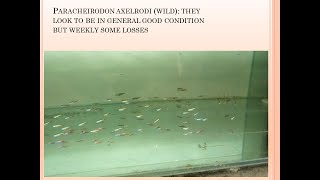
Hello, dear aist, welcome again to one of my cases of fish diseases. And Today the case 152 about a wild cardinal tetra. Yes, there is still some wild cardinal tetras available in our aquarium hobby or in the aquarium industry. Although there are many tank raised ones more and more still there are many pretty wild ones coming in and they sometimes have a better color than the tank raised ones. Not always, but in many cases they are very interesting fish to have, particularly for the breeders to have new genetic material to start breeding with. So the wild cardinal here I had to offer here for my work as a fish doctor, had a specific case. They came of course from the wild and if it's coming from the wild, like I explained you in my previous fish disease cases, wild fish can bring in wild diseases. So I share you my PowerPoint and share you my findings by using a dissection and my microscope. And in this wild cardinal tetra, we found internal worms. Well, what's new for a wild fish typical to find internal worms. And we found also tubercles in the organs. So you can get more info from my books. That's what I'm trying to live from, is selling books on fish diseases. It's part of my work I invested in and I hope you try to get some of them in your language. I have books in seven languages so they can help you to understand fish diseases and how to treat. Here, the wild Parachariodon axelrodi, the cardinal tetra, they looked in generally okay. I mean there were weekly, a few losses, but not a major problem. You can see they're swimming well quietly, they're not nervous, they're not itching, not laying on the bottom. But if we start looking more closer in, in the aquarium, we could see that here it starts with this one, like a skinny one, a weak one that separates from the group and dies in the coming days. And that's the one you should take out, is an example for the other bunch of fish in the aquarium. And they are the first ones, well to show the signs of the problem that is appearing in the whole group. Many other ones will also have it. You don't know how many, but at least this will tell you that you have to examine and that it might tell you, well what kind of problems we can find. And here we go through the internal organs and they all full of tubercles, the liver, the spleen, look, there's hardly any healthy tissue left so badly the organs were infected with, with tubercles. And we also found these kind of worms, trematodes here, two of them actively alive. And of course it has an impact on the health of the fish. These kind of worms, they shouldn't be there, but well, it's a wild fish. Always wild fish carry a few worms. And these ones were active and alive. And even one of them was producing a lot of eggs. So it was a kind of special case of trematode which is already producing eggs, which is unusual to see. Usually they are available as Metacercaria intermediate host fish is a meter intermediate host for the larvae of this kind of fish. But here we found a special case. I didn't classify it. I'm not a. My purpose is to classify to a specific name. That's for the scientists who work in the laboratories. Well, the tubercles are the major problem in the organs which affected the general health of the fish, weakening the fish that the fish is not eating anymore and eventually will die. So the treatment you can do is well to understand that those tubercles are very difficult to treat because it's usually Mycobacterium. That's what science tells us when we study the reports. When fish are studied on tubercles, of course you can try to treat the worms with Prazikanthel. That is usually what we use for controlling these kind of worms. But many fish which are very badly sick with all those Mycobacterium, they will not survive the treatment because the treatment is also a stress. So you better put a weak fish gently asleep with a tranquilizer. And maybe the other fish don't need a specific treatment or with Prazikanthal and just feed them with a good food. Or you can try to treat with an antibiotic. You can ask your vet or fish doctor like on wild fish oxytitracycline. It seems to be a good help for wild fish and treating. But any case, when it's Mycobacterium and those worms, it's better to separate the fish and put it to sleep. You can try to help with fish food, a functional fish food like Dr. Besley biofish food Fuko or the professional tree that helps the fish during the infection and fastens recovery. So these are things that might help. And many of the fish look healthy, so they don't need that much medication. Just the food might already been a good help for your fish. So get information from my books like I told you previously, important to get acquainted with fish diseases or to become a VIP on my Patreon Channel where you can get training on fish diseases to get become a specialist. So I hope this information helped you to understand fish diseases, to understand diagnosing and also how to handle treatments. Sometimes just feeding a good food is already a big help for most of your fish. Well, this was a case of a wild cardinal. Interesting. Yes, thank you and continue to watch my other videos. Also other cases of fish diseases. Bye bye.