Gerald Bassleer, a fish pathologist, examines a young koi with internal organ damage. He walks through the dissection, identifies the affected organs, and explains what lab tests could confirm the cause.
Chapters
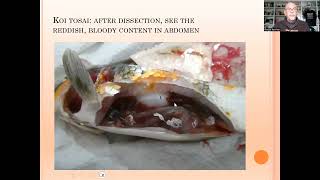
Hello, dear Akarist, welcome again to one of my cases of fish diseases. And today it will be something interesting about those that love koi fish, the most popular pond fish. Yes, sometimes I deal with problems or diseases of koi fish and sometimes I have those special cases I can examine. So follow my next few minutes and explain you my findings when I do the dissection of the fish and I show you my microscopic observations. So I will share my screen and show you the PowerPoint I prepared with all the details I have for you. And it was a case of a koi tosai which had internal problems with the organs. And you can read more about fish diseases in my books and particularly the new Illustrated guide to Fish Diseases has a lot of info about koi and other cold water pond fish for you Available. The koi I was examining did suffer from larger bellies. Popeye. And there were some losses recorded. Here we see him swimming in the fish tank. Many looked okay, but there were a few that were suffering. And that's the ones we had to examine. And that is one of these that I had in my hands. You see the popeye, you see the larger belly. You see the fish is getting weaker and slower, not so active like a koi normally is in a bucket like that. Then he tries to jump out. And when we did the dissection, we saw a reddish bloody content in all the organs, a bloody appearance which is not normal. And when we take the parts of the organs out, and here we see the red bleeding edges of the liver. That is not normal. Liver should be nice orange, reddish brown. And also the intestine, you see the reddish parts, bleeding parts in the intestine or the gut. That is not normal, that bleeding. Maybe check the organs internally. He saw these kind of black, how can I say, blood vessels which are clogged up with blood clots. So the same thing happens with the kidneys and the spleen. So it looks in bad shape, the organs. What could we determine? That was a difficulty to say it was a bacteria or a virus. We couldn't say exactly because it seems to be a complex case where that a diagnostic lab should do a profound research. They can take samples of the tissues, they can make cultures of the bacteria. And then you can see if there are bacteria or could be pathogenic and growing. And the same counts for virus. A virus you can only detect by laboratory research. Meanwhile, you can ask your veterinarian or your fish doctor to apply an antibiotic that might help, particularly when you have valuable quality fish swimming around that you don't want to lose. So you want to take some action seriously. Of course you have to check your water quality and your food supply. If that is all okay. Viral infection normally cannot be treated. Sometimes it can be put in an inactive stage through temperature change. We see that with spring vorimia virus that if you raise the temperature at 25, 80 degrees, that the virus goes down in a kind of sleeping state, but doesn't kill it. It's still there for the general health. We can try feeding the fish with Dr. Basler Biofish food professional treat that helps the fish during an infection and fastens the recovery. But I would say here sent his fish to the laboratory because koi is valuable and are important. And my books tell you the same thing. In some cases you can do a diagnosis and some cases, well, you don't know. And that is to be honest, sometimes you don't know. Also you found that organs are bad. Well, you might have training for that. Come to my Patreon channel and that might help you to. To help you to solve problems. So as I said, I'm a fish pathologist working on the field and sometimes I cannot find exactly the pathogen back. I can see pathological changes, changes to the organs and seeing something is bad. I could not see any parasites because that's another thing I could exclude. So this case, that's the ones I recommend to send to the laboratory. Okay, thank you for watching and stay tuned for my next video.