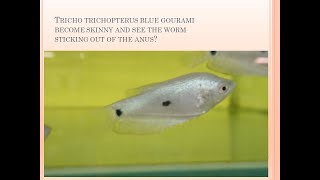
Gerald Bassleer examines a blue gourami with visible intestinal worms and bacterial infection. The fish shows classic signs: extreme thinness and worms protruding from the anus. He identifies the parasites as nematodes and prescribes praziquantel followed by antibiotics, plus a 20-day feeding protocol with pumpkin seed extract.
Questions this video answers
Gerald Bassleer
Case nr. 155 — Trichogaster trichopterus (blue gourami)
Nematodes (Camallanus / camelanus species)
Praziquantel (referred to as Prazikanthal in the transcript)
Pumpkin seed extract feeding for 20 days, followed by Dr. Basler Baiser food Fuko for at least 20 days
Chapters
Hello, dear aquarists, welcome again to one of my cases of fish diseases. And today we will talk about gourami, the trichogaster trichopterus blue. That's a common fish in our aquarium. And I will show you my findings by dissecting the fish. Of course, I will show you the observation in the aquarium. How sick does he look? What kind of symptoms does he show you so you can understand fish diseases. And of course, I need to share you my microscopic findings so I can make my conclusions and recommend treatments that might help you in the future to solve your problems with fish diseases. So I will share you my PowerPoint and my findings during my work as a fish doctor. And this fish had an internal worm infection and a bacterial infection. So this gourami was suffering. In my large book, if you want to learn more about diseases of gouramis or your gourami specialist, well, get my large book, the new Illustrated Guide, because I have specific chapters on diseases of gourami fish. And here we had the blue gourami and the fish tank, and it was skinny. And you could see here, look at the anus, there's a little worm hanging out, sticking out. I will show again the video. You see the little black, dark, reddish worm sticking out, hanging out of the anus. Well, is it a worm or not? Well, let's see what we can find. When we take the microscope, of course, we first always check the skin and the gills. And in the gills we saw some irregularities, abnormal parts, some damaged parts. So the gill seems to be affected not very badly. But I call these bad gills. They're not nicely formed, and so they will have showing a respiratory problem. For this gourami, we found bad organs. You know, you see here the melanomic centers in the spleen and also in the liver, while these organs are badly affected by bacteria. And the same is for the kidney here, see the black spots, the red spots? And here they're the calcification of the tubuli. So that that is not a normal kidney. That's a kidney which is not working properly. So the organs are badly affected. And then we found inside, in the intestine worms, round worms, the nematodes camelanus. They are typical. See, you can recognize them. And that's the ones we saw with the one gourami sticking out. See, that's the camelanus, a few of them. And that is causing the fish to weaken. And then the fish can get bacterial infection as a secondary infection. So in my case, I would conclude that this is the main problem that's the worms. And the problem is in an aquarium, here you see this one gourami and here it's not a worm. There are excrement sticking out. So so the fish is going to poop into the water. But also at the same time, larvae of those worms can spread in the aquarium because those nematodes, those camelanus, are life bearing worms and they spread baby worms through all the other fish in the aquarium. So that's the way you have to think about when you start treating. So this can be the main cause and causing the secondary bacterial infection. So the worms is the first thing you have to treat. And usually Prazikanthal is a good medication. You can ask also there are some other worm medications. You can see it in my books or you can ask good advice from your veterinarian or from your fish doctor. At the same time, try a few days later to treat with an antibacterial or antibiotics medication. Because there is some secondary bacterial problem. I would recommend you improve the health of the fish with the help of a functional food that also helps the immune system with pumpkin seed extract that controls the worms infection. It's not a cure, but it's a help. And at least feeding for 20 days, no other food. And afterwards feeding with the Dr. Basler Baiser food Fuko for at least 20 days, no other food that helps during the infection and fastens the repair of the fish. Read more about it in my books, particularly the large book New Illustrated will have more details about gouramis and about the worm infections. Or become a well trained fish doctor at my Patreon channel. So I hope this case of the blue gourami, which I found somewhere here in one of these fish tanks in the fish house, helps you to understand fish diseases and infections with roundworms, nematodes and secondary bacterial infections. Thank you for watching and stay tuned for my next case of fish disease.