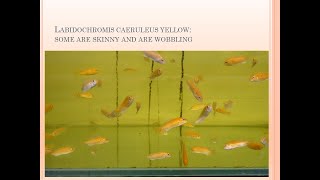
Gerald Bassleer presents Fish Disease Case #157: a breeder-sourced yellow Labidochromis corolleus showing signs on arrival of wasting (skinny, wobbling), gill damage, and internal tubercles (mesenteries, near gut, spleen). He attributes lesions to a bacterial infection likely linked to poor breeding/handling or contaminated live/frozen food, and advises antibacterial treatment focused on gill infection, immune support (Baijersfruit forte, chlorella/greens), breeder counseling, and further reading/watch materials.
Chapters
Hello, dear Aquarist, thank you for watching my videos and watching all the cases I present on fish diseases. And Today it's already 157 and it's going to be about an interesting fish, a chicklet. For those that love cichlids. Well, those are the ones that like to watch the videos more often than regular hobbyists. And today it's about a Labidochromis corolleus, a yellow variety which came from a breeder. And we had to examine on the first day they arrived. So I start to show you my screen with the fish swimming in the aquarium, because to tell you we found tubercles in the organs and that just on the day they arrived. So that was not a good thing. First of all, I recommend you to watch to read my books like the new illustrated guide in Fish Diseases, where I have a lot of chapters, a lot of details about diseases of cichlids. Malawi, Tanganyika, South American cichlids. Also here we see them swimming in the aquarium, the Libidochromis. You see they are wobbling. You see how skinny they are. A few are skinny. So I was called in. Please check these fish because they just came from the breeder and that's not normal. Some look better, some look bigger, but look at them. They looked skinny and look weak and might have solving problems in the coming days. So the first thing we noticed, the damage in the gills. You see the gill rod here and here also. So that is a bad part for the fish to have a serious problem. We found in the organs a bad spleen, mid melanomic farc. That's usually due to an infection. In this case we found some bacteria because we found the tubercles here in the mesenteria, the tigament tissue. We found tubercle here and tubercles there. We have more spots, different spots next to the gut. All tubercles we found internal in the organs. Not so heavily yet, but this will develop in the coming weeks to a serious problem, that the organs will be badly affected. So they came in already with the problem should not be the case. So the bacteria should be treated with a proper antibacterial drug, particularly the gills. That you can cure and kill the tubercles is a question. You can try to control it that it doesn't get bigger in this case, by giving good care of the fish. I have to check for the origin of the problem because it is the poor breeding. So you should advise the breeder. The breeder should think about the kind of food is maybe giving a bit of frozen food or live food that is polluted with pathogenic bacteria. Maybe there is a poor handling involved and you can help the fish by strengthening the immune system with a Dr. Basley Baijersfruit forte or also the chlorella or the green. I didn't notice it, but the professional green is also very good for these kind of fish. So learn about more about in my books of fish diseases or become a member at my Patreon to become a specialized fish care keeper. So I hope this case helped you to understand some problems that can come from breeders with diseases which are sometimes hard to handle. This about the cichlids, I have certainly more cichlid videos on different kinds you can see. So watch my playlist on fish disease cases. You will find some more things about cichlids. Thank you for watching.