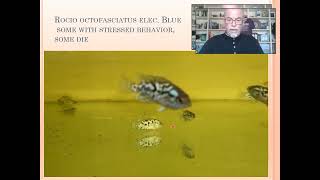
Gerald Bassleer (video author) presents fish disease case #162 involving Rocio octofasciatus (electric blue cichlids). He documents aquarium signs (wasting, swollen belly/dropsy, pale gills, mortalities), microscopic evidence of bacterial colonies on scales and flagellated parasites identified as Ichthyobodo (formerly Kostia), and necropsy findings (pale liver, green pancreas, bloody intestine, abnormal spleen and blackened kidneys). He recommends prompt combined treatment against parasites and bacteria, supportive functional food, and references his books and fish food product for specific treatment regimens.
Chapters
Hello, dear aquarists, welcome again to one of my cases of fish diseases. And today it's for the cichlid lovers, the people who like to keep cichlids. Yes, those cichlids can have problems. And today I will talk about a South American cichlid, the Rozio. That's the new name of the Rozio species. So I will show you my details at the coming hour. Coming hour? No, forget it. I don't give those lectures of one hour. I give dues of five minutes, six minutes, seven minutes. Because it's a case of fish diseases where I show my findings in the aquarium and my findings in the microscope. So let's start here and show you my details in my case 162, the Chiclet Rodzio Octo fasciatus, electric blue, with a parasitic infection caused by ichthyobodo, used to be called Kostia, and a bacterial infection. So watch the videos I can show to you. But of course, how can you study fish diseases? Get my books, Mount Fage diseases. The link is below the Rocciopto fasciatus here in the aquarium. You see here, that one, skinny one, a little bit wasting away as stressed. And look, some already died here. Here's one other one here, which is wasting away. And other ones look still pretty. Okay, but there is a problem going on and the weak ones die first. Yes, that's why we have to start checking the fish as soon as possible. And we pulled one out and we saw one had a big swollen belly. And look, the respiratory pavilion is poor. He's dying. That swollen belly is a possibility. It's a disease that caused that. So we have to check the fish. And that's why we need to do examination with a microscope. We saw on the scales, see a lot of bacteria here and here, whole colonies of bacteria. Then I can show you here in the video, you see the bacterial colonies here. And then you see here, the millions of bacteria moving in the water, dancing, you can say on the spot, many black spotted. Well, yes, bacteria. And that is causing a problem for the fish here. The same thing on the scale. We see some bacteria, not that many here, Here is some and here is some. But we see some little tiny animals, creatures moving around the parasites. Ichthyobodo. Well, it's not so easy to see on this magnification of 100. So let's go to 200, 300. And then we see here all those tiny flagellates. See them here, sitting here, attached. They're not swimming around that many, but There are many attached. So they're for sure causing a serious problem of the fish. Skin lesions and bacteria infections can occur. When we checked for the gills, well, the gills were very pale. Look at it. The gills were very pale. What could be the reason? It's usually coming from an internal problem that the organs. Internal organs are not doing well. So the fish has some maybe blood anemia. You know, weak blood system is weaker fish. So. And look at the rot here, rotting away. So that is bacteria usually a cause. So when we open the fish and we dissect the fish, look at the whitish organs in there. And that's the liver. And that is normally not white. It should be nice orange red. And what we took out here, the organs, internal organs. Here is the pale liver. And you see the large green pancreas. Well, that means the fish hasn't been eating a lot. So that fish was too exhausted to eat. And we saw the intestine. Yes, bloody intestine, which is not good. Intestine is not blood normally nice orange red. So it means there is a kind of infection going on. Then we saw also the poor liver here. Look at the big holes inside of this discoloration. And here the spleen with bad shape. That's not normal. And here the kidneys. Look at the kidneys, all black. The tubuli is all not working anymore. And that's why the gills probably were so white. So that's some of my pathological conclusions. And as for the treatment, well, fish has to be treated against the parasites and the bacteria all at the same time. You cannot wait. The longer you wait, the worse it will get. So my suggestions is that I can tell you, please go to my chapters in my books where I talk about combinations of such kind of treatments, parasites. I have a specific chapter on that and particularly talking about caring of the fish. You should think also about using a functional food that helps the fish to defend against the disease and to have a quicker repair. And that you can use like our Dr. Basler. Buy fish food Professional care. So my books can help you to get the correct treatments, the correct dosage and how to use what you can combine together. More cases to come. Yes, stay tuned, subscribe, get more training on my Patreon if you want, or get my books. So I hope this is another case that you might be interested in when you are a Chiclet lover. So I have more cichlids cases to come. Yes, but also other fish. Please stay tuned, subscribe and like my video. Thank you for watching.