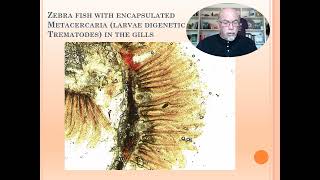
Gerald Bassleer examines a zebrafish with trematode larvae encysted in its gills, causing wasting, poor appetite, and respiratory distress. The infection comes from a bird-snail-fish cycle linked to pond exposure. Severely affected fish rarely survive, but immunity-supporting feed and biosecurity can help prevent spread.
Chapters
Hello, dear aquarist, welcome again to my next case of fish diseases. And I hope it will teaches you a lesson what to understand what a diseased fish can look like and what he can suffer from. Today it's by case 163. So I had Minnie before and many will maybe cover the fish you like or the fish you have swimming in your aquarium. So watch it and learn from my observations and the use of a microscope. So let me share you my PowerPoint and that I can talk today about the Brachydaneo rereo, the zebrafish, a very common fish in the hobby today. The fish had encapsulated trimatode worm larvae or metacercaria in the gilts. I explain a lot about fish diseases in my book, so try to get some if you want to learn more about fish diseases. The Brachydania rereo, they show some signs of disease because some are wasting away. You can see here the tinny one, the tiny ones, skinny ones, wasting away. They're getting skinny, they eat very badly, they don't swim normally, they don't eat so well anymore, etc. So we took out the gills and what we found were, look, all these organisms inside and those are encapsulated, encapsulated little worm larvae. They're sitting there and waiting to be eaten by a predator. I will explain you later on at the end of my video how it's possible that the fish can get that. So there's quite a few. They are disrupting the health of the gills and causing a serious problem of the gill tissue. Here we had more at the basis here, here and here, deforming the gills. So the gills are not working well. So the fish will have problems in respiration. Here we see it in higher magnification and that's taking away healthy tissue and causing a lot of damage. Those encapsulated worm larvae. And at the same time we found also poor internal organs, a poor spleen, a poor liver. Usually secondary bacterial infection occur. Why? Because if it gets weak, his immune system goes bad because he had too many worms. And that fish is not respiratory system is not working. So he will have a loss of immunity and get all kind of infection. Particularly bacteria is very common. So to explain you about how it comes that that fish had metacercaria worm larvae. That's because there were birds near the pond. Those fish came for sure from a pond. And the bird puts out droppings. And in the droppings there are worm larvae. They go inside the snail, the snail creates worm larvae and at the same time, I'm sorry. Here there are worm eggs. The eggs are eaten by the snail. The snail creates kind of larvae and the larvae go inside. The fish are creating those kind of metacercaria encapsulated. And then the fish is eaten by the bird again. So the cycle can continue. So snails are in the pond and a bird is at the pond. So the ponds are not well biosecure protected. And that's why the fish get those encapsulated worms which can damage the tissue. And the worm will get big inside that big blue bird here or heron. That's the cycle. We have this kind of same conditions with clinostoman in metacercaria. Worm larvae here, typical. What we can see in platy see the white spots are not ick. Those are clinostoman metacercaria worms. And this seems to be a problem come years ago in the fish farming from Florida. So the zebrafish, what can you do as a treatment? Well, the badly affected fish cannot be saved because they become too weak and they have too much damaged gill tissue. Some fish might have a little infection and it can be saved by a functional food that restores the immunity their health so they can defend themselves against other pathogens or they become stronger. Then we Recommend to use Dr. Basler Bifiz food forte check if the problems get worse. Yes, sometimes an antibacterial treatment might be necessary. If the fish gets weaker, check with the supplier, the breeder, because there is the cause of the problem. I explained in the previous diagram where there are birds and snails. I explain a lot about that in my books on fish diseases. So try to get them if you didn't have them yet. Maybe you want to have a training on fish diseases as a fish doctor. Well, go to my Patreon or cat again at my books. So I hope this case gives you some insight how a worm infection can affect a fish and that it can come from a bad pond management. Yes, the breeder can create problems. I hope this video helped you to understand this kind of fish disease. Keep on watching, subscribe and like this one and continue to learn about fish diseases. To be a good fish hobbyist or aquarist. Thank you for watching.