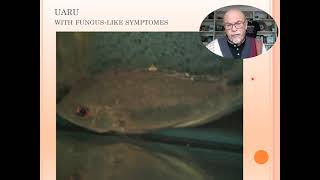
Gerald Bassleer presents fish disease case no. 166 involving a South American cichlid (Uaru) with lesions on the dorsal fin that visually resembled a fungal infection but were shown by fin scraping and microscopy to be a stalked ciliated parasite (a false fungal diagnosis). He contrasts microscopic appearance of parasite versus true fungal hyphae and recommends treating with anti-parasitic aquarium medications (not antifungal agents), citing FMC (Formalin + Malachite Green) and similar products; he references more detailed guidance in his books.
Chapters
Hello dear Aquarist, welcome again to my next case of fish disease. And today it's about the South American Chiclet. The Oaru. Oaru is a very popular fish and I show you a specific problem that I countered during my work as a fish doctor. So watch my explanation or watch till the end. But to explain also what you can do as a treatment. So what can you do with a case 166. Well, we diagnosed a false fungal infection on the Uru Amphia cantoides. A parasitic infection. Yes, we have a lot of information on that in my books and also advice bar treatments. Get the link below so you can purchase them. The fungus. Look at the water here at the fish tank. Yes, that really looks like fungus. Look at doesn't look great. Look at the spots, the specks here on the dorsal fin. And everybody diagnosed it as a fungus infection. Yes, because of little wart like types, you know, tufts. And not all of them have it and not all their fins had it. But very specifically here on the dorsal and we checked it with a microscope. We took a scraping and then you see this kind of little animal sitting there. It's not fungus, it's a ciliated stalact, ciliated parasite. Look, it's moving and extending. When it's getting open it's a feeding process. When it closes it's retracting process. It's in the sleeping in the column stage but it's extending and opening during a feed. Look, he's starting to feed here. It's a little animal attached in tufts there in groups on the fins and on the dorsal part the fish. And here we see it in a higher magnification. Here you see the feeding going on, the retracting. It's going open again and you see the cilia. That's why it's called the stalact. Ciliate little hairs and that's used by getting the food particles inside the parasite and they're getting attached to damaged tissue here and they're making the damage even worse. So also bacterial infection might also get into it to the fin or the scales of the fish. That's how fungus looks like. It's quite a different thing. It's not an animal, it's not moving. It's little threats. That's real fungus. So that's the difference. The treatment for the well it's often false diagnosed. So taking a scraping can explain you if it's real fungus or not. That's why real fungal medic have no result. So we have to treat against the ciliated parasite. And we recommend using medications like fmc, that's Formalin, Malachite Green and other similar products from the aquarium shop. You can get ask your advice or ask your fish. Doctor. We get a lot of information on that in my books on fish diseases. So get them. You learn how to practically treat your fish. I hope this kind of disease explains you. Our eyes can be wrong because we could see the fungus. But it was not fungus. It was a parasite. So you have to treat accordingly. Thank you for watching. I hope this teaches you a lesson.