Gerald Bassleer examines marble mollies dying from Camallanus worms and bacterial infection. The team found large nematodes in the intestines, a pale liver, and blood clots. He recommends nematode medication, antibacterial treatment, and pumpkin-seed extract to support recovery.
Chapters
Dear Aquarist, welcome again to my next video case on fish diseases.
And today it's about a life bearer. I'm going to talk about the Black.
Molly, which was showing a worm infection. And that's a nice thing of course.
To show as a, as a fish.
Doctor because those parasites are big and nice to observe with a microscope.
And we found in the Black Molly.
Sorry, the Marble Molly, the Porcelia, a.
Nematode worm infection called Camelanus.
And we also found a secondary bacterial infection.
So I share you my PowerPoint, of.
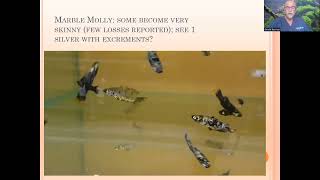
Course my details, a lot of them available in my books in different languages are available online in the link you can find here below the Marble Molly. While some become very skinny and we had a few losses reported in the last week, but nothing obvious we could observe.
We saw some skinny ones and they.
Were active, they were hungry, looking for food. But some were getting very skinny and wasting away.
And that's how we could notice the skinny ones.
And some of them, well, we could.
See sometimes hanging out at the anus, looks like excrements like here. But it's. It's difficult to observe with this kind of fish. So well, we have to take out.
A weak one, a skinny one, which is gonna die anyway. And we examine it and then we.
Found this kind of big worm inside.
The internal body cavity.
Because the worm came out of the intestine, because we did collected the material.
Squeezed it and then this big nematode comes out.
It's a Camelanus. And sometimes we see babies already sitting.
Inside this nematode worm. We also find that the organs were badly affected. Here we can see the organs getting.
Those clusters, blood clots.
You can say we saw a pale liver.
Well, those were not good conditions for that, Molly.
So what we could conclude that luckily.
Is that Camelanus is something that comes.
Usually by feeding live food or having fish in contact which already have that nematode.
Because the nematode is a life bearing.
Worm and it gets spreads, it can.
Spread very fast, its babies into the aquarium and infect the other fish.
So you have to apply a nematode medication.
And in my books I have different choices.
Explain to you what could be used for it.
You also can use a functional fish.
Food that helps to fight off nematode infections and repair. And therefore we have our pumpkin seed.
Extract in our Dr. Bas deer by fish food.
And maybe you need to treat with.
An antibacterial medication that has to control the secondary bacterial infection.
So details you also can find in my books.
That's why I publish them.
And you can become a Patreon VIP.
To enjoy my classes on fish diseases. So I hope this case on an.
Interesting worm infection helped you again to understand fish diseases.