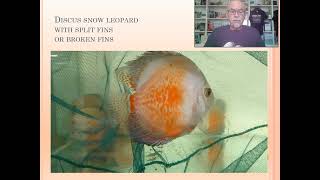
Gerald Bassleer examines a leopard discus with severe split fins and finds the real problem inside: a blocked intestine full of parasites like Spironucleus, pale gills, and bacterial infection. The split fins are just a symptom of systemic weakness that needs antibiotics and metronidazole to treat.
Chapters
Hello dear fish keeper. Welcome again to my case of fish diseases. Yes, 181 about discus. Yes, the lovely discus for the discus specialist. Might be interesting to follow about this case about split fins again. Yes, that's my second one. I had other videos. I have some links below. You can follow the other videos that can teach you lessons what to understand. Because split fin is a problem for discus keepers. But to understand how to diagnose and to try to prevent that problem is something to learn. So keep on watching my videos and particularly this one which is about. Well, a special one. A discus snow leopard from a European breeder had split fins but also parasites and bacterial infection. More to learn in my books on phish diseases including discus. Yes, I have information that can help you. Discus snow leopard. You can see here the case of split fins. Broken fins also called. You also see the other one in the back there. They look nice for the body. They look pretty healthy. For the rest. They were a little bit slow but still eating well. But split fins is not normal. But the fish were keeping up surprisingly not showing other major problems. Here we see the one. You can see here that the anal fin. Look how badly the split fins are here and here in the top, the dorsal fin. So I took it with the net. So you can see it much better in detail. This fish were already in an advantage stage. And in my opinion it was come too far that no adequate treatment was applied because it was not correctly diagnosed. Diagnosing. Yes, split fins. Is that a bacterial infection or fin rot? Well, we examined and took parts of the fins which we took in and examined in the microscope. And so far we could see no particular large amounts of bacteria. We saw a little bit. You can see them here, a little bit around here. But we didn't see major necrotic tissue. Some parts added. And here we see it in the video in detail. You can see well if you have good eyes. Depending on the viewer you. You can see the black spots dancing around in the water. And this can here be a part of necrotic tissue. But other parts are very clean and had nothing to do with a fin rot. What we found were bad looking pale gills. We put it in a microscope. You see here the coloration is pale and it's not looking healthy. So there is somewhat a problem causing these gills not to be good. We didn't see particular gill rot, but this might be a problem of the organs. In the organs. Well, we found melanomic fark center. We saw some clusters. So the organs seems to be infected. Most cases like this, it's a bacterial infection causing that. And at the same time we found the blocked intestine here. We did a dissection of the discus and you see here that intestine is blocked as a big part. So we pulled it out and you can see the black part here, which is not normally passing through, should be equally distributed. And then we found inside. Well, if you look well, we found Spartanucleus, a few parasites dancing around, moving around in the water. Some parts of the, in the excrement you find a lot. In some parts you find a little bit. But there is a problem here that these Paraneucleus parasites which are moving around can cause damage to the gut flora, the microbiome, causing lesions in the intestine, weakening the absorption of fish food nutrients and causing bacterial infections. This is all part of it. And at the other part of that intestine we found other kinds of parasites. Look at the whitish transparent little balls here moving around in the water. I can hardly indicate. You can see in different parts they're moving around and a little transparent. They are different looking than Spiranucleus. It used to be called in the history in aquaculture hexameter, those transparent ones. I didn't send it to the laboratory to identify which particular species it is because it takes a long time, it takes a lot of money. But at least we know it's a flagellate. It's a flagellated parasite. And for those flagellated parasites we can apply treatments like metronidazole or dimethronidazole, which I explain in my books how to treat and what you can do for it. So the treatment for this leopard, snow leopard, discus fish. Well, first of all, do a good examination which can tell you you're dealing with a bacterial infection, you're dealing with a parasitic infection, so you have to treat accordingly. The spit flints mostly are a secondary problem due to weakening of the organs and bad blood supply. I explained that in a specific video on split fins. You can see the link below for that video. There might be some bacteria, but that's not the major problem of the split fins. Fish is weakened. Treatment should be advised by your fish doctor or veterinarian. Here, antibiotics and, and here also metronidazole, dimethronidazole for the parasites because then the fish can recuperate, it can restore its fins and some fish can be corrected after a time. But certainly important you should apply a correct medication at the correct dosage, at the correct timing, overdosing is a bad case of treatment. Anyone maybe has suggestions, has experience or or can I have critics? Yes, always welcome to discuss it and put it below your comments. Read more in my books More things to learn to understand what we learned in our study on fish diseases 45 years. Maybe you want to become a specialist fish doctor in getting more knowledge how to train yourself to become a good examinator of fish disease as well. I have a special training for that on my patreon. So I hope this helped you to keep your fish, and particularly the discus fish, in the best condition that it teaches you a lesson. Do a good diagnosis. Thank you for watching.