YouTube presentation by Gerald Bassleer describing a clinical case of a female Betta (halfmoon) with mixed infections: oodinium (velvet), gill flukes, and probable mycobacterial tubercles. The presenter documents external signs (broken fins, parasites on skin and gills), internal granulomas/tubercles, and recommends combined antiparasitic and supportive treatments while noting limited options for advanced mycobacterial infections. The video promotes the presenter’s books and training resources for more detail.
Chapters
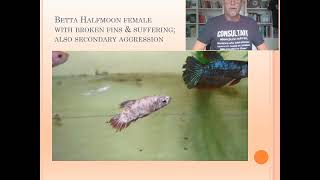
Hello, dear Akrist Fishkeeper, I'm back again for you about this next presentation on a fish disease and I'm working as a consultant. As you can see, I have some knowledge, I have some experience and I want to share with you. Maybe I'm a wizard and a magician, but probably things you can learn from me during my PowerPoint. I share with you about the case of Beta halfmoon, a female with oodinium gill flukes and a bacterial infection. So you can read more about this in my books. Also about Bettas. I have lots of information available. And here we show you the Betta. Well, not looking well. You can see that the fins are broken. The fish is suffering. There are several ones which are in very poor condition and also some aggression which is sometimes secondary happening with Bettas when one is getting weak and the other ones start to eat on them. Yes, we sometimes have very aggressive female Bettas. And then we found on the skin scraping we found oodinium or velvet disease. You see all the particles, the parasites attached here to the finish and the scales here we see a more close up of those parasites. They're not moving, they're sitting still. You can read more about that in my books in detail. And then we found that the gills, also all the little spots, the black spots, the Odinium parasites, but also gill flukes, you can see them here moving, moving around. Yes, that's a problem occurring on a fish with a combined infection. Here we see it in more close up. You see the oodinium parasites, the black parasites attached to the gills. And you see the gill flukes, which is easy to notice when they move around, of course. So it's a mix of infections in this case here. And you can see that the gills, well, are influenced badly by those pericytes which are causing lesions and the risk of secondary bacteria infections. That's the cause with velvet disease. And at the same time we found internally tubercles in the organs here in the spleen, here on the right of the kidney. So that was also badly affecting the fish at the same time with the parasites. So it's a complex disease treatment we have to do, we have to treat three diseases. So. So, and I would recommend to combine the medications against oodinium or velvet disease, together with the gill flux treatment. So the combination, you can ask your aquarium shop or you can get the information, or you can ask your fish doctor or you can find the details in my books on fish diseases. Treatment against the tubercles, probably mycobacterium. Well, that is not so well functioning because they are encapsulated and it's hard to treat. And particularly those which have a lot of tubercles, they will die. No chance. You can, you can cure them. Still, you can help the fish with a functional food like Dr. Besler biofish food, Fuko or professional care so the fish can build up immunity himself. Read about it in my books. A lot of information and treatments I share with you. More cases to come. Please subscribe to Tune with Fish Diseases with me or get your special training as a fish doctor at my Patreon. Well, I hope this as a consultant, that I could help you a little bit to understand fish diseases, particularly here with three diseases mixed together, and that you have to take the appropriate actions. Thank you for watching.