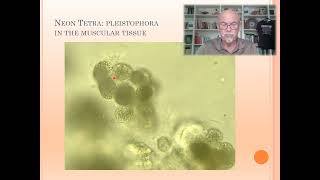
A short YouTube case presentation by Gerald Bassleer examining a sick neon tetra afflicted with ‘neon disease’ due to Pleistophora (microsporidian spores), secondary bacterial gill infection (gill rot), probable mycobacterial tubercles in organs, and intestinal Spironucleus. The video shows macroscopic photos and microscopic images, explains diagnosis, and recommends removing/euthanizing heavily infected fish, treating secondary bacterial gill infections and Spironucleus, and improving sourcing and husbandry.
Chapters
Hello, dear aquarist. Welcome to my next case of fish diseases. About the neon tetra. Yes, a very popular fish, but they can get sick. And I explain you a particular disease that we regularly encounter in our aquarium industry and in the hobby. I hope you never receive it as a hobbyist. It should be selected out by the importer, or at least the exporter or the importer and the pet shop. Well, I share you here my PowerPoint where we talk about the neon tetra with a neon disease, Pleistophora, but also a bacterial infection and the parasite Spiranucleus. Yes, a whole mix of problems. You can find good info about tetrafish in my books and particularly chapter in the big book. We have a lot of information about the diseases of all the tetrafish. And the neons, of course. Here we see the neons. And you can see here this one in particular. Here, watch this one. You can see some parts of the body are discolored. It's losing the blue color. You can see some beginning of Popeye, some extended eyes coming out. So the fish was looking skinny also. And Popeye, what he looked terrible. So that is the fish we took out. Do an examination. Here we see another view. You can see here the discoloration. You can see well, this is something for neon tetras. Yes. Neon disease is most likely a problem that can occur from certain breeders from certain areas. So you should avoid this kind of purchase. Particularly the importer has to watch out. He should control his supply. The problem with that tetra, because he's so weak that he also gets already secondary bacterial infections in the gills. Look, the gill rot, many parts are rotten away. Yeah. When the fish weakens, many organs start to fail. And it's like people getting sick with a virus or something. He get easily pneumonia. This is gillmonia. It's a disease, an infection that is quite common also in the fish. Here you see the parts of the gills badly damaged with a bacterial infection. So that is something that the fish is suffering from. And when we took some tissue of the fish. Here we see the muscular tissue. You see all the black encapsulated little spores, little dots, little black spots. A larger magnification, I will show you a detail. Here we see more parts of another part of the muscular tissue. See, this is normal tissue. And this is invaded tissue with a lot of parasites, causing the whitish look of the fish. And then here we see the capsules of plistophora. There's a couple of hundred in each capsule of Porosporozoa Parasites that don't move, they're sitting still. And here we see that the high magnification, all the little spores taking away healthy tissue invading the fish and making it unhealthy and causing spore secondary problems. And then we found not only the Pleistophora or not only the gill rot or gill bacterial infection, but also internally. We found in the organs tubercles. Tubercles in the organs most likely caused by Mycobacterium. So this fish came from a bad breeding facility. And then we took a sampling of the gut, the intestine and we found you can see it here, a few tiny moving parasites, Spirornucleus and bacteria in between a lot of bacteria. There's a few spiry nucleus moving around in the fluid which we here put under the microscope. So that's also something we have to worry about. So treatment of this kind of problem. Well, these pores cannot be treated because they are sporozoa. And there's no medications well known to penetrate and get these spores rid of the fish. Eliminating from the fish. It's very important that we watch this purchase, that we inform the breeder the very weak fish. Well, you better put it gently asleep and euthanize it with a tranquilizer. Treat the bacterial infection especially cure the gills because that's killing the fish at the end. Also treat against spynucleus. Yes, used to be called hexametha. But there are many good medications available in the pet shop. Ask your aquarium shop for all the good medications that can help you and you recommend feeding with or fish food. If your pet shop doesn't have check online. You can get our best biochar food. Aloe vera, which is good for repair of the gills. Good for immunity or the forte. It's stimulant for the immunity of the fish which you can see the fish was very weak and suffering. Get more details from my books. You get better trained. It's available at our website and maybe you want to learn more become a to get the training at our Patreon. More cases to come. So keep on watching my videos and stay tuned. We have more interesting diseases coming up. Always. Because fish sometimes can get sick. Yes, but you have to learn the tricks how to treat and cure. Thank you for watching.