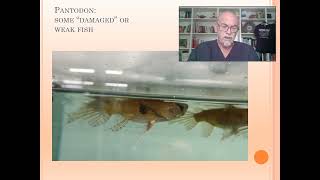
This is a transcript of Gerald Bassleer’s YouTube video (Fish disease case no. 187) about African butterfly fish (Pantodon bukholsi) obtained from the wild. He documents combined parasitic (encapsulated metacercariae, free nematodes possibly capillaria) and secondary bacterial infections, describes clinical signs (damaged fins, emaciation, gill blood clots, melanomacrophage centers in organs), and recommends combined antiparasitic and antibacterial treatment plus improved nutrition and handling; he also refers viewers to his books and Patreon for detailed protocols.
Chapters
Hello, dear Aquarist, welcome again to my next cage of fish diseases 187. And today it's about the butterfly, the African butterfly fish or the paton Pantodon bukholsi. And it's a fish coming from the wild. You can imagine when we talk about fish from the wild, they can bring in wild diseases which you can control. Yes, because we have a way to examine the fish when it's necessary. And here we found parasitic worm infections and bacterial infections. Yes, well again, a combination of a parasite and a bacteria. Yes, this is common. You should have learned already through all my videos. Then when we talk about the diseases that. Well, we talk about it in the book. It's the combination. The parasite makes the fish weak and the weak fish can get the bacterial infection. And that's why we have to take the proper actions. Here we see that Panthadon in the aquarium, some had damaged fins, they're weak fish, some are very skinny and well, that makes this give the idea, well, we have to do something about it. A few died the recent day. So we take actions and particularly the skinny ones, we take out the badly damaged ones with some damage at the tails and the fins. And then we found already in the gills those large blood clots here. So the gills are somewhere affected by something that is bothering the fish. We could not see particularly bad gill rot. We saw some part badly damaged, but we saw the blood clots here, which is not good looking. It's an internal problem. And of course we saw the internal organs, the spleen and the kidney and the liver with melanomacrophage centers, a defense of the organs against bacterial infections. Yes, and we found tubercles. No, not tubercles. We found encapsulated metacercaria, which are worm larvae, on different parts in the internal organ. It's typical for wild fish and some can live for it for a long time, they cannot die from it. In many cases we don't see that the fish is suffering from it, but the handling, the stress, not maybe properly taking care, the lack of good food. And maybe the heavy infected ones, which are badly infected with Pitta sercari, are more weaker than the other ones. They're getting easier, sick. But then we found nematodes, well, free swimming worms, nematodes. Well, this might be another reason why the fish is becoming so weak. Here we found another one and it looks like a type of capillaria worm. Not 100% sure, but it's how it looks like when we look at a head area. So the treatment for Jutta butterfly fish is well to understand. First of all it's a wild fish and they can bring in those wild diseases which we can control if we take the proper actions. You can treat the free nematodes and you can treat the bacteria infection. You can combine the medications and ask your fish doctor or the pet shop for advice or in my books they tell you also how to treat these kind of problems and at the same time you can try feeding this butterfly with some flake food they like floating flute. Well floating food like our Dr. Besley or Bishop flake forte is a help for this kind of fish to strengthen and to make a better defense with a better immune system. So my books try to get them to learn more or become a professional go to my fish doctoring section at Patreon. So I hope this video and this explanation helped you to understand the diseases on these pantodones and to take proper actions. Thank you for watching.