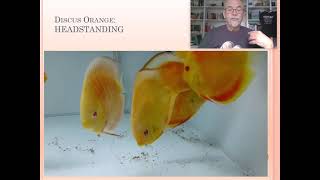
Gerald Bassleer presents case 188: an orange discus showing "head standing" behavior. Examination (external, skin/gill scrapings, necropsy) revealed intestinal blockage and mixed parasitic infections (Protopalena, large numbers of Spironucleus, Nyctotheris) plus indications of bacterial involvement in organs (spleen, liver, kidney). He recommends treating parasites with metronidazole in the water for 48 hours and addressing bacterial infection with appropriate antibacterial medications and supportive feeds; further details are in his books.
Questions this video answers
Case 188.
Protopalena, Spironucleus (thousands observed), and Nyctotheris.
Metronidazole added to the water for a 48-hour treatment.
Chapters
Hello, dear fish keeper, dear aquarist, thanks for joining me again for this video. And today it's about discus fish. Yes, a discus fish with a particular syndrome, head standing. Yes, many of you have seen it maybe in the past or now that your fish are standing on the head, maybe you have it as a breeder, maybe as a fish keeper. And we show you what I found during my examination as a fish doctor, what problems can occur and what kind of infections can cause it and what you can do as a treatment. So follow this video and maybe follow my other videos on my discus fish. Links are below. And today it's about case 188, about the discus orange with a head standing syndrome, which has a mix of infections. Many details I publish in my books on how to treat and how to prevent diseases and how to diagnose, and they are available in different languages. You can see the link below where you can order my books. But talking about head standing, well, you might have seen this. Look at this discus here. You see how thin he is at the back. So he has some internal problem. Looks like his body is not well formed. He's not swimming normally anymore. Sometimes he acts normal, yes, but sometimes he is abnormally standing on the head. So here we see another part of the day. And you see the other discus are looking fine. They seem to have no problem for now, but you might see more problems coming up in the coming weeks. So you have to act now and examine this one which is suffering, obviously. Look with our eyes. Can you see something? Yeah, maybe you can notice here there's a little speck in the tail. Well, let's go in detail. There is a little growth here. While we examine that in the microscope we see some, yes, some nodules, some growth with some blood inside. So it might be caused by maybe bacterial infection, maybe something you can send to the laboratory and do a proper diagnosis of the kind of bacteria. Yes, but you might think this is coming from an internal problem. This is not external because there's no thin rot, no skin damage. So you better still have to check. But what we found, and we taking some scrapings from the skin, we saw some deformation in the scales. And this happens when the fishes suffering from weakness, having a poor nutritional supply or a bad absorption of essential nutrients. So the scales start to get deformed. Here is another scale. Look at the deformation here. And this. Usually when fish are suffering from an internal problem, when you have those deformed scales. So that's particularly when you watch your fish closely and do a proper diagnosis in Examining the fish internally. And of course the first we do after the skin scraping we do the gill examination. And the gills didn't look perfectly nice, red colored. And we checked in the microscope and we saw some serious necrotic damage on the gills. So that of course a potential risk of dying because in the gills collapse are not doing well. It's like mankind when they die from pneumonia. Fish can die from Guildmonia and they die and they are not able to recuperate. It's too far gone the damage. And you see here some swallow lamellae which can be caused by failing kidneys for example. So let's see what we found further in the fish. So we did an examination where we removed this part of the body. And we saw some fully filled gut or intestine. And we saw some bloody red markings on the swim bladder or the gas bladder. So we go checking organs. And the first part we examined was the intestine or the gut. We saw over here some obstruction here, this part is clear and this distal part like is blocked here with a lot of accumulation of excrements. And I will show you here the video of my examination of parts of the excrements. And we found those parasites, Protopalena, those longer elongated parasites moving quickly around. And we saw that thousands of tiny Spironucleus parasites used to be called hexameter. And here we see another part when we take excrements from that gut. And we see the parasites Nyctotheris, another parasitic infection, causing damage to the intestine and together with the spiral nucleus parasites, well causing serious damage. And those spironucleus parasites, as I show here, there are thousands of them. And that is of course causing a bad microbiome, bad absorption of nutrients. The fish will suffer from many different problems and possibly having also a bacterial infection. This is what we can find by examining the organs. Look here. The left is the spleen, in the middle is the liver. And at the right here are the kidneys. And you can see there are markings inside, dark markings. And that should normally not be the case. They should be clear, nice, smoothly colored. You can see here the melanomicrophark centers in the liver and at the right in the spleen. And this is a well, macrophage reaction as a defense reaction against an infection. In mostly cases it's bacteria. And here also in the kidney we see the same problem occurring with blood clots. And we see at the same time some tubercles occurring. So that this might be. That's a reaction of the organ to a bacterial infection. Maybe Mycobacterium maybe can send it to the laboratory. But the fish is particularly suffering with those parasites combined with the bacteria. And that is of course showing a head standing syndrome. But a head standing is not a disease. Disease are the parasites or the bacteria, which we could determine by doing a proper examination like we showed here in our presentation. And you can treat of course with one of the better medications for that is metronidazole. And I recommend to add it to the water as a 48 hours treatment. In the food it's limited because you don't know exactly how much the fish will take or if he's still eating and can take up the medication. So treat the water to control the spreading of the parasites and at the same time you can control the bacterial infections during or afterwards. Ask your pet shop or veterinarian for a good antibacterial medication. You can find some details on that in my books. Also, some food can help, like our biofish food lapacho. Feeding it for three weeks, maybe four weeks. Hardly to say how long it will be effective. You watch your fish, how they react and you also can feed afterwards with the Dr. Basleer by fish food fuko or the grapefruit seed extract moringa. Helping in the control of the bacterial infection and helping in the repair of the fish. More info on fish disease diagnosis, prevention and the use of medications in my books in different languages. More cases to come. Follow me if you want to get a training at Patreon and learn from my books. So this was another case, a specific case on a discus suffering from head stranding. Watch more of my videos on discus. I show you the link below where you can get more. Getting more acquainted with the different problems that can occur and how to tackle the problems and how to treat and to save your fish. Thank you for watching.