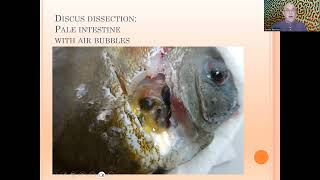
Gerald Bassleer examines a discus with hole-in-the-head syndrome, revealing pale intestines, internal bleeding, and gas bubbles in the gut. He argues the head lesions are secondary to gut problems and recommends improving water quality and using probiotic foods to restore the fish's microbiome.
Chapters
Hello, dear fish keeper, dear discus specialist, particularly in particular, when you like discus, you want to avoid problems because those are valuable fish. You like discus because they are so well, interesting to watch and to enjoy as a hobbyist. Unfortunately you can have problems and diseases. And today it's about holes in the head. Yes, something that can occur on discus. And I had already many videos about this subject. And every time I do an examination on a case like that, I give you my findings. And also today I give you my observations, my microscopic observations and my suggestions what you can do about about this kind of disease called hole in the head. So I share you my presentation, which I prepared on a PowerPoint for you. And it's a discus with holes in the head that had internal problems. So let me share with you what I have and first of all get my books on fish diseases and both discus diseases, particularly the big one talks a lot about the different kind of diseases on discus fish. Here we see the discus fish in the tank. Some had hardly any holes. This one in the back had holes. I look at this one here at the front. See the holes here on the head, the mouth region. This is not normal. And here we see the giganda discus. You see the tiny holes, it's not big, but it's not normal. And those holes appear in the lateral line organ, which is extending on the head, around the gills, around the head. And this part also smallly, slightly eroded. But particularly here we see the holes appear. And it's at the beginning stage, something you have to observe and act on time. When you see that and try to find out what is causing it. You can take some first axis, provide good water conditions and good food with probiotics and prebiotics, so that all also first things you can do to help the fish and read about it. See my videos that explain the different cases of hole in the head syndrome of this discus fish or other discus fish. We examined the gills and we found here some bad lesions in the gills and also here reddish parts of bleeding and some lesions to the gills. Were I having a problem? Yes. And when we did an internal examination of that discus fish, the discus fish with the hole. Sweet. I just showed you. We found the pale intestine. See how pale it looks? And we found a lot of air bubbles all around the intestinal cavity. And the fish was rather skinny. You can see here. This is rather empty. Well, abdomen. The liver had MMCs. You can see the melanomic center that's usually erection on, usually against the bacterial infection. Could also be viral we see much more here on the left in the spleen and also in the kidney. That means those organs are not functioning properly properly anymore. They're somewhere healthy. Tissue has been taken away and causing weakening of the fish. And also in the gut, the intestine. We saw bleeding markings, which is not normal, should not be red. Red markings all along the intestine. And we found air bubbles inside. Normally discus doesn't hardly have any air bubbles inside. And some parts had a lot of air bubbles. So something was causing gases in the intestine. Could be a disruption of the microbiome, for example. Well, that's our findings. The holes in the head are a secondary syndrome. We couldn't find anything as a disease inside the holes. No parasites, no particular bacteria, not yet. Maybe the coming weeks they would develop into holes getting larger, caused by the bacterial infection which is secondary. See my other videos. I'll give you a link below where you can see more videos of the discus fish here. Poor internal organs, a bad microbiome of the intestine. This is causing a lack of resorption of essential nutrients. So I would recommend to restore the microbiome with a functional fish food like Dr. Basler. Buy for food professional care. Taking quick actions within the first days and weeks will limit further damage and then risk on larger holes. So you have to prevent that it's getting worse. So up to you to take actions. And maybe reading my books can help you to understand these kind of diseases. Well, more information you can get at my fish doctoring classes at my Patreon or in my books. Well, this is a hole in the head syndrome of a discus. The beginning stage on time to react and learn more from my other videos. Subscribe and keep on watching. Thank you for watching this problem.