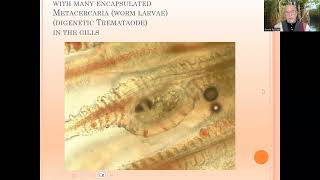
YouTube video (Gerald Bassleer) describing a disease outbreak in blue neon cichlids (Adinocara/Adinocara pulcher) where encapsulated metacercariae (digenetic trematode larvae) in the gills damage tissue and predispose fish to fatal secondary bacterial gill infections. Bassleer explains the parasite life cycle (birds → snails or other intermediate hosts → fish), notes common breeding/outdoor risk factors (snails, wild birds, live food), shows microscope images of encapsulated larvae, and recommends management: euthanize severely affected fish, consider antibacterial treatment for secondary infections, and support survivors with functional foods; he also references his books and Patreon for further guidance.
Chapters
Hello, dear aquarist, dear fish keeper. And for those that like cichlids. Today it's about a cichlid that has a serious problem in the gills causing the fish to die. So watch my videos and my findings where I use the microscope to show you what's going on. And well, this was a nasty problem for this Adenocara pulsar. Chiclet. Oh, Shiklet should be here with parasitic gill and bacterial infection. Two infections at the same time. Many details you find on treatments and diagnosis and photographs on diseased fish. Well, you get my books. The Adenocara acara Shiklit, the blue neon variety, became weak skinny, they were losing color. See some in the back here getting very skinny. And that's why some died after a couple days, couple of weeks. And others look fine, look better, not so sick and eating well, but still the microscopic findings of checking pieces of the mic of the gills of the microscope showed us many encapsulated worm larvae called metasarcaria, which are larvae of the digenetic trematode worms in the gills. Look at how many are here and taken away healthy tissue here, another part of another gill taking away healthy tissue here. And enlarge you see the larvae here taken away healthy tissue. And it's encapsulated you cannot reach with treatments. And inside it's alive during the time that it's waiting here at the fish, as in the intermediate host, before it's eaten by another big bird or usually birds in the nature. And that the cycle will be completed. I show you later what I mean with the cycle of the parasite or what you can do about it. The problem that happened that the fish weakened, the gills were weakening. Look reddish bleeding here already very advanced gill rot. Bacterial infections occur and that's why the fish die. They don't die because of the encapsulated worms. No, the worms are not killing the fish. Of course it's taken away healthy tissue. Of course it's weakening the fish and it's giving a risk of a bacterial infection. And that happened here. Here there's no worms anymore to see no worm larvae, but all devort gills by bacteria infection. Terrible. This fish is dying from pneumonia. For human it's Gilmonia. I call that also the liver had poor tissue. See the reddish part, the. The. The darkening parts. So the liver was not working well either because the infection from the gills also goes inside the fish. And the origin of the problem is that there are worm larvae coming in through the snails or originally first from the bird, then into the water into snails and then from the snails comes a larvae that comes into the fish. And somewhere encapsulated here, it's in a Florida gar for example. But anyway the cycle is going like this and then the fish is eaten by the bird so it closes the cycle. Parasite from the bird through a snail or another intermediate host can be another tiny fish, can be another crustacea like, like maybe a water flea, Daphnia. Things like that can also be a cause. So live food can be a risk and then eaten by the fish. And then the parasite has a chance to wait until he's eaten again. And that's usually happening in fish farms where fish are kept outside, no biosecurity. And the birds are flying around putting their droppings into the water or sitting at the water and giving a chance that Toothpur resides. Larvae come into the water and you have snails in the water. Or of course then the snails is another risk that it can pass on to the fish. So it's usually a problem at the breeder. That's what happened here. And that's up kills then the fish. It's the bad gills because I explained the fish becomes weaker, more damaged gills and die. So the very bad ones, very skinny ones which are really suffering, put them gently asleep. And I can recommend Arkhamor Plush which is a very safe product for my quarter Muenster. Maybe maybe an antibacterial treatment like with an antibiotic can help especially to cure the gills because it's the gills where the fish are particularly suffering from the bad gills and that the fish will die. Metacercaria are worm larvae that are encapsulated alike acid. You cannot treat them because they are in a capsule. They are protected for anything except by eating by a bird. You can help to restore the immune system of the fish so he has a better health. And I recommend a functional food like Dr. Basley or biofish food Forte well books help you to understand fish diseases. Try to read them, try to get them. And I hope you can get maybe training at my Patreon up you for you to choose that well I think this is a serious problem from a fish that came somewhere from a breeder who did not do good care and is causing a serious problem for some of the fish. Some might be healthy and do well and have much lesser infection. But you don't see that. Okay. I hope this helped you to understand this kind of fish disease. Thank you for watching.