Gerald Bassleer examines an imported koi that arrived weak with parasitic infections, gill damage, and internal bleeding. The fish had Costia and Ichthyobodo parasites, a swollen kidney, bloody liver, and signs of bacterial infection. He recommends lab testing, antiparasitic treatment, and veterinary care.
Chapters
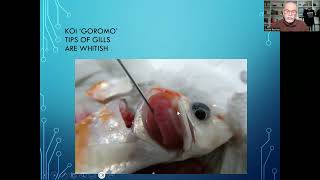
Hello dear fish keeper. Dear koi keeper, or do that have pump fish? Yes, sometimes I see koi during my work as a fish doctor. And here it were koi that just arrived into Europe that were presented to me for an examination. So I will share you my PowerPoint that might help you to understand what we can find on diseased koi. Because here they became skinny. We found parasites, bacteria and maybe a viral infection. You can find details on diseases on pont and goldfish and koi fish in my books on fish diseases. The link is below here. The koi goromo had some losses after shipping and arrival. Yes, some fish were weakened and they had a big head and a slender body. Some of them, not all of them. You could see some of them here. In between here we pulled one out. You can see here the big had the slender body. And here we see it in the video. And that's the one we gonna examine. This fish is not well formed anymore. It had some previous damage, previous bad history. So interesting to examine before the other fish in the pond or in the aquarium are getting worse. The koi here. Well this is the one we examined. We can see here how skinny it looks. This fish was not in a good shape anymore. And we took a skin scraping and as a video shows we found some costeas. You can see them here moving in the water there in the water. A few here and there. Not a massive amount. Maybe on other parts. Maybe the fish already had some treatment during shipping. Could be. But some costias were on the scales available. What we found when we removed the gill cover, we found some white tips of the gills. Well, the gills should be nice formed, all nice red colored. But examining the gills in the microscope revealed that the tips were like a deformation. Look, these fill. Look at this. It's like encapsulated and the lamella are gone. So might be a repair after history. Maybe the fish have been damaged. And look at the repair tissue. It's like scar tissue covering the gill. So that's not a perfect gill anymore. It's like it lost some, some lamellae due to previous damage. I. I presume. Also in the gills we found some parasites, ichthyobodo. You can see them here moving around. Also here on the tip used to be called kostia. Well, some parasites on the skin, some parasites on the gills costume. Yes, that gives us a lesson that we found parasites. The bloody organs was a typical sign. When we cut open the fish look very bloody interior organs. We saw a very enlarged kidney here which is above the swim bladder or behind the swim bladder. And these organs we took out for examination the different parts here, the different organs. Spleen, liver, kidney. And we found that the kidney was bad condition. Look, very dark inclusions. So the gill. Sorry. The kidneys were not well working anymore. They had some. Looks like some hard inclusions. And so that will not function properly to eliminate the waste. As it has to do the same for the liver. Look, the liver with black strains and reddish bleeding parts. This is a bloody liver. Look at the melanomicrophage centers in the spleen, which is not a healthy spleen. This could be all due to bacterial infection. Look at that spleen. This is not a well formed spleen. A pathological sign of a problem. Well, many fish still look perfect, but yes, some are badly damaged, very weakened and ready to die. We found parasites, Costa. Yes. That you can treat. Many medications available. You we might think about the bacterial infection. Yes, you can apply an antibacterial treatment. But still might be a virus involved here. So I would recommend, because you have so many coins available with a possibility to getting sicker that this would be checked by a laboratory. Get advice from your vet or your fish doctor. And you me can help also the koi to recuperate to restore immunity with our Dr. Basler Biff, his food professional treat. Yes, also for koi. Read my books, get more information on fish diseases and how to treat. Or get my training at Fish Doctrine at my Patreon. So I thank you for watching you the koi keeper or the koi lover. Yes, they can become sick and do a proper examination. Or get your fish doctor or vet involved. Thank you for watching.