Gerald Bassleer examines a Black Neon tetra with yellow grub, a parasitic worm that forms nodules under the skin. The parasite cycles through birds, snails, and fish. Treatment options include manual removal, chemical baths at 10 mg per liter, or medicated food, with prevention focused on keeping birds away from tanks and controlling snails.
Chapters
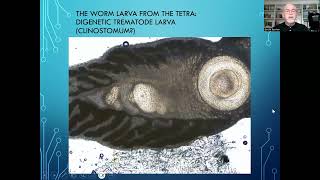
Hello, dear Aquarist, thank you for watching this video about the Black Neon tetra, which has parasites, worms in the skin, in the muscular tissue. Yes, something special and I like to share that with you with the, the PowerPoint I made that might help you to understand this kind of infection. So this was a parasitic worm infection on this Black Neon tetra. And we discussed worm infections and other infections in my books where you also can read about the treatments you have to do or can do. And these books are available in several languages. You will see the link below the Herbal Taxerodi, Ephysia Bicon, Herbal taxerodi. You see this one here in the middle, you see the dorsal part. There is a kind of growth or the nodule in that fish. Let me play it again for you. Here it is, watch it. You see the brown speck, the deformation in the body. Here is another black Neon tetra. Here it is, you can see the growth or the deformation or a nodule that's at the dorsal, dorsal part of the fish muscular tissue. We took the fish out and here we can see that growth, that patch, that nodule on the dorsal part of that black Neon tetra. So we dissected that fish and we eliminated that part. And we could see here an organ which is, yes, a worm. And this is called in common literature the yellow grip. Yellow grip is a worm larvae and usually it's a parasite called clinostomen. It's a larvae of a traumatode. So I will share you more details with the view of this very nice looking parasite, the trimatode larvae, the clinostomal species. Most likely it's glenostoman, although I am not a specialist in identifying. Usually you have to bring that to parasitic specialist. But you can see here the two suckers and the body structure which looks similar to clinostomon. So what can you do as a treatment for this kind of fish? Well, first of all you have to understand that the parasites were introduced at the breeder by birds and snails. I show you further on some details on the cycle, how that happens. And some good results were reported with Brazy Cantel adding to the water 10 milligrams per liter for 24 hours. Some reports are good, not always. Some try also medicine into the food, carnivore medication. Okay. On bigger fish you can eliminate that worm by a tweezer or a little pinset. So, but that of course you have a damage, you have a wound, you have to treat the wound of that fish. But for this black Neon tetra, well, it's no use to try to take out with a tweezer because you will damage the fish. That small fish. You can help with a functional fish food that helps the repair of the fish. And I would recommend Dr. Basler bias biofish food. Aloe vera that helps in the repair of the skin. And here's some details about the skin worm. Well, it's a kind of worm that's sitting in the skin. It's coming from a bird like the blue heron. And the eggs are released from the flukes, the adult flukes or worms which are inside the bird host. And those free swimming eggs hatch into the snails like miracidia. They're inside and then they undergo a sexual reproduction and they become a cercaria, a meta cercaria, a larva. And that meta sarcaria swims to the fish. Because when you have snails in the pond and you have birds flying around, you will have a risk that this can happen on your fish. And then you see the white speck sitting there. And when the fish is eaten by this bird or the blue heron, the fish larvae or this larvae meta circadia becomes a large trematode. And that trematode will again release eggs. So the cycle is there. And it usually happens at ponds in nature which are not covered, not protected against the birds and where there are a lot of snails in the pond. So it's the breeder who has to take actions. I explain these things also in my books on fish diseases. You want to get training on fish diseases, go to my Patreon. There's a lot of information you can find there or you can find it in my books. So I thank you for watching this specific case of the yellow grub, a kind of worm larvae that is infecting the muscular tissue or the skin of the fish. Sometimes the fins, sometimes the tails. It's a well known problem in our industry. Maybe you've seen it. Give your comments. Thank you for watching.