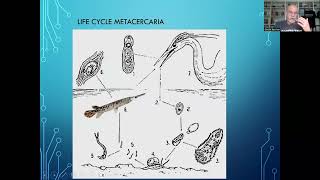
Gerald Bassleer examines a Betta splendens with severe internal worm infection from digenetic trematode larvae. The fish showed emaciation and isolation, with necropsy revealing numerous larvae near the intestine and liver. Once established, the infection is hard to treat; prevention through breeder biosecurity is key.
Questions this video answers
Case nr. 241
Betta splendens (Fighting Fish)
Larvae of digenetic trematodes (metacercaria) located near the intestine and liver
Praziquantel (suggested, not guaranteed)
Dr. Bassleer B fish food forte (with immunostimulants and pre/probiotics)
Chapters
Dear A dear fish keeper today about a Betta that is, well, dying, that has became sick. They were looking very skinny and well, unfortunately as a consultant I tried to solve the problem by taking my microscope and that I use to collect my information and I want to share that with you in my, how can I say in. In my PowerPoint. Well, let's see what we can tell you about a Beta with a worm infection called in this case Meta Cercaria. It's fish disease case241. Read my books so you learn more about fish diseases. Also about Bettas, I have a specific chapter that is explaining the most important diseases of Betta fish. The Bettas, well you can see some look a little bit skinny, they're separated from the other ones. They're behind the group of Bettas that are looking for food. So they will slowly waste away. Here there's one hanging at the end of the aquarium on top. So that's the first ones who show. Well, I'm not feeling well. There is something troubling me. Well, that's for me as the fish doctor that comes in and that takes out the very badly suffering fish, the most sick fish that are sacrificed for examination. And in this case, well, I show here after dissecting the fish that I found a lot of larvae. Here you see those dark organisms, those are larvae of digenetic trematodes, also called metacercaria. And they are in next to the organs, next to the intestine in the liver. And you also can see the spleen which has many melanomicrophage centers. So in that case, what you can see that fish, his organs are wasted away. The fish will not be able to be cured. And I explained that in my treatment suggestions that is difficult to cure such a case of fish disease because the cycle has to be stopped. That the parasite cannot come into the fish, that has to happen at the breeder because the breeder has a bird and has snails. Well, because the parasite has a cycle that passes on through the snail in the pond and then comes as a larvae into the fish. And when the fish is eaten again, the cycle is closed and the bird can continue to reinfect the pond and other ponds in the area. So it's understanding the life cycle of Beta cercaria is, you know how to prevent that the disease can come into your fish. Here, the Betta treatment. Well, the origin of the parasitic infection, like I said, is the fish farm or the breeder with poor biosecurity, with birds and snails, maybe the food was infected. Maybe that can also be a reason that these worms are introduced to the fish. Badly affected fish, well put them gently asleep. You cannot use a medication not able to cure. You can help with a functional fish food that helps the fish to repair with Dr. Basler B fish food forte with immunostimulants and pro and prebiotica. Some people try anti worm medications that might help in some cases when the worms are not badly or the larvae are not badly encapsulated here. In this case it might be useful to use for example Prazikantel. Maybe it's a suggestion. If you don't try anything, well you lose your fish. Read my books. I explain about treatments of this kind of disease and all the many cases available or get to my training of fish doctrine at my Patreon Channel. So I hope this video helps you to understand this disease of the Betta fish. Thank you for watching.